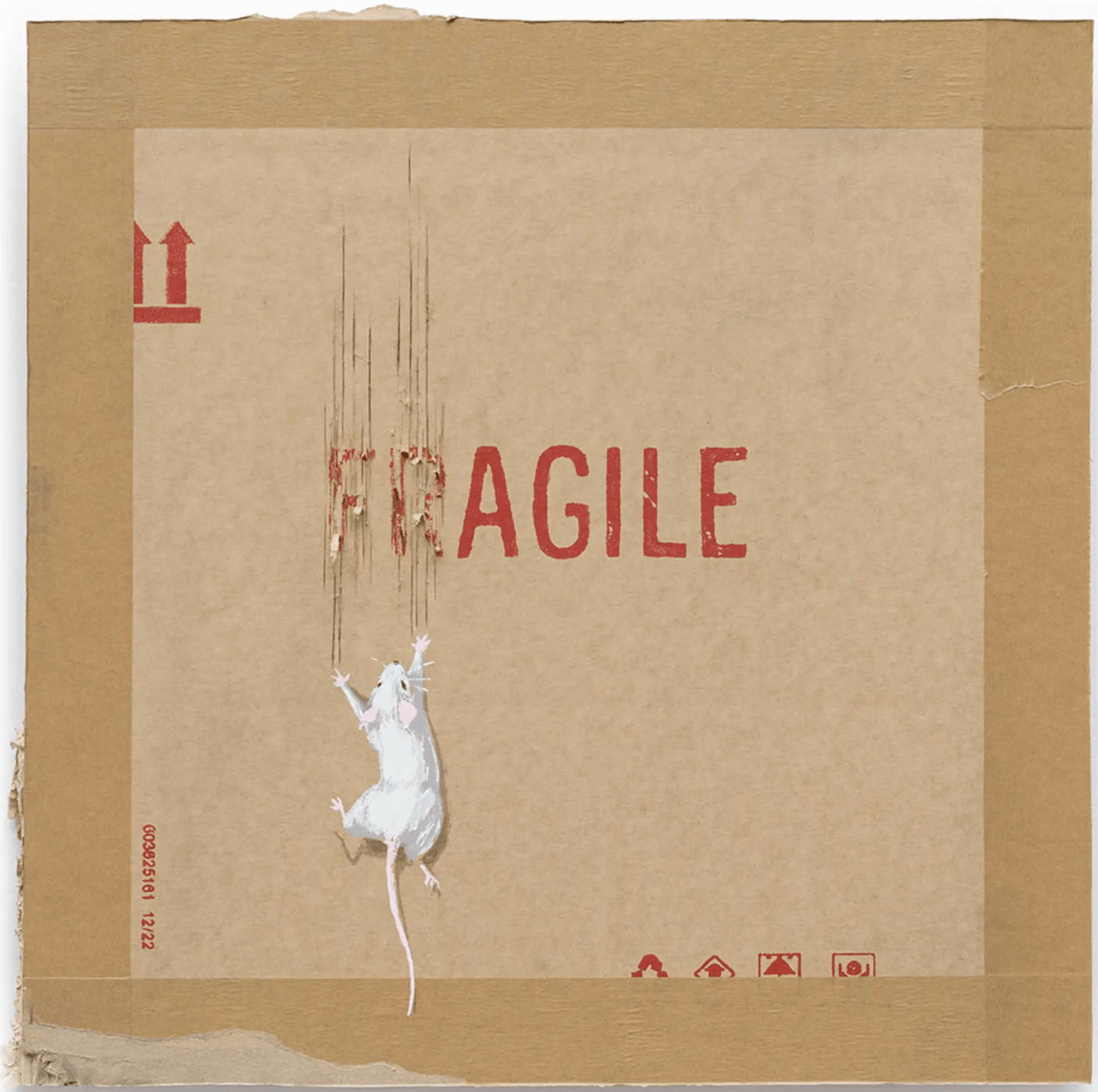
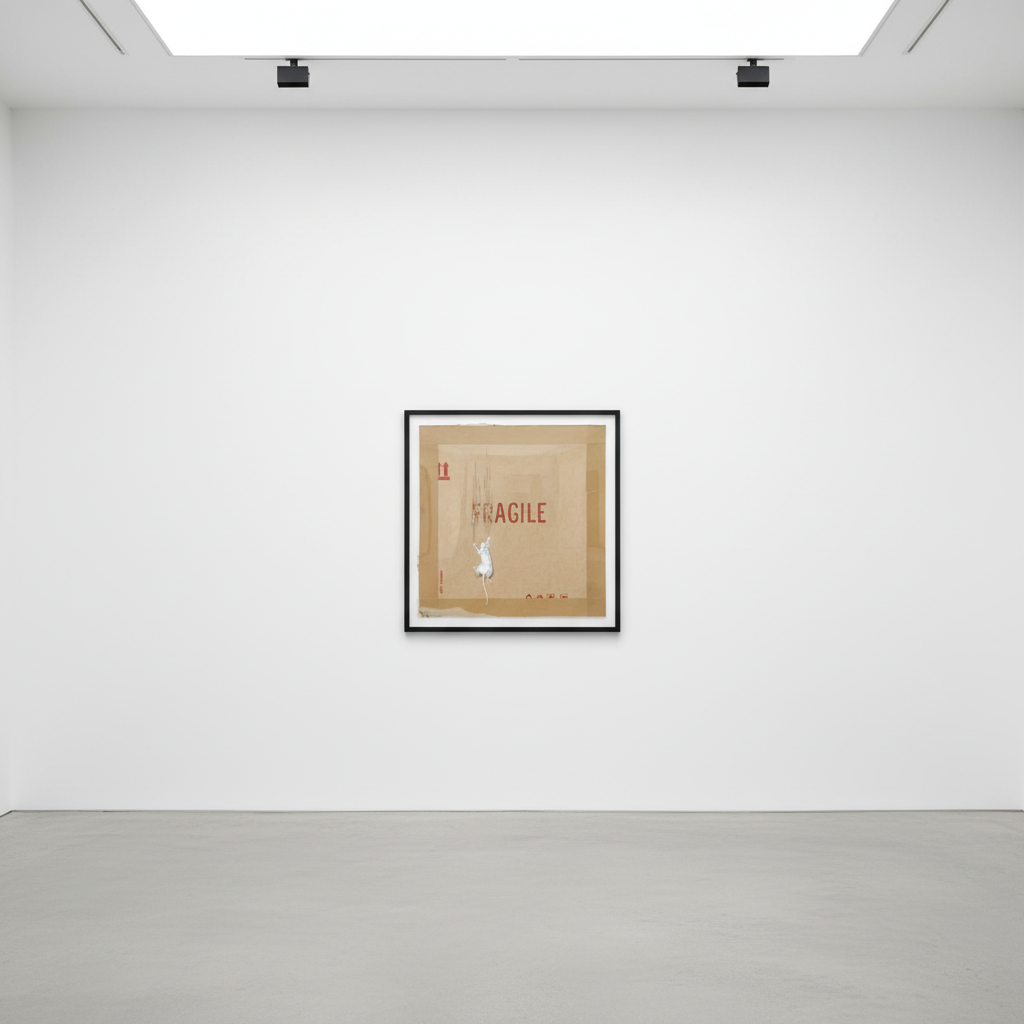
(Fr)agile
May 17, 2026
Who is Banksy? For more than two decades, Banksy has remained one of the most enigmatic and influential figures in contemporary and urban art. Shrouded in secrecy, the British street banksy artist has captivated global audiences with his politically charged, darkly humorous, and visually compelling artworks—often appearing unannounced on city walls, bridges, and even amusement parks. Despite widespread fame, Banksy’s true identity has never been officially confirmed, fueling a complex web of theories, speculation, and myth-making. But who is Banksy? And why has the question of his identity become as iconic as his art itself?
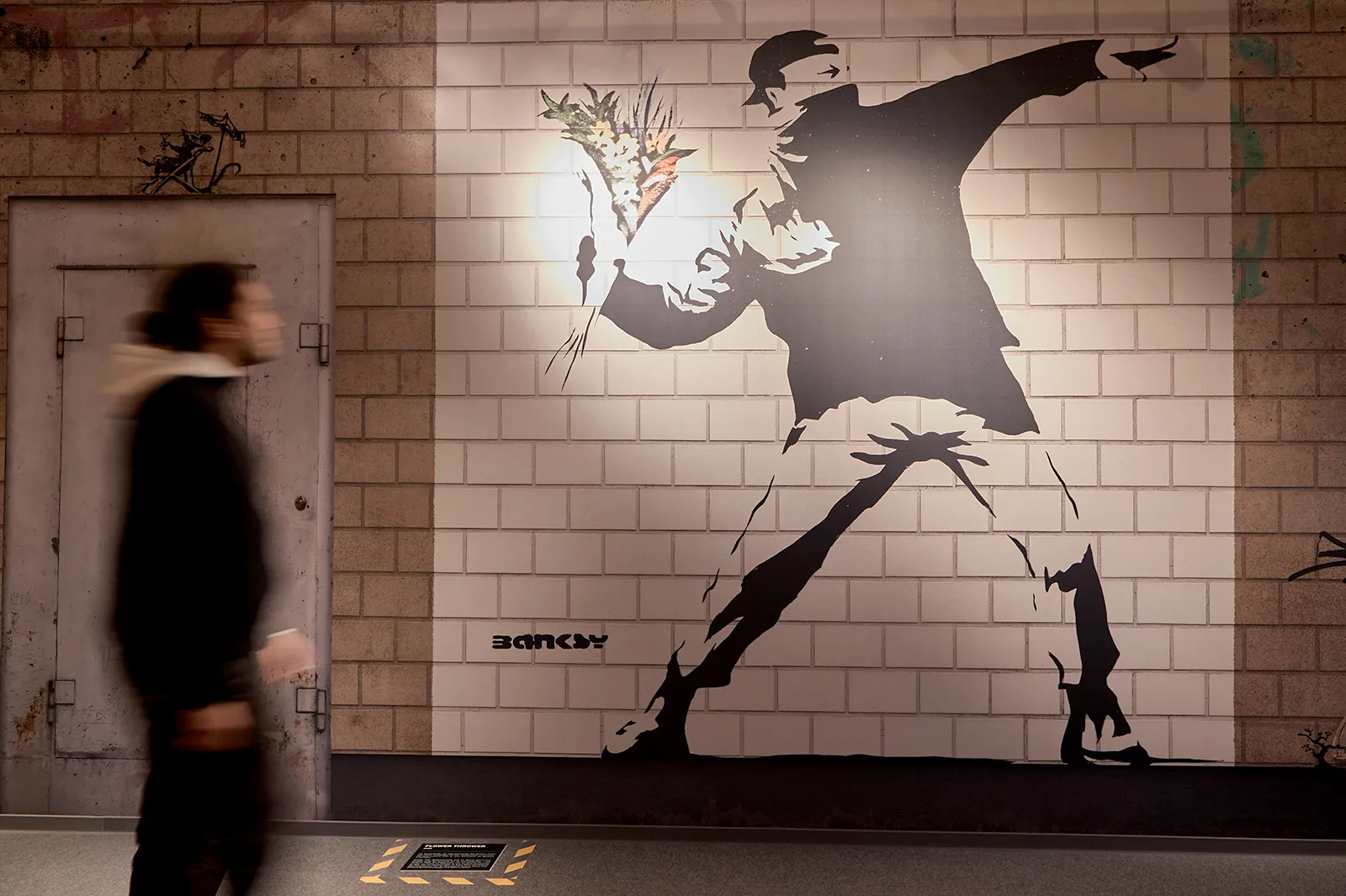
Banksy, Flower Thrower Wall. Available at Guy Hepner, New York.
Browse Available Banksy Works at Guy Hepner
Banksy’s career began in the early 1990s in the underground graffiti scene of Bristol, England—a city known for its vibrant subcultural art movements. Initially, his work bore resemblance to traditional freehand graffiti, but his signature style evolved into stenciling, a faster and more reproducible method that allowed him to create detailed pieces with speed and precision, ideal for evading police and working covertly.
By the early 2000s, Banksy had moved beyond local notoriety. His satirical, anti-establishment works—such as “Girl with Balloon,” “Kissing Coppers,” and “Love is in the Air”—began appearing not only across the UK, but also internationally, in cities like New York, Los Angeles, Bethlehem, and Paris. His art tackled issues like war, consumerism, inequality, surveillance, and animal rights, and his refusal to reveal his identity only amplified public fascination.
Understanding banksy influences is essential to understanding the work. His practice draws from multiple traditions simultaneously.
The most direct technical influence is Blek le Rat, the French street artist who pioneered stencil graffiti in Paris in the early 1980s. Banksy has acknowledged this openly: “Every time I think I’ve painted something slightly original, I find out that Blek le Rat has done it as well, only twenty years earlier.”
The Bristol music scene of the early 1990s was equally formative. Massive Attack, Portishead, and Tricky were operating in overlapping social circles, and the DIY ethos that produced trip-hop—sampling, recombining, subverting existing material—runs directly through Banksy’s practice. Jamie Reid’s punk graphic design for the Sex Pistols—cut-and-paste, ransom note aesthetics, establishment imagery turned against itself—is another clear antecedent. Andy Warhol’s appropriation of commercial imagery, the Situationist International’s theory of détournement, and the tradition of British political cartooning from Hogarth to the present complete the picture. His work synthesises all of these into something immediately accessible and persistently disruptive.
Banksy’s anonymity is not just a personal quirk—it’s a calculated artistic decision. By staying nameless, he challenges the notion of the artist as celebrity, undermining the art market’s obsession with persona and authorship. His absence creates a vacuum, inviting viewers to focus solely on the message of the work rather than the biography behind it.
Moreover, anonymity has shielded Banksy from potential legal repercussions. Much of his work is technically illegal, often sprayed on public or private property without permission. Remaining incognito allows Banksy to continue producing provocative art without prosecution.
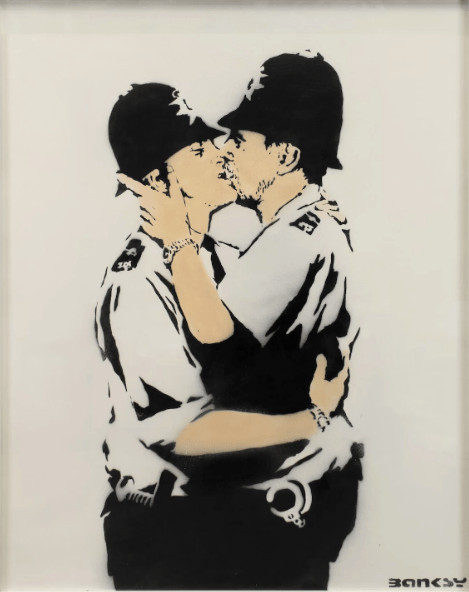
Banksy, Kissing Coppers, 2004. Available at Guy Hepner, New York.
Despite the efforts to maintain secrecy, several high-profile theories have emerged over the years about banksy identity. Some are backed by circumstantial evidence; others are pure speculation. Below are the most discussed contenders.
The most commonly cited theory identifies Banksy as Robin Gunningham, a former public schoolboy from Bristol. In 2008, The Mail on Sunday published a detailed investigation pointing to Gunningham based on photographs, interviews with acquaintances, and connections to Bristol’s graffiti scene. Gunningham attended Bristol Cathedral School and was reportedly known for his interest in art and subversive humour.
A 2016 scientific study by researchers at Queen Mary University used geographic profiling—a technique used in criminology—to compare the locations of Banksy’s works with known addresses linked to Gunningham. The results were strikingly consistent, strengthening the case.
In March 2026, Reuters published an 8,000-word investigation that went significantly further, cross-referencing geographic data, financial records, and public registrations. After the 2008 Mail on Sunday unmasking, all public records of Robin Gunningham—tax filings, employment records, property registrations—vanished entirely. Banksy has not confirmed or denied the Reuters investigation.
Supporting evidence: Gunningham fits the age, education, and timeline. Known to have used stencils and had ties to the Bristol art community. Geographic correlation to Banksy’s work. 2026 Reuters investigation cross-referencing multiple independent sources. Counterarguments: No definitive confirmation. Gunningham has neither confirmed nor denied the association.
Another compelling theory links Banksy to Robert Del Naja, frontman of Massive Attack and a former graffiti artist. Known as “3D,” Del Naja was part of the Bristol graffiti scene and has been an influential cultural figure since the 1980s. Journalist Craig Williams suggested that Banksy’s artworks often appear in cities where Massive Attack performs, hinting at a possible touring pattern.
Supporting evidence: Direct ties to Bristol and the graffiti scene. Multiple eyewitnesses claiming Del Naja was seen creating street art. Touring correlation with Banksy’s new pieces. Counterarguments: Del Naja has denied the theory, though playfully.
Another less mainstream theory connects Banksy to Jamie Hewlett, the artist behind Gorillaz and Tank Girl. Some suggest that Banksy is not a single person, but a collective, with Hewlett contributing significantly to the visual direction. Supporting evidence: Stylistic overlap in certain works. Shared creative circle. Possibility of Banksy as a brand, not an individual. Counterarguments: Hewlett’s work remains distinctively comic-based. No concrete links.
One of the more radical ideas is that Banksy is not a single artist but a collective operating under one pseudonym. This would explain the prolific output, the ability to produce large-scale installations such as Dismaland or The Walled Off Hotel, and the simultaneous appearance of works in different locations. Under this theory, Banksy operates more like a brand or movement—much like Anonymous in the hacker world. Supporting evidence: Massive projects suggest coordinated effort. Scale and speed of works seem difficult for one person to manage. Counterarguments: Many pieces bear a consistent hand and voice.
The irony is that Banksy’s refusal to reveal his identity has become central to his brand. If his name were confirmed, much of the mystique—and arguably, the impact—could evaporate. The aura of Banksy is not only built on the power of the message, but on the tension between presence and absence, authorship and anonymity.
Moreover, Banksy’s anonymity is an act of resistance—against celebrity culture, against commodification, against the traditional hierarchies of the art world. His invisibility is political. It forces audiences to engage with the work directly, rather than the person behind it.
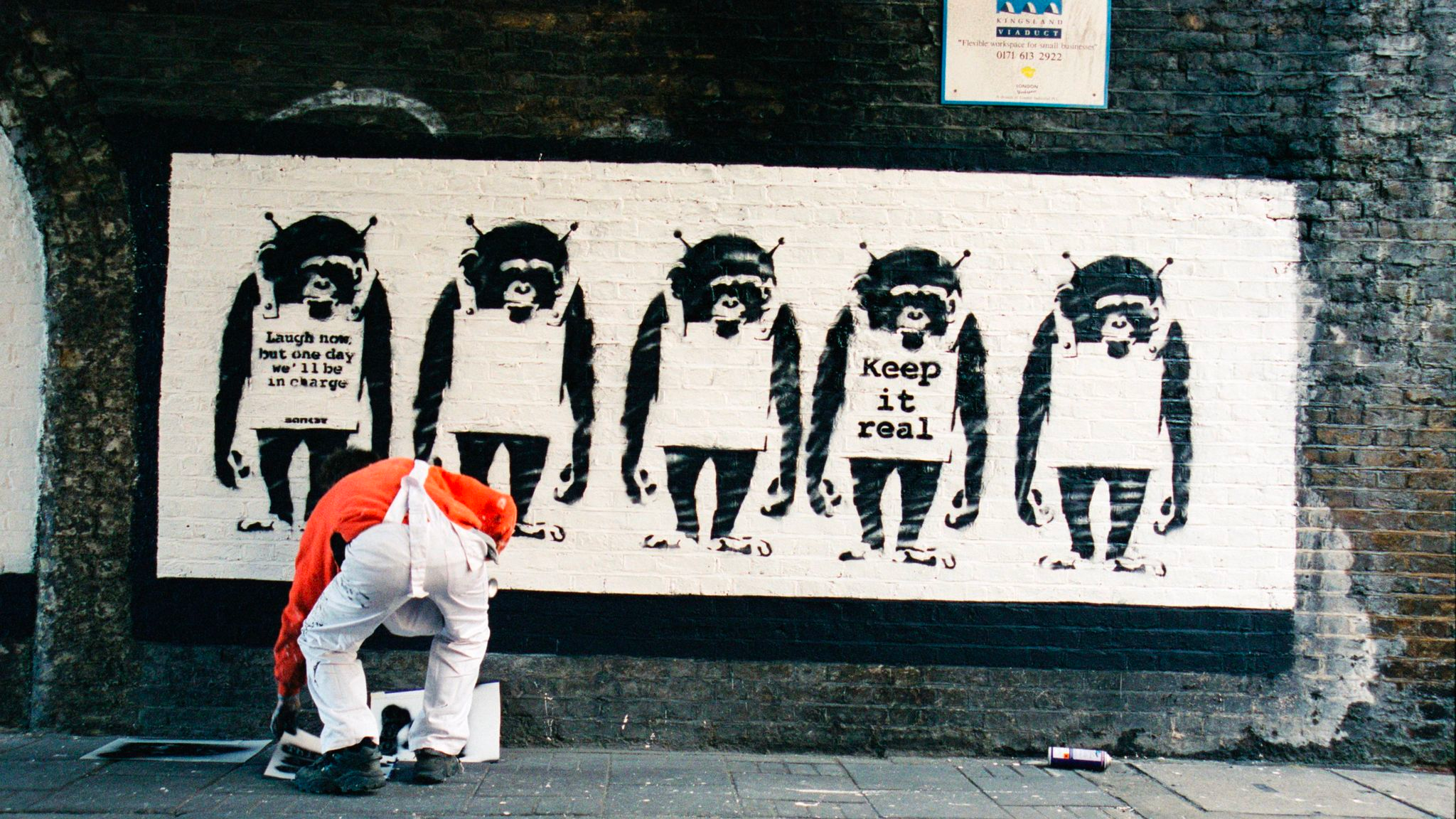
Banksy, Girl With Balloon Pink AP. Available at Guy Hepner, New York.
Banksy politics are anti-war, anti-surveillance, anti-capitalist, and consistently sympathetic to migrants, the displaced, and those on the wrong end of institutional power. Napalm (2004) placed the Vietnamese napalm girl alongside Ronald McDonald and Mickey Mouse. His nine murals on the Israeli West Bank barrier in 2005 remain among the most significant acts of public art of the century. Kissing Coppers (2004) targeted institutional homophobia. Devolved Parliament (2009, re-released 2019) replaced every MP with a chimpanzee and sold at Sotheby’s for £9.9 million. Love Is in the Bin—Girl with Balloon self-shredded at Sotheby’s in October 2018 for £1,042,000—resold in 2021 for £18.58 million. In August 2024 he produced a series of animal murals across London from Kew Bridge to Peckham.
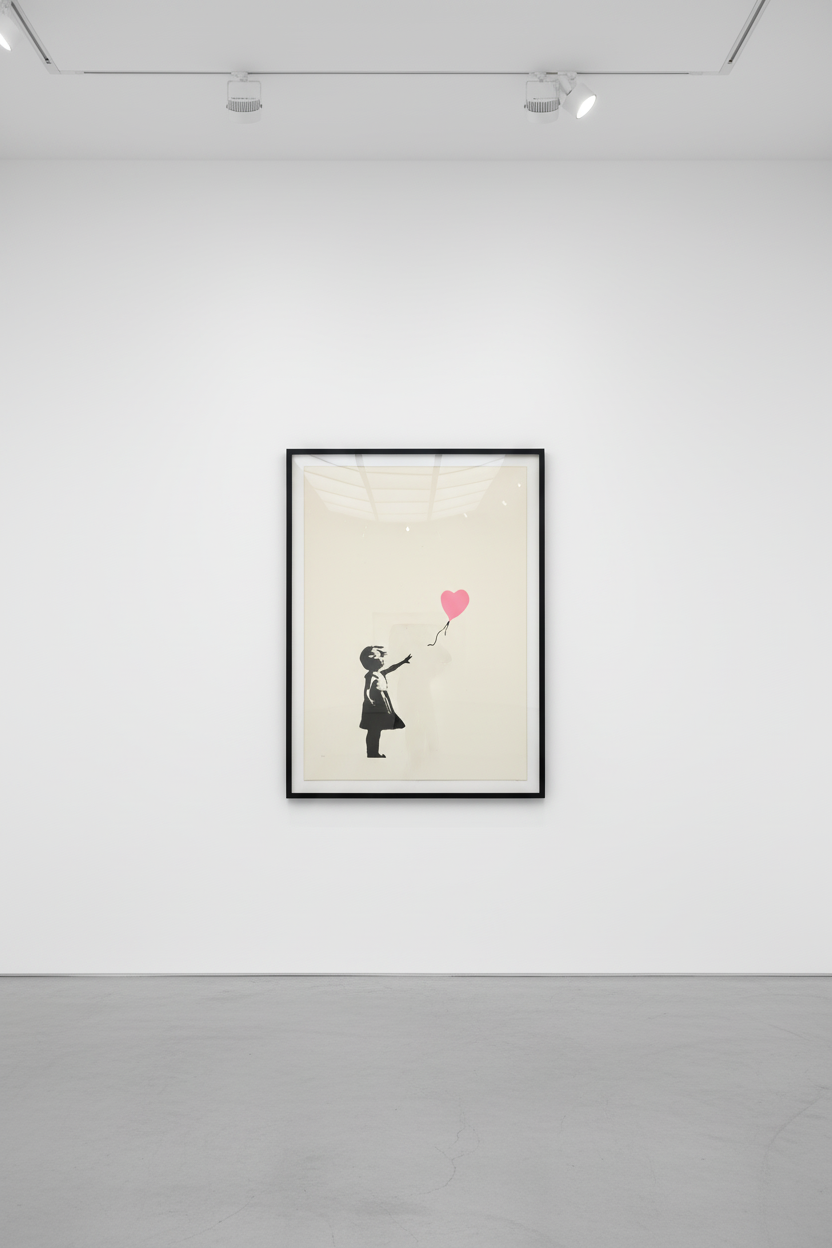
Banksy, Choose Your Weapon Magenta. Available at Guy Hepner, New York.
Regardless of who he is, Banksy’s cultural impact is undeniable. His banksy art fetches millions at auction—sometimes self-destructing in the process—and his public interventions, from “Love is in the Bin” to “Devolved Parliament,” spark global debate. He’s turned walls, refugee camps, and derelict buildings into canvases for protest and poetry.
In a world where personal branding dominates, Banksy remains a ghost—arguably the most famous unknown figure in the art world. Perhaps the question isn’t “Who is Banksy?” but “Why do we need to know?” Maybe the answer lies not in unmasking him, but in recognising that some truths—like the most powerful pieces of art—are most potent when left unsolved.
Pest Control is the only body authorised to authenticate Banksy’s work. Print editions come with authentication cards—a tear-away COA stub attached to the print. There is no Banksy catalogue raisonné. Works without traceable Pest Control documentation carry significant authentication risk.
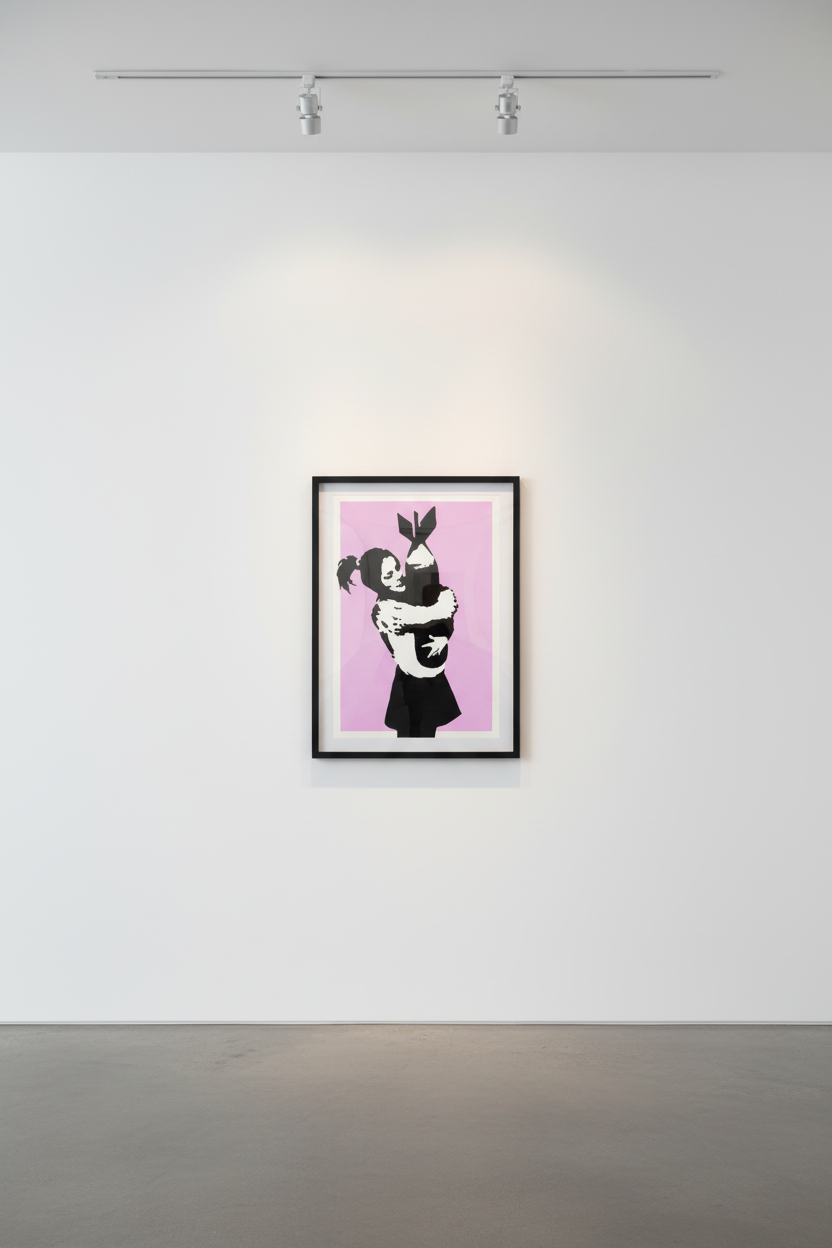
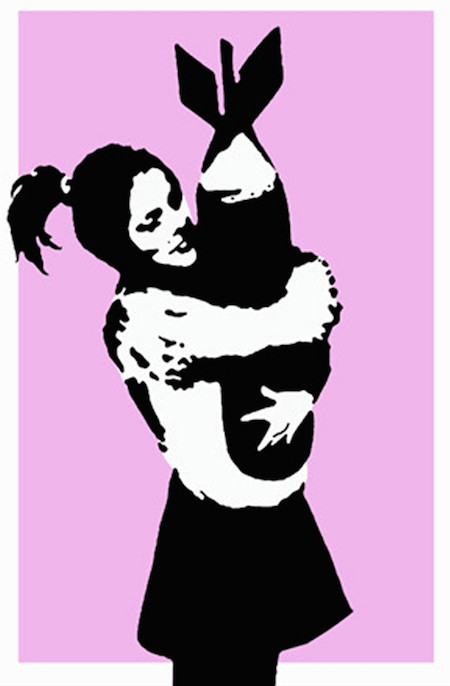
Banksy, Bomb Hugger Unsigned. Available at Guy Hepner, New York.
Discover Banksy original art for sale at Guy Hepner and get in touch with our gallery if you are looking to buy Banksy signed prints. Looking to sell? We can help—contact info@guyhepner.com for further details.
View All Available Banksy Works at Guy Hepner
Banksy is a pseudonymous England-based street artist, political activist, and film director active since the early 1990s. His satirical stencil works have appeared on walls worldwide. He has never confirmed his identity. The most credible identification points to Robin Gunningham, named by the Mail on Sunday in 2008 and the subject of a Reuters investigation in March 2026.
Banksy influences include Blek le Rat (stencil technique), the Bristol music scene and its DIY ethos, Jamie Reid and punk graphic design, Andy Warhol’s pop appropriation, and the Situationist International’s theory of détournement.
The banksy identity has never been officially confirmed. The strongest evidence points to Robin Gunningham. A March 2026 Reuters investigation cross-referenced multiple sources but Banksy has not responded. His anonymity is legally protected in the UK.
Banksy politics are anti-war, anti-surveillance, and anti-capitalist, consistently sympathetic to migrants and the displaced. He has addressed the Israeli-Palestinian conflict, the European migrant crisis, environmental destruction, and the commodification of dissent.
Unsigned editions of major works typically range from £15,000–£60,000. Signed editions command two to four times the unsigned price. Contact Guy Hepner for current market pricing.
Guy Hepner Gallery maintains an active inventory of authenticated banksy art with full Pest Control documentation. Browse available works or contact the gallery for availability.
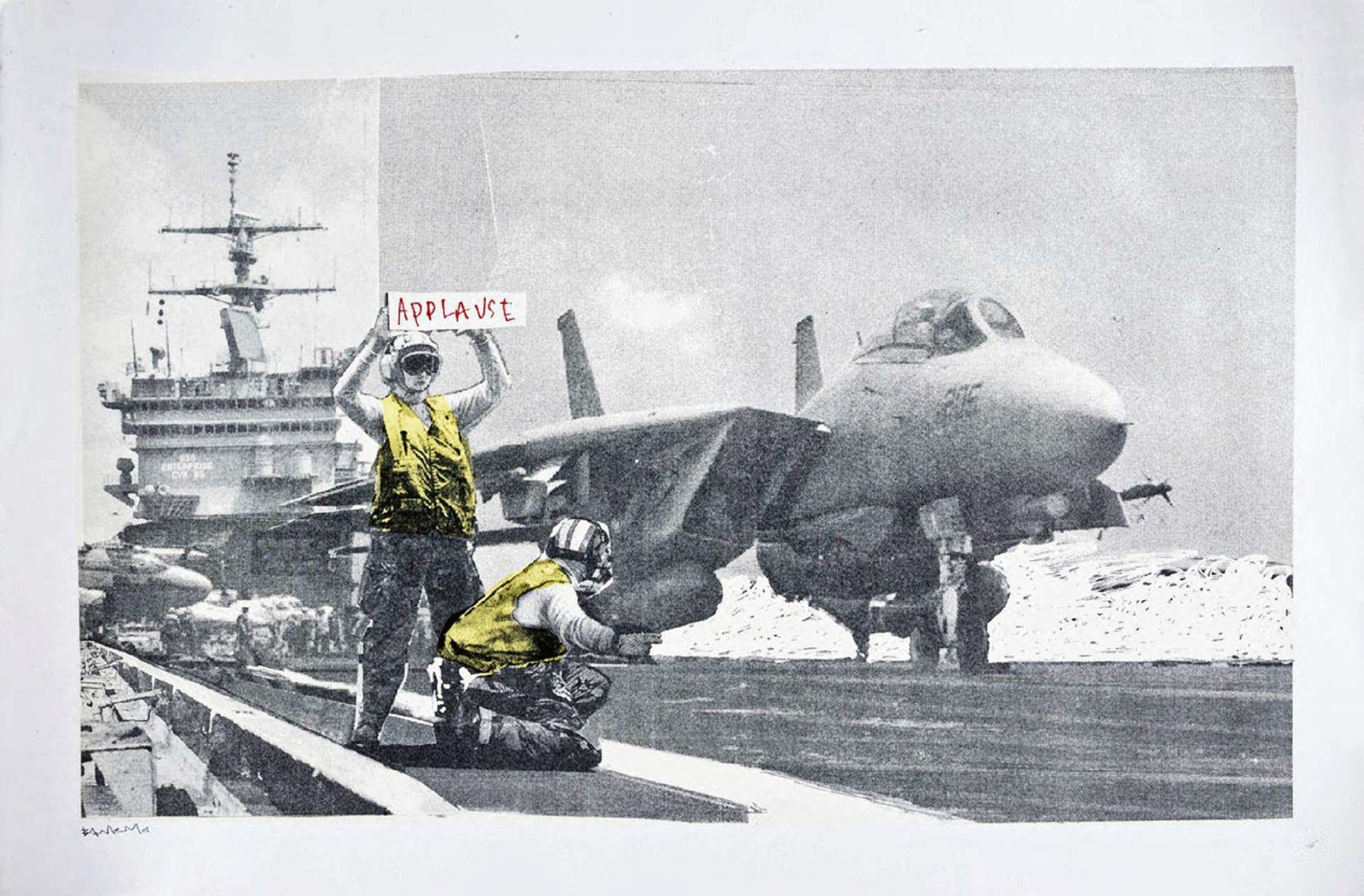
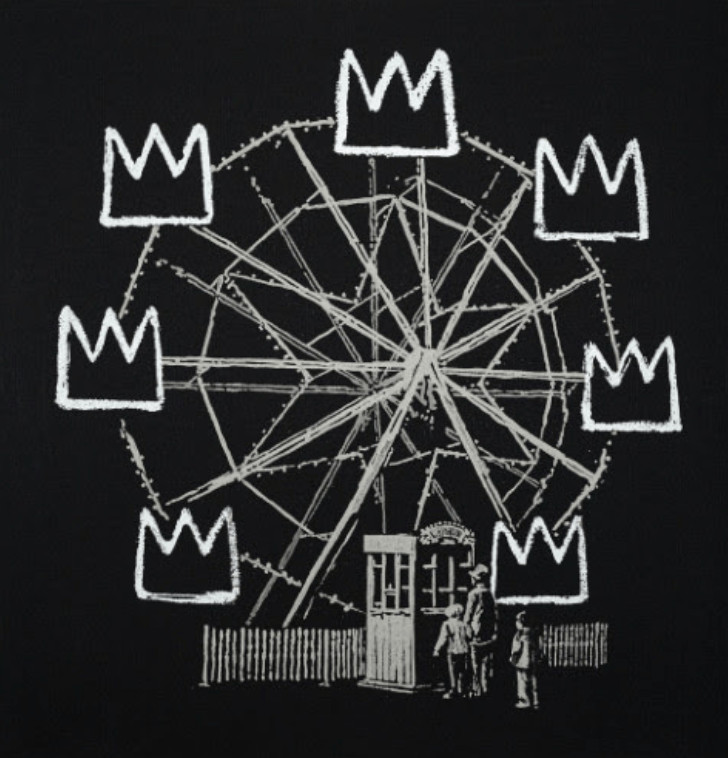
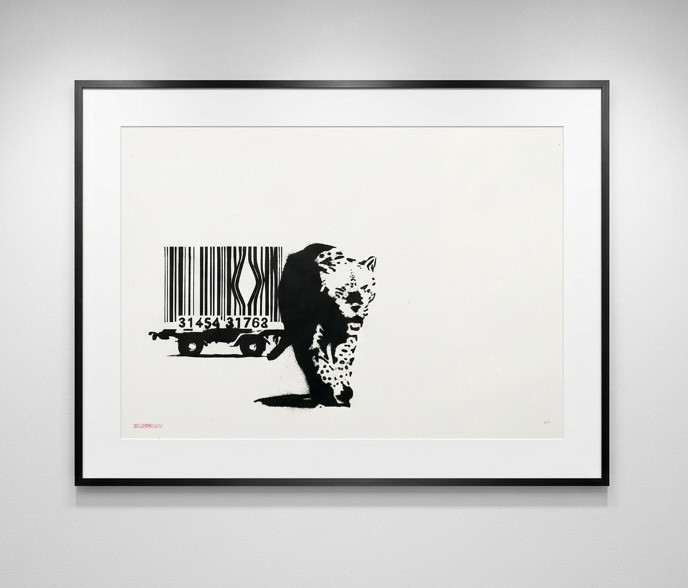
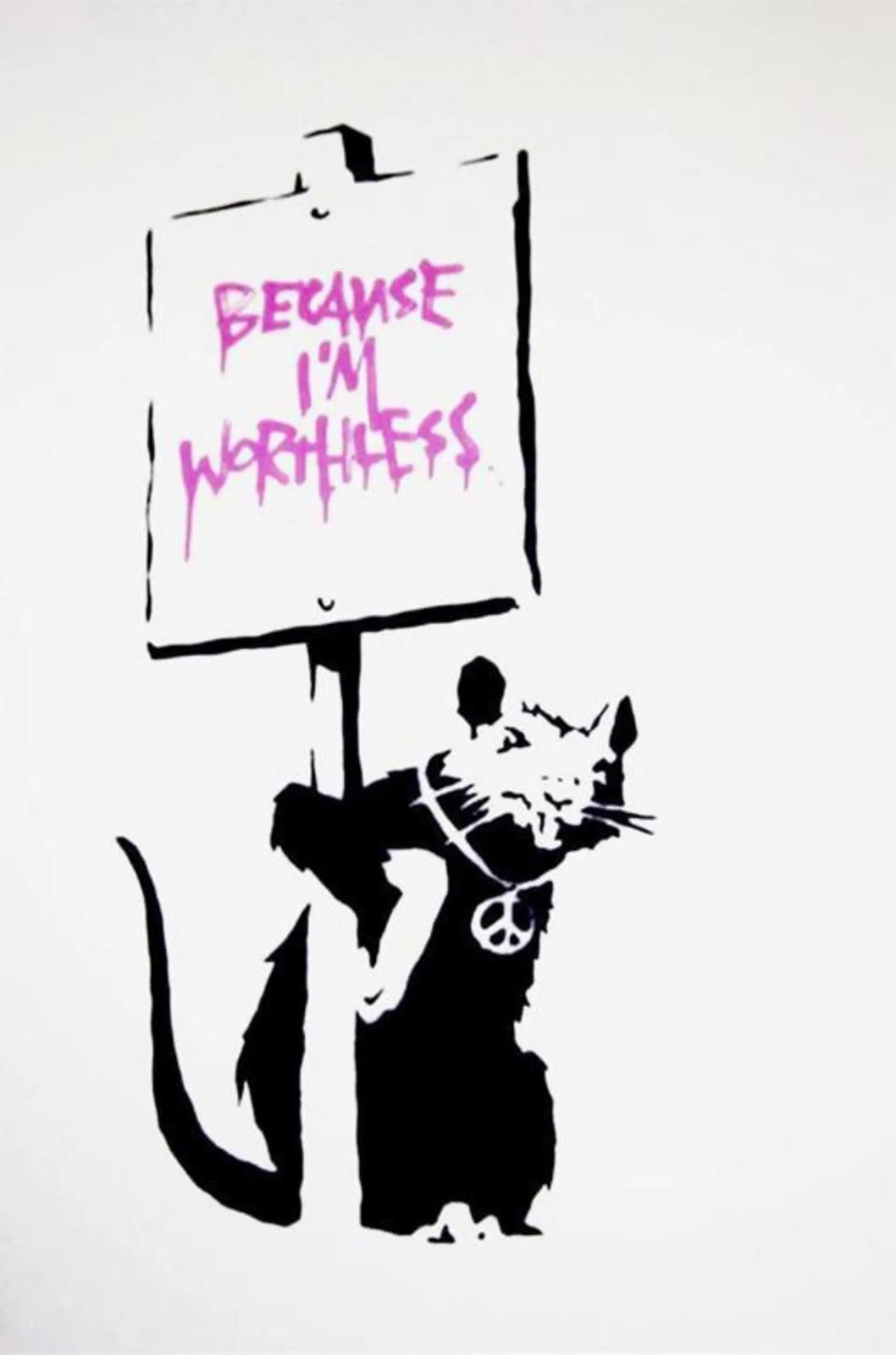
Explore Banksy prints for sale at Guy Hepner: (Fr)agile, Applause, Banksquiat, Barcode, Because I'm Worthless.
Related Series