Anatomy

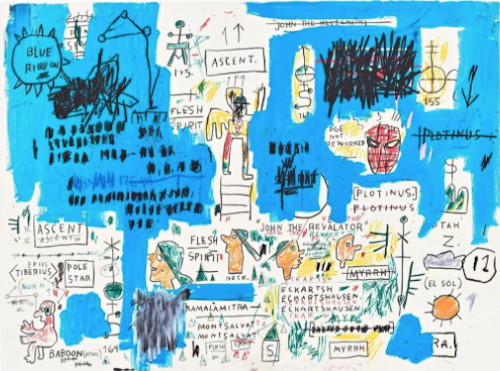
Jean-Michel Basquiat made paintings that looked like they were assembled from the wreckage of the world he lived in — words crossed out and written again, anatomical diagrams next to cartoon figures, historical names alongside brand logos. The apparent chaos was deliberate. Every element in a Basquiat work was chosen, placed, and weighted. To understand Basquiat's meaning is to learn to read his symbols: a dense visual language built over less than a decade that changed how contemporary art thinks about race, power, and the politics of representation.
Basquiat was born in Brooklyn in 1960 to a Haitian father and Puerto Rican mother. He grew up between cultures, languages, and class positions — an experience that shaped a visual intelligence hungry for multiplicity. By his late teens he was tagging Lower Manhattan as SAMO; by 23 he was represented by major galleries and selling work for six figures. He died of a heroin overdose at 27. In that compressed timeline, he produced one of the most symbolically rich bodies of work in the history of American art. Understanding what Basquiat paintings mean requires engaging with the specific vocabulary he built and used.
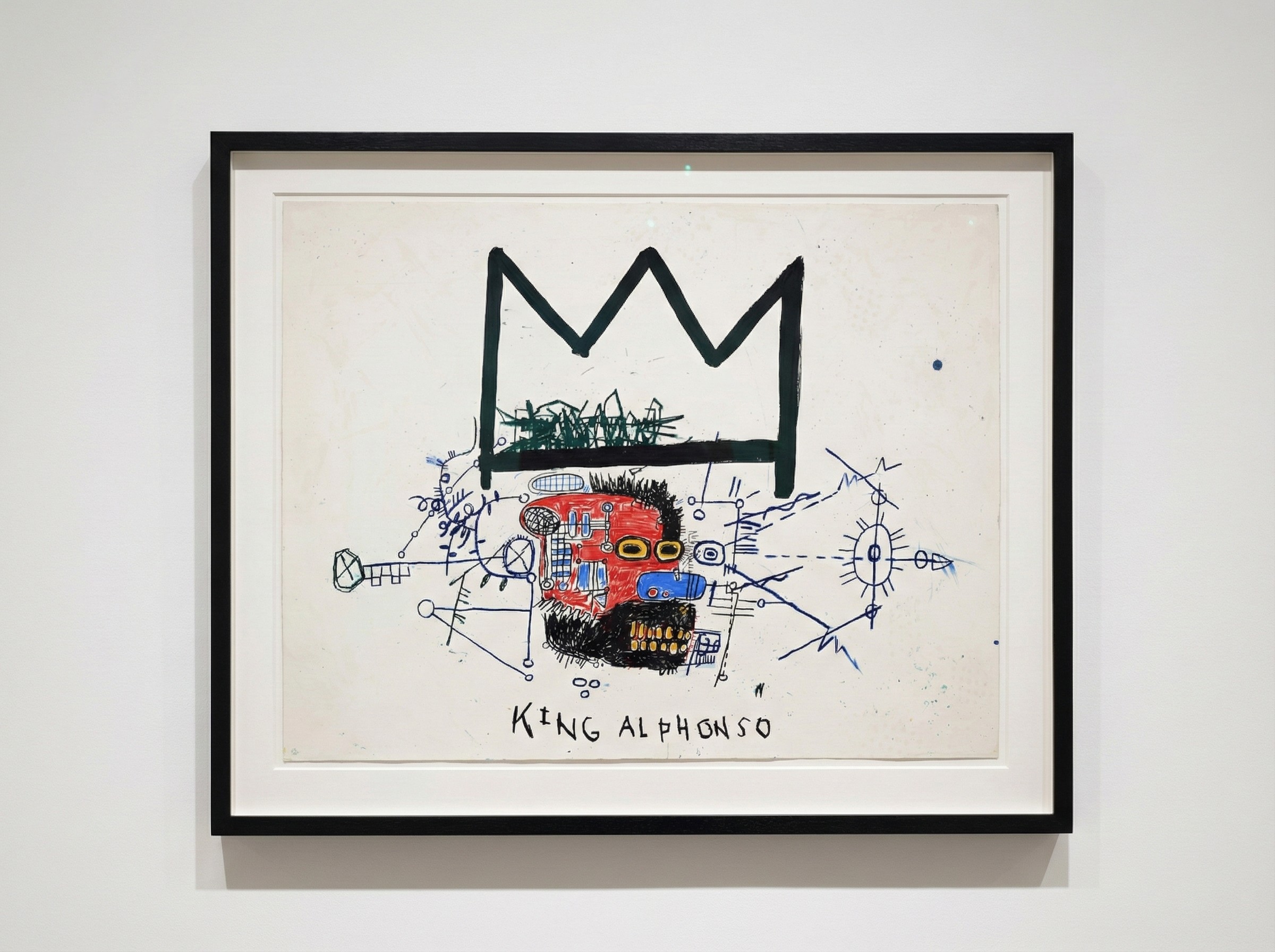
The three-pointed crown is Basquiat's most recognisable symbol and the most direct expression of his core argument. It appears in his earliest street work and continues through to his final canvases — conferred on jazz musicians, boxers, African kings, anatomical skulls, and his own image. The crown is not decoration. It is an act of recognition, performed by the artist in lieu of the institutions that refused to perform it.
Basquiat placed crowns above figures like Charlie Parker and Dizzy Gillespie — musicians whose genius was underpaid, exploited by club owners, and undervalued by the cultural establishment. In paintings like Charles the First (1982), the crown transforms an elegy into a coronation. The Basquiat crown meaning is inseparable from race: it is specifically Black greatness being named, elevated, and insisted upon. The deliberate imperfection of the hand-drawn form — irregular, immediate, made with a brush or spray can — signals that this coronation belongs to the street, not to institutions. Anyone Basquiat chose to crown was a king.
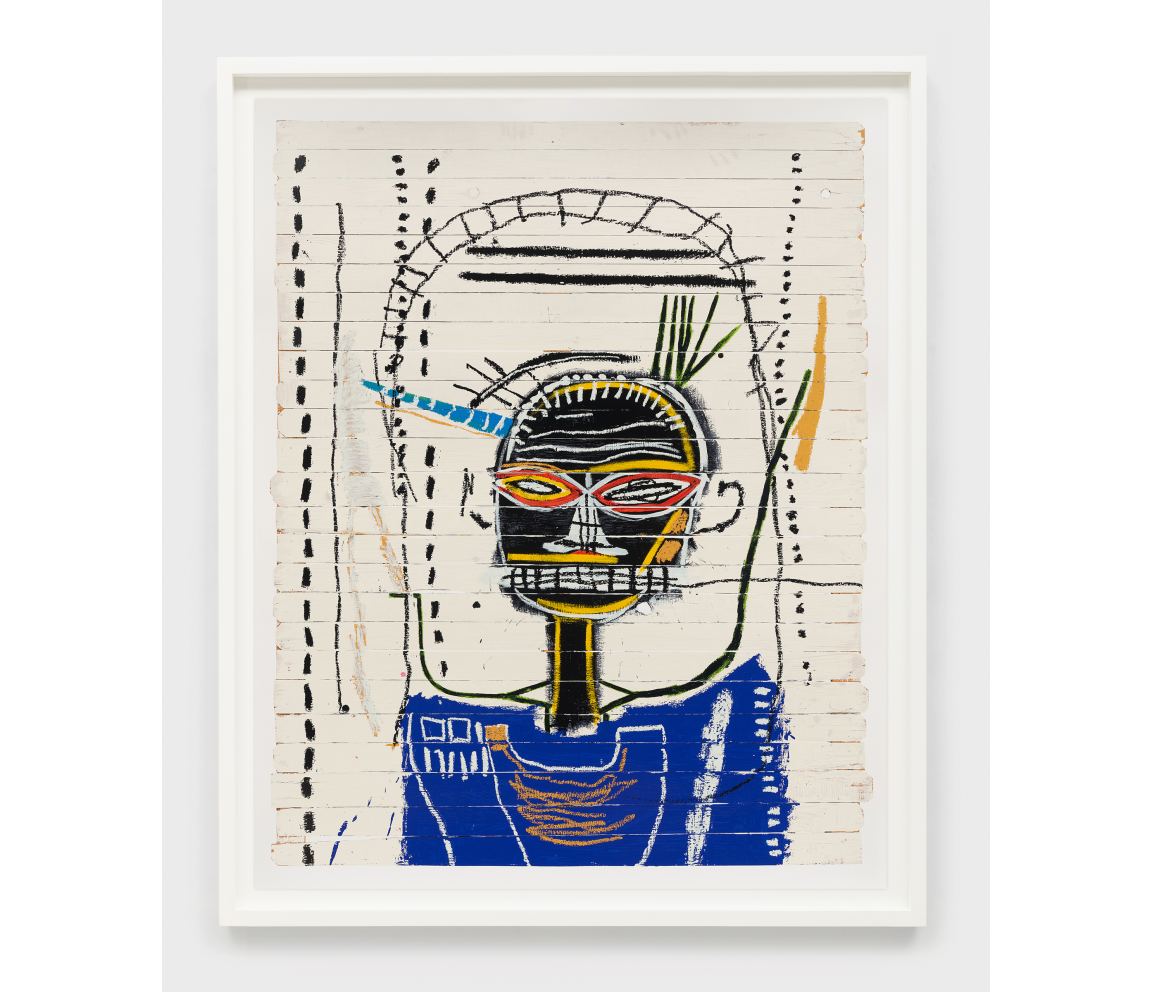
Skulls appear throughout Basquiat's work, often paired with his crown to create one of contemporary art's most compelling image-pairs. The crowned skull is simultaneously an elegy and a celebration: the skull acknowledges that all lives end; the crown insists that greatness does not.
But Basquiat's skull imagery carried additional weight given the cultural context he was working within. He was acutely aware of the history of Black bodies in Western science and medicine — their use as subjects for dissection and study, their dehumanisation in medical literature, the ways the physical Black body had been objectified and exploited. His anatomical studies, drawn from Gray's Anatomy and other medical texts, reclaim these representations. To render a skull with care, to crown it, to give it a name — this was to restore humanity to a body that institutional culture had treated as specimen. The meaning in Basquiat's art is often most concentrated at precisely these intersections of the personal and the political.
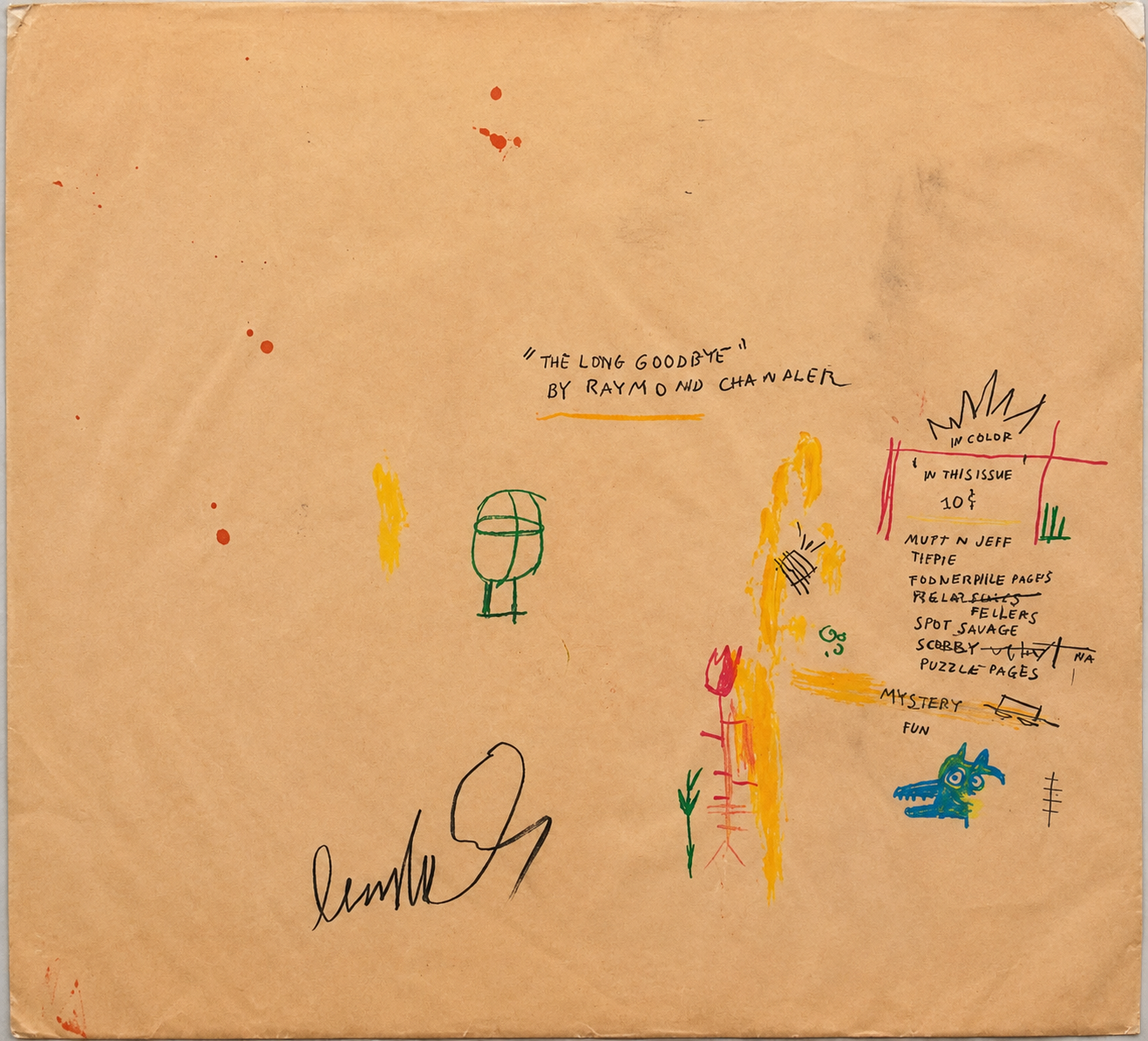
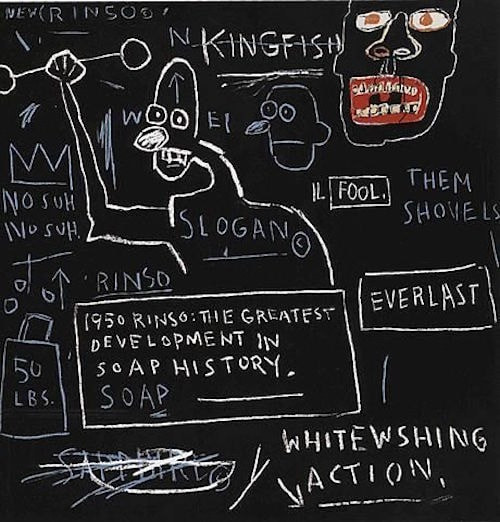
One of Basquiat's most immediately distinctive techniques is the crossing out of words — writing text and then striking through it with a horizontal line or painting over it partially. This is one of the most misunderstood elements of his work. The crossing out is not deletion. In Basquiat's visual language, a crossed-out word is more present, not less. The act of erasure draws attention to what is being erased.
The technique mirrors the experience of Black history in Western culture: present but struck through, visible but officially unacknowledged. When Basquiat crosses out names, anatomical terms, or price figures, he is enacting the gesture of erasure and simultaneously refusing it. The word remains legible; the crossing-out becomes the commentary. Jean-Michel Basquiat's meaning is often constructed through this kind of double gesture — saying and unsaying simultaneously.
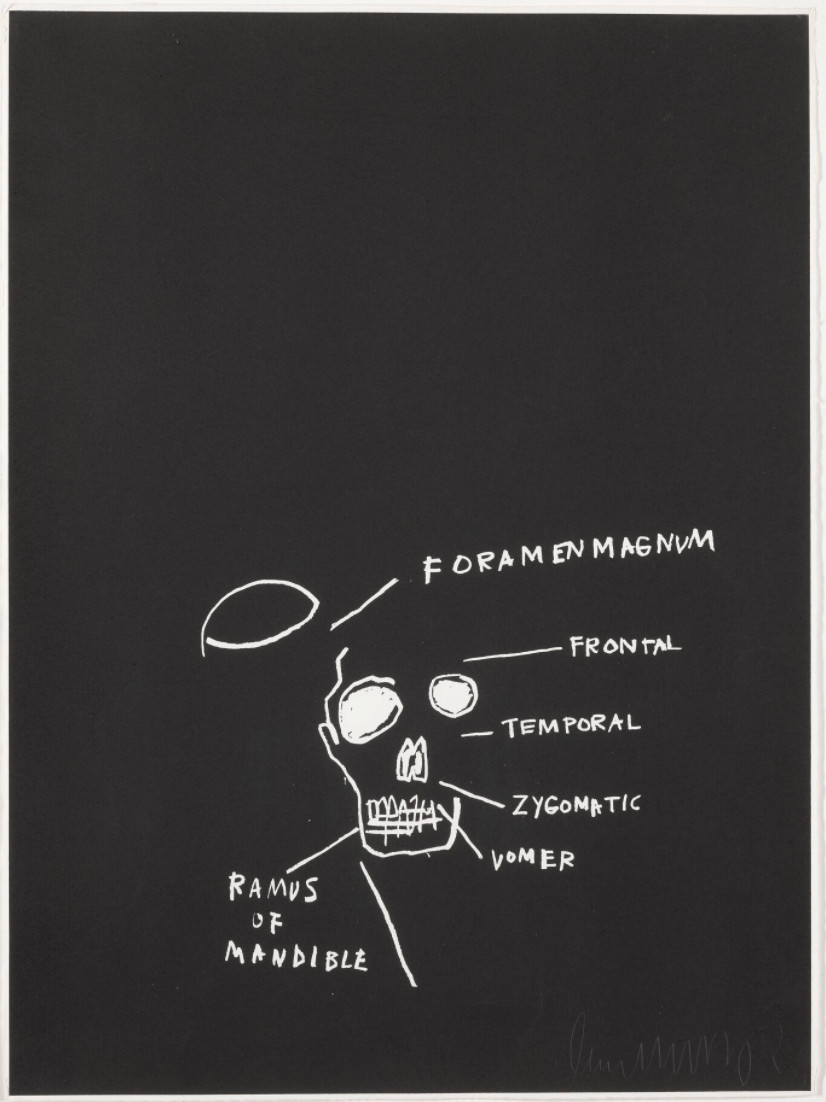
Basquiat kept a copy of Gray's Anatomy in his studio and drew from its illustrations throughout his career. Skeletons, organs, muscle groups, and circulatory systems appear across his canvases — sometimes labelled with medical terminology, sometimes annotated with his own observations, sometimes combined with crown imagery or figurative painting.
The anatomical works are among the most intellectually dense in his output. They engage with the history of medical science, the treatment of Black bodies as objects of study, and the deeper philosophical question of what it means to be embodied at all. Basquiat's anatomy is not clinical — it is passionate, contested, and politically aware. The body in his work is a site of struggle: for recognition, for dignity, for the right to be seen as fully human rather than as specimen. What Basquiat paintings mean in their anatomical mode is a sustained argument about the politics of the body.
SAMO — Same Old Shit — was the tag Basquiat used across Lower Manhattan in the late 1970s alongside Al Diaz. The SAMO phrases were not standard graffiti. They were aphoristic, cryptic, and literary: short text works that read like compressed poems or advertisements for an attitude. "SAMO as an escape clause," "SAMO as an end to the nine-to-five blues" — the phrases were satirical, self-aware, and designed to unsettle.
SAMO established the principles that would define Basquiat's entire career: the use of text as image, the disruption of institutional language, the insertion of street culture into art-world contexts. When Basquiat ended SAMO in 1979 — tagging "SAMO IS DEAD" across the downtown streets — he was announcing his transition from street artist to gallery artist. But the SAMO sensibility never left his work. The crossed-out words, the aphoristic text fragments, the deliberate roughness of surface: all of it traces back to those Lower Manhattan walls. Understanding basquiat meaning requires understanding SAMO as its origin point.
In Untitled (1982) — the crowned skull that sold for $110.5 million in 2017 — crown and skull appear in their most concentrated form. The painting is almost confrontationally simple: a black skull against a vivid background, topped by the three-pointed crown. Every element Basquiat used has been stripped back to its essence.
Charles the First (1982) brings together the crown, text, and jazz iconography in a dense, layered tribute to Charlie Parker. The canvas contains multiple text fragments, musical references, and the crowning gesture — a work that exemplifies how Basquiat's symbols function in combination rather than isolation.
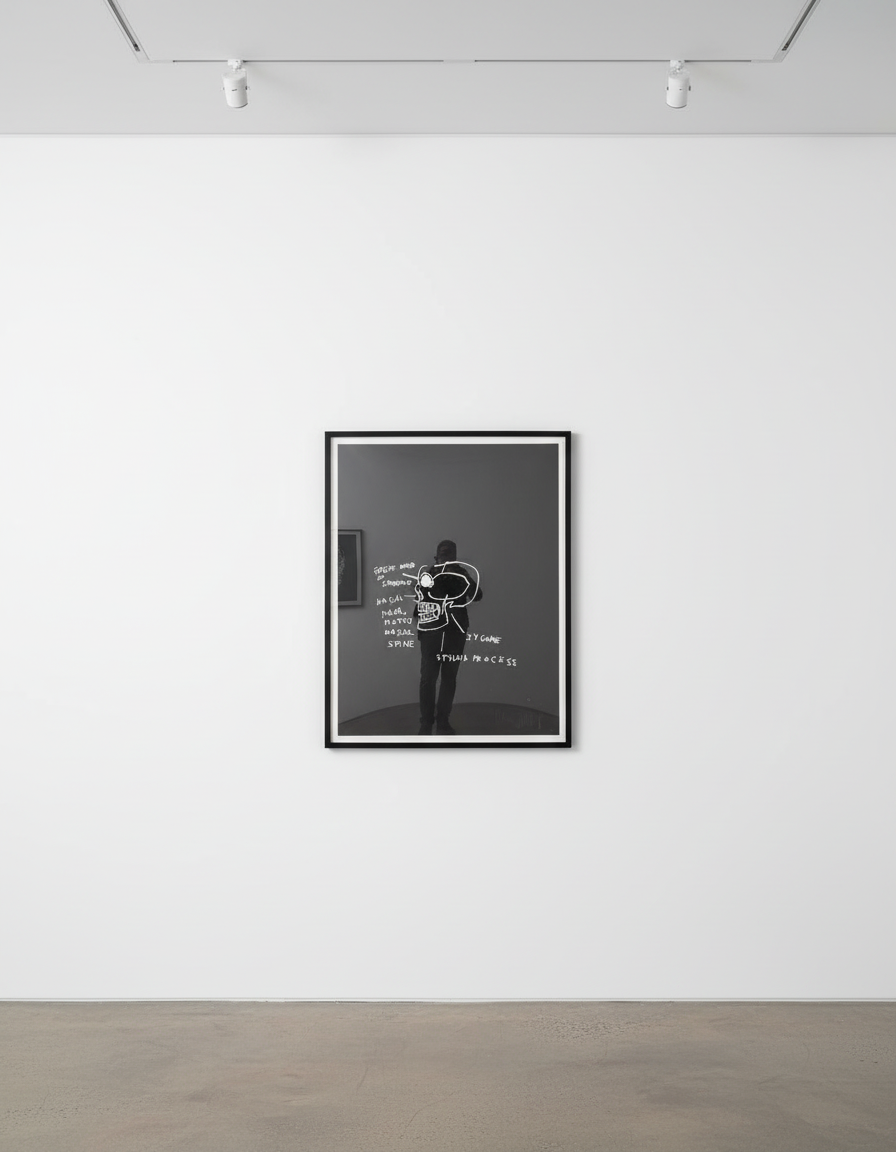
The Anatomy series prints extend his anatomical symbolism into a reproducible format — skeletal diagrams annotated with Basquiat's characteristic mix of medical terminology and personal commentary, often featuring crown imagery. These works demonstrate how Basquiat's symbols translate across media, from unique canvases to accessible print editions.
Guy Hepner holds one of the most significant collections of authenticated Jean-Michel Basquiat prints and works on paper available in the current market. The gallery's Basquiat holdings span his key series — including the Anatomy prints, the Superhero Portfolio, and individual works featuring his crown and skull imagery — at price points accessible to collectors at various stages of their practice.
All works are accompanied by full provenance documentation. The gallery's specialist team can advise on specific works, editions, condition, and the broader context of Basquiat's practice for collectors seeking to understand what they are acquiring as well as what they are owning.
Browse Jean-Michel Basquiat works at Guy Hepner
Basquiat's visual language is among the most studied in contemporary art, and for good reason. His symbols — the crown, the skull, the crossed-out word, the anatomical figure, the SAMO tag — are not decorative elements. They are arguments. Read together, they constitute one of the most coherent and sustained critiques of power, race, and recognition in the history of American art. To understand what Basquiat paintings mean is to engage with an intelligence that refused to be dismissed, crowning those who deserved to be seen and daring anyone to look away.
## Further Reading To explore one of Basquiat's most iconic symbols in depth, read our guide: [What Was the Meaning of Basquiat's Crown Motif?](/news/362-what-was-the-meaning-of-basquiats-crown-motif) --- **Thinking of selling your Basquiat?** Guy Hepner Gallery offers free, confidential valuations for Jean-Michel Basquiat prints, paintings and drawings. [Get a free Basquiat valuation](/sell/jean-michel-basquiat)Explore Jean Michel Basquiat prints for sale at Guy Hepner: Anatomy, Daros Suite, Estate Prints, King Alphonso, Original Works.
Related Series