The Land That Made Us One
10 works
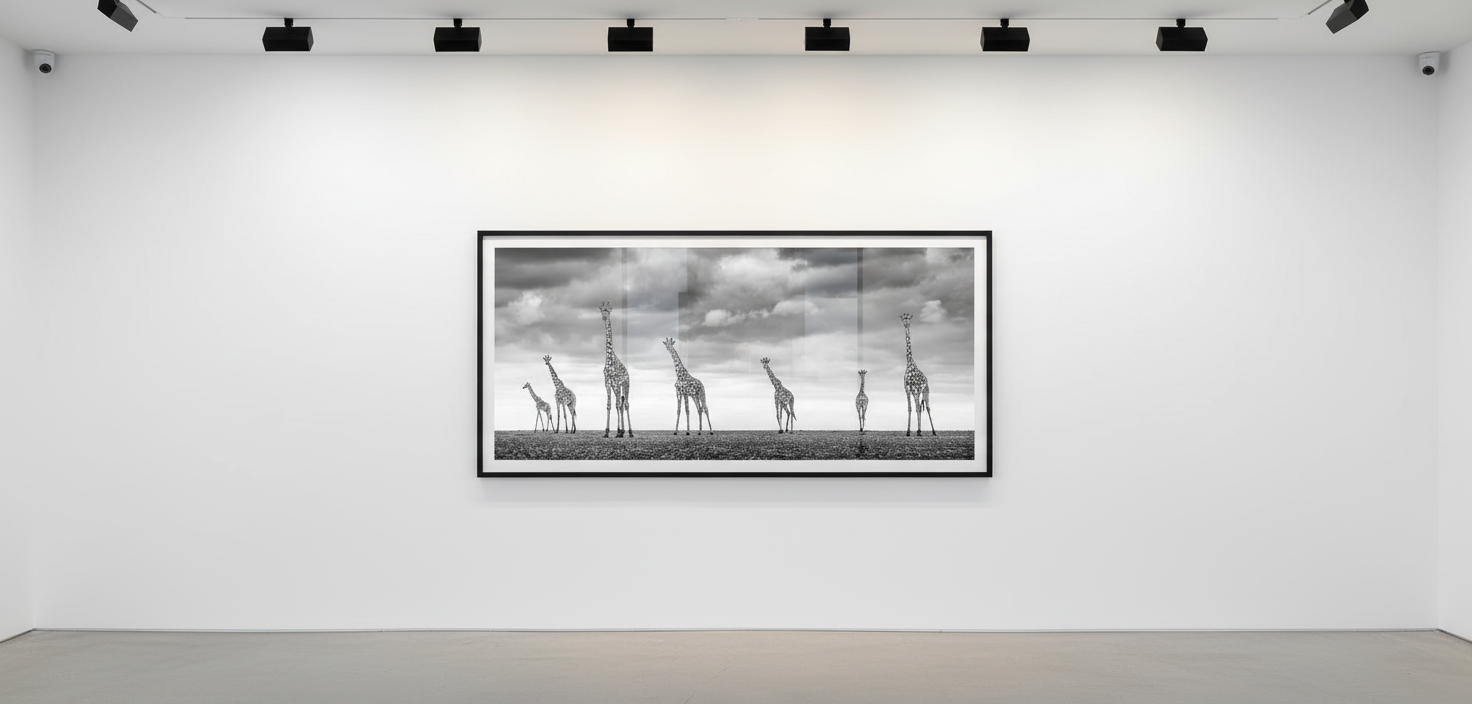
Giraffe City, 2022
Silver gelatin print
18 x 37 in Ed of 8 28 x 57.5 in Ed of 8 38 x 78 in Ed of 6 48 x 98.5 in Ed of 6
Amboseli’s dry lakebed is one of James Lewin’s all-time favorite places to photograph. The featureless, cracked surface stretches for miles, evoking a sense of being on the moon. He has spent weeks following elephants as they venture across the lakebed, but only on a handful of occasions has he seen a group of giraffes cross this vast, barren expanse where there is no food or water.Giraffes are best photographed in groups and are notoriously complex subjects due to their cautious nature. Since it is crucial that Lewin’s work has minimal impact on wildlife, he adopts a “let nature come to you” approach - an often time-consuming method that demands hours of patience and frequently ends in disappointment. Giraffes are especially sensitive to movement and can be spooked even by slight shifts inside a vehicle. To avoid disturbing them, Lewin and his team positioned themselves far ahead of the group, only adjusting their location well in advance of the animals’ approach.He knew that if the giraffes came within range of his 200mm lens, he would have a chance at capturing a remarkable moment. On two separate attempts, the giraffes veered slightly off course, moving out of reach. Undeterred, the team repeated their process - waiting further ahead - and finally achieved a head-on view. Lewin especially valued the moment when the two closest giraffes paused and looked directly at him. Their stillness created a tighter grouping, which proved critical for the success of the composition. Had the spacing between them been wider, the image would have lacked cohesion.After watching the group disappear into the distance, Lewin reviewed his images. He was instantly thrilled with what he had captured - it conveyed the immense scale of Earth’s tallest land mammals. A low shooting angle had also been essential; the giraffes rose like skyscrapers, their seemingly endless necks and iconic patterns stretching high into the sky.
James Lewin is a British fine art wildlife photographer based in Kenya. He is entirely self-taught, having first picked up a camera while working with anti-poaching and research units on the front line of conservation. He later left a career in real estate in London to pursue photography full time.
Lewin photographs wild animals exclusively in their natural habitats, often working from customized vehicles or on foot, and getting within close range of his subjects using wide-angle lenses shot from a low vantage point. This approach emphasizes scale and presence, giving his black and white images a monumental, almost sculptural quality. He spends extended periods in remote parts of Africa, following individual animals for weeks at a time in pursuit of compositions that capture a rare moment of intimacy or drama.
His work carries a strong conservation focus, and Lewin has partnered with organizations supporting anti-poaching efforts and habitat protection across Africa, directing a portion of print sales toward these causes. He has received more than 25 international awards for his photography.
Lewin's photographs have raised significant funds for wildlife conservation, contributing to efforts to protect wildlife corridors and endangered species including Africa's remaining "Big Tuskers" and the black rhino.
Guy Hepner works with collectors seeking James Lewin's fine art wildlife photography. Contact us to discuss available inventory or to inquire about upcoming releases.