Early Works
10 works

Yoshitomo Nara
Yoshitomo Nara (b. 1959, Hirosaki, Japan) stands as one of the most influential figures in contemporary Japanese art, whose deceptively simple portraits of wide-eyed children—at once innocent and subversively defiant—have become icons of the Neo-Pop movement. Trained in Düsseldorf and deeply influenced by punk rock and anime culture, Nara creates works that resonate across cultural boundaries, commanding an international collector base and record-breaking auction results. His
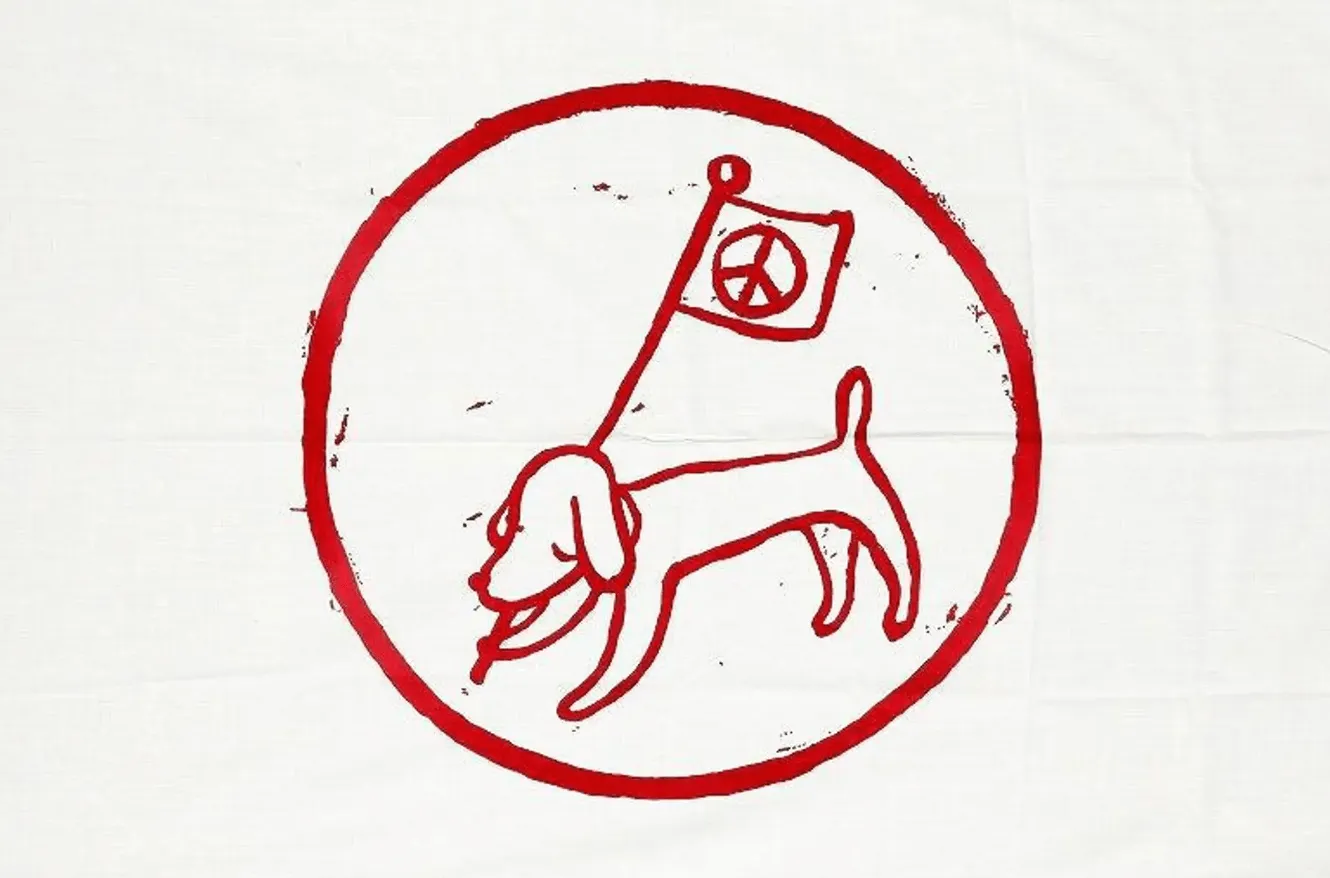
Yoshitomo Nara (b. 1959) is one of the most beloved and internationally collected Japanese artists working today. His distinctive paintings, drawings, and sculptures of wide-eyed children and dogs — simultaneously innocent and unsettling, tender and defiant — have made him one of the defining voices in contemporary Japanese art and a global phenomenon whose works command extraordinary prices at auction.
Born in Hirosaki, Aomori Prefecture, in 1959, Nara grew up in a remote region of Japan in a house where he was largely alone as a child — his parents worked long hours, and he spent much of his formative time listening to Western rock and punk music and making drawings. This isolation and the music he absorbed profoundly shaped his practice: his figures carry a quality of solitary interiority and a suppressed rebelliousness that connects directly to his own childhood experience and to the spirit of the music that accompanied it.
Nara studied at Aichi Prefectural University of Arts before moving to Düsseldorf in 1988 to study at the Kunstakademie, where he remained for twelve years. This period in Germany deepened his visual formation and exposed him to the major currents of European contemporary art while reinforcing his commitment to his own highly personal visual language. He returned to Japan in 2000, by which time his international reputation was firmly established.
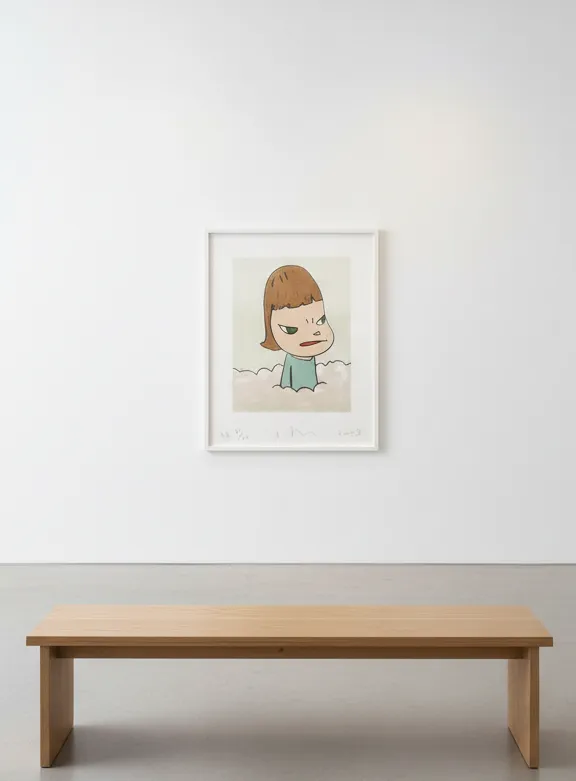
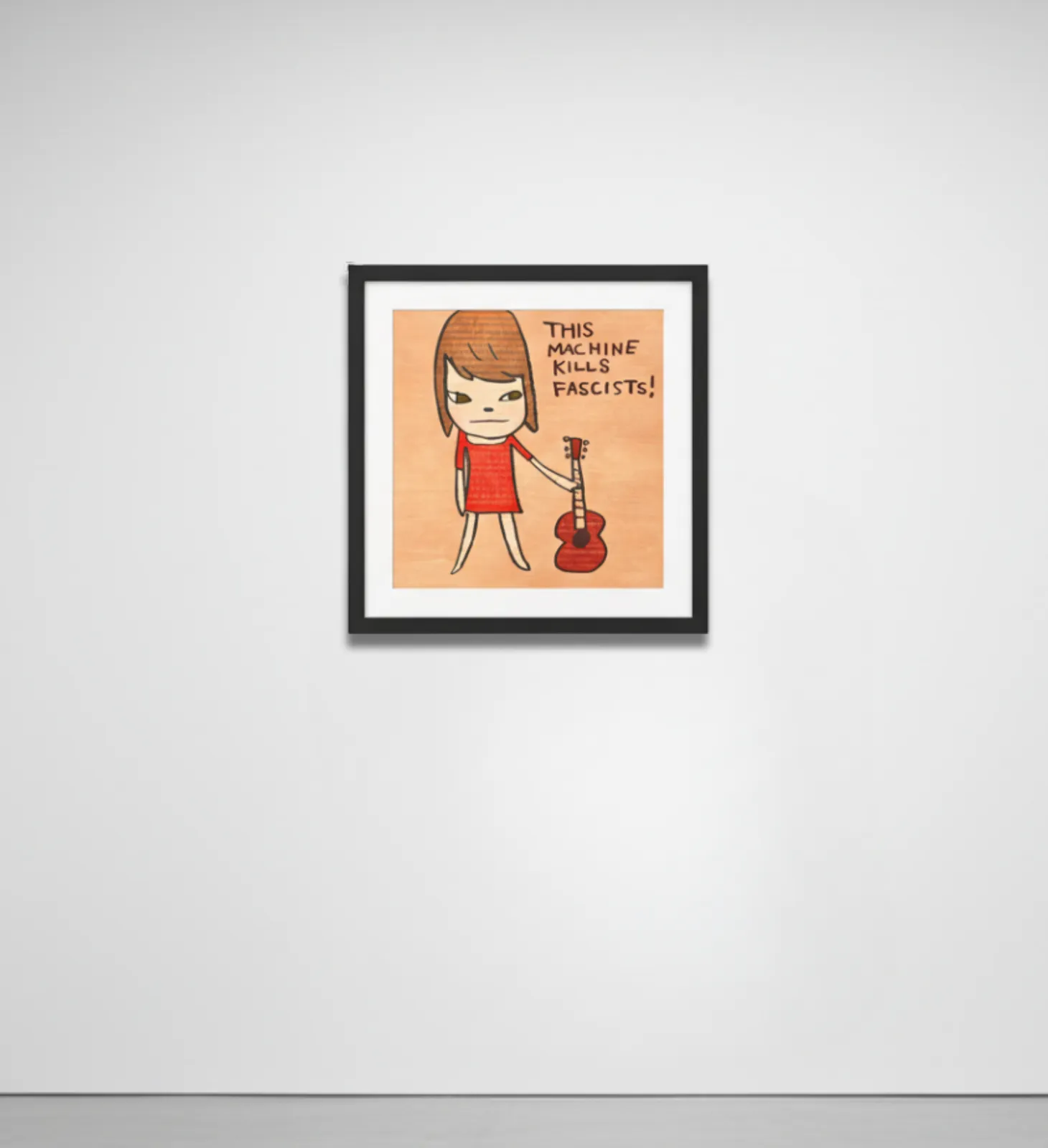
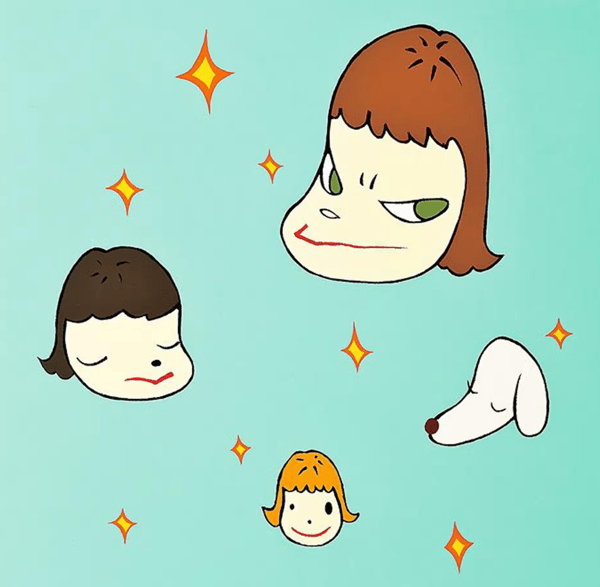
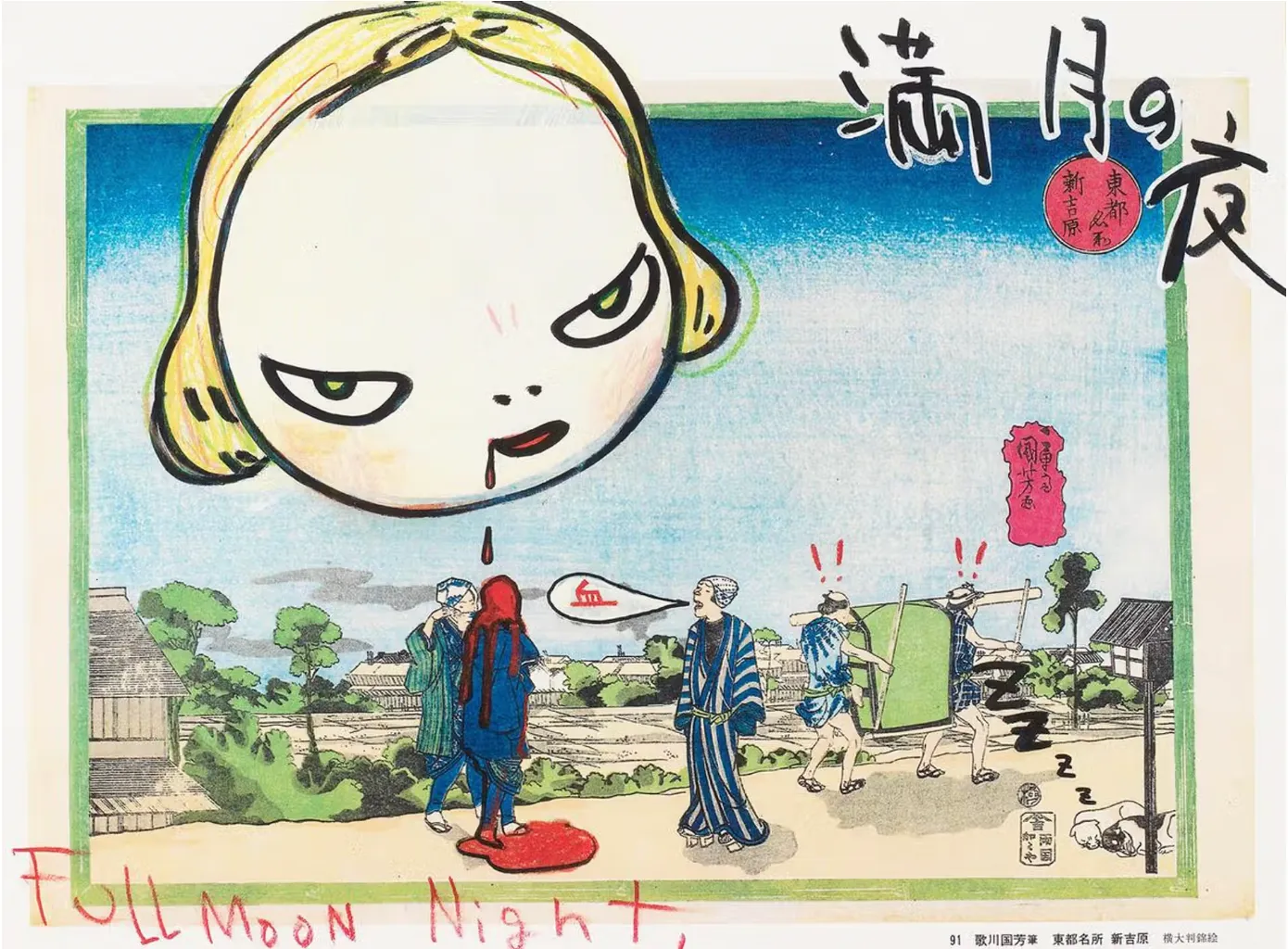
His signature imagery — a recurring cast of children with disproportionately large heads and enormous eyes, sometimes brandishing knives or wearing menacing expressions, sometimes simply staring with unreadable directness — operates on multiple levels simultaneously. The works are accessible and visually seductive, drawing on anime, manga, and folk art traditions that give them immediate cultural legibility. But they also carry a psychological depth and emotional ambivalence that rewards sustained engagement: these are not simply cute images but complex meditations on childhood, loneliness, resistance, and the vulnerability that underlies apparent toughness.
Nara's market has grown to remarkable heights. His painting Knife Behind Back (2000) set an auction record of $24.9 million at Sotheby's Hong Kong in 2019, establishing him among the highest-valued living Japanese artists. Strong results continue across all formats: paintings, works on paper, sculptures, and ceramic works all perform well, with consistent demand from collectors in Asia, the United States, and Europe.
The breadth of his collector base — spanning institutional collections, private foundations, and individual collectors across multiple generations — ensures strong market liquidity and continued secondary market activity. His sculptures, in particular, have attracted significant collector attention, with large bronze and fibreglass figures appearing in major private and public collections worldwide.
Nara's cultural influence extends well beyond the art market. His imagery has been widely referenced in fashion, music, and popular culture, and his position as one of the artists who brought Japanese contemporary art to global attention — alongside Takashi Murakami — places him at the centre of a significant moment in the history of art's globalisation. His retrospective exhibitions at major institutions, including the Los Angeles County Museum of Art, the Museum of Contemporary Art in Chicago, and the Asia Society in New York, have confirmed his standing as an artist of genuine historical importance.
Nara's work is held by major institutions including the Museum of Modern Art in New York, the Los Angeles County Museum of Art, the Hara Museum in Tokyo, the Museum of Contemporary Art in Los Angeles, and the Yokohama Museum of Art, among others.
Guy Hepner provides access to Yoshitomo Nara works for collectors seeking to engage with one of the most significant Japanese artists of his generation. Our New York gallery at 177 Tenth Avenue offers expert guidance on available works, authentication, and acquisition strategy. Contact Guy Hepner to discuss current opportunities.

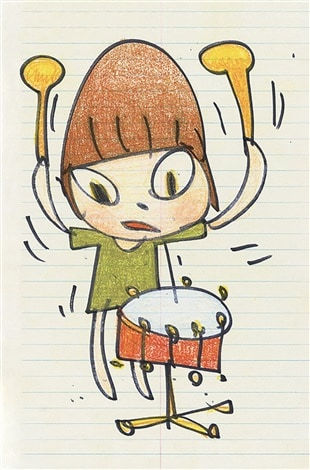
Yoshitomo Nara is among the most significant Japanese artists of his generation and one of the most globally collected figures to have emerged from the cultural moment of 1990s Japanese contemporary art. His print editions — silkscreens, lithographs, and woodblocks — translate his characteristic imagery into the multiple format with a directness and emotional immediacy that mirrors his painting practice. The large-eyed children, the solitary dogs, and the night-walking figures that populate his work carry a melancholic complexity beneath their apparently simple surfaces that has resonated with collectors across generations and cultural contexts.
Nara's print market is genuinely international, with particularly strong collector bases in Japan, the United States, South Korea, and across Southeast Asia. His editions are typically produced in limited quantities, individually signed and numbered, and accompanied by publisher documentation that provides the basis for authentication. The relationship between his prints and his paintings — many print editions derive from or relate directly to specific painted works — gives individual editions an art historical dimension that adds to their collecting interest.
The secondary market for Nara prints has demonstrated consistent strength, driven by the combination of his museum profile, the global reach of his collector base, and the finite supply of his editions. Works from key series — the Night Walker prints, the solo figure editions, the dog works — have established significant auction benchmarks. Condition is important: many Nara prints are on delicate Japanese papers that require careful handling and storage. Guy Hepner Gallery offers a curated selection of Nara editions with full provenance documentation.