GUYHEPNER

Andy Warhol Diamond Dust Shoes For Sale

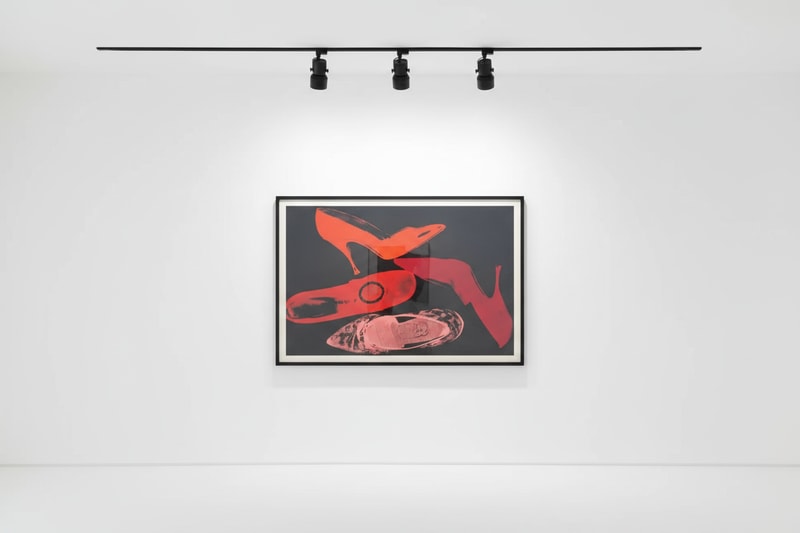
Andy Warhol: Diamond Dust Shoes

Series Performance & Market Position

The Diamond Dust Shoes portfolio stands among Warhol's most materially distinctive print series, commanding strong six-figure to seven-figure results at major auction houses. Guy Hepner has completed 478 Warhol transactions totalling over $51 million across 292 collectors, providing direct insight into how this series performs within serious collections.

Recent auction activity demonstrates consistent institutional demand. Diamond Dust Shoes F.S. II 255, F.S. II 256, and F.S. II 253 each achieved approximately $2,954,000 at auction in May 2025, following comparable results in October 2023 when these same works reached approximately £3,315,000. This pricing stability across multiple sales windows indicates established collector consensus on the series' value proposition.

Within the broader Warhol market—where Shot Sage Blue Marilyn achieved $195,040,000 at Christie's in May 2022, setting the record for any 20th-century artwork—the Diamond Dust Shoes occupy a specific collecting tier. They attract buyers seeking Warhol's material innovation without the eight-figure commitment required for unique paintings. The series benefits from the same market dynamics driving recent print results: Mao F.S. II.96 and II.97 each sold for $4,648,000 at Christie's in May 2025, while Flowers achieved $4,076,000 and $3,832,000 at Sotheby's that same month.

For collectors building museum-quality Warhol holdings, the Diamond Dust Shoes represent accessible entry into his most physically luxurious body of printed work.

Technical & Historical Context

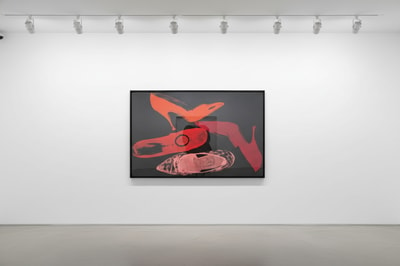
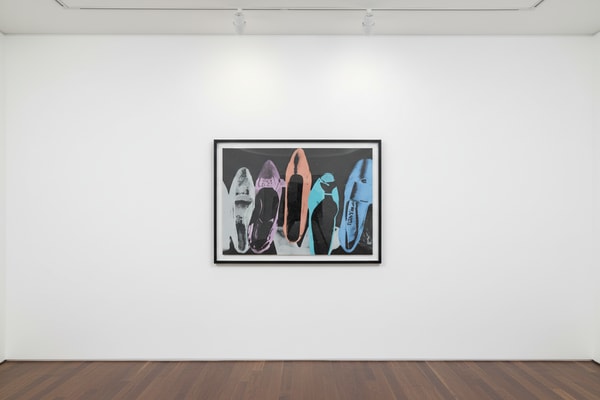
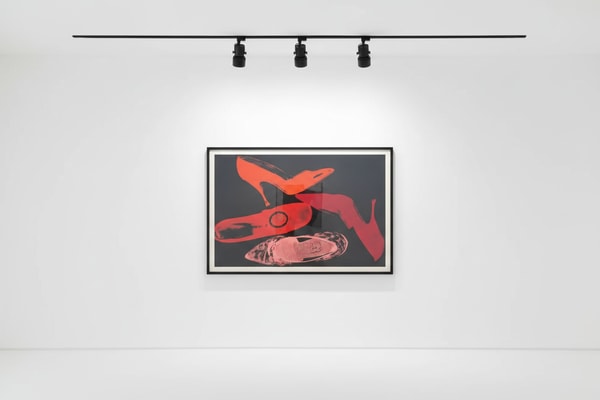
Warhol created the Diamond Dust Shoes portfolio in 1980, published by Ronald Feldman Fine Arts and Multiples, Inc. The series comprises screen prints on Arches Aquarelle paper, measuring approximately 40 x 60 inches—among his largest print formats. Each work incorporates crushed industrial diamond dust applied to the print surface, creating optical effects impossible to reproduce photographically.

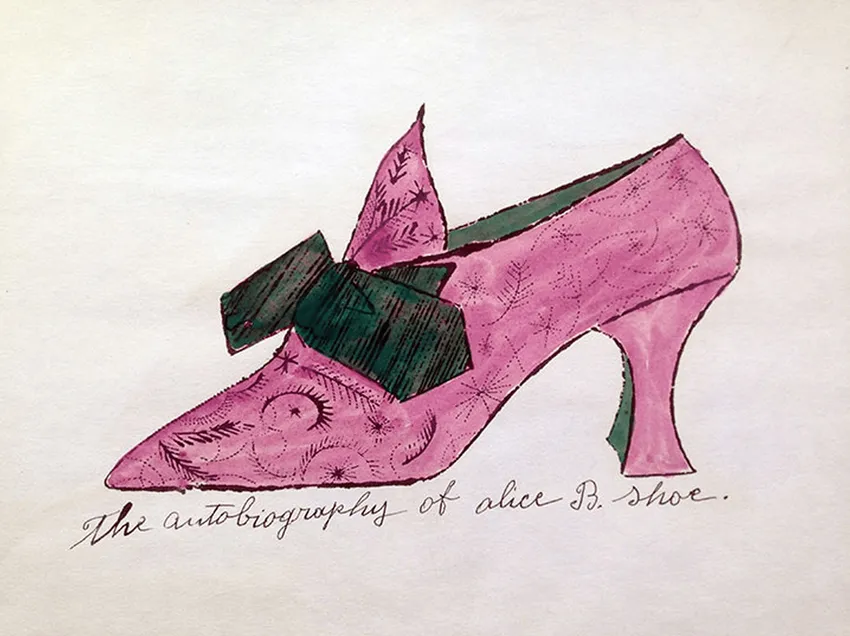
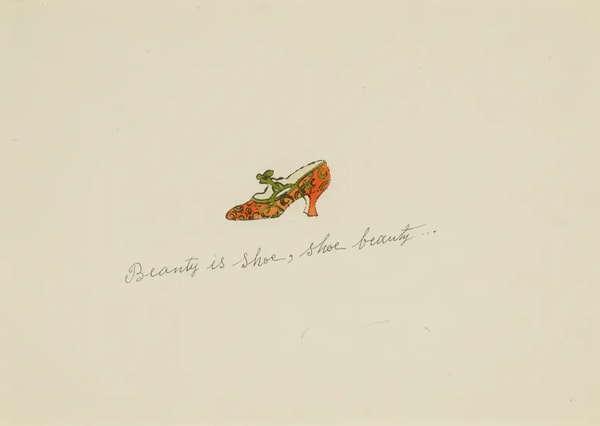
The shoe imagery references Warhol's commercial origins. Before achieving fine art recognition, he worked as an illustrator for I. Miller shoes during the 1950s, winning industry awards for his blotted-line technique. The Diamond Dust Shoes revisit this subject through the lens of his mature practice, transforming commercial footwear into glamorous, almost hallucinatory compositions.

The diamond dust application connects to Warhol's persistent interest in surface, materiality, and the transformation of ordinary objects into luxury commodities. Unlike his earlier Shoe prints from the 1950s, these works operate as pure visual opulence—the glittering surface simultaneously references consumer desire and comments upon it.

Individual Works & Collector Preferences

The series includes numbered editions alongside unique variants, each presenting distinct collecting opportunities.

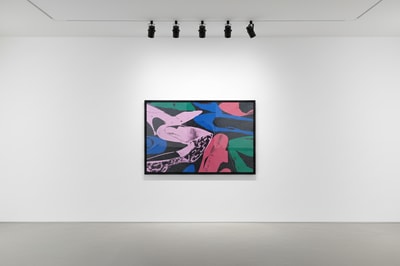
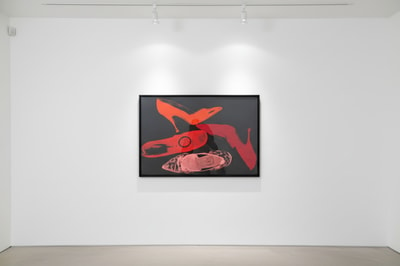
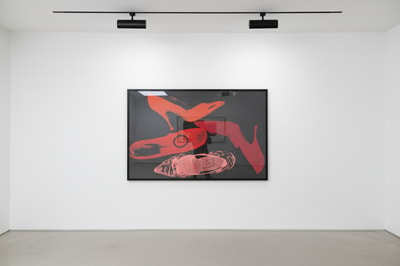
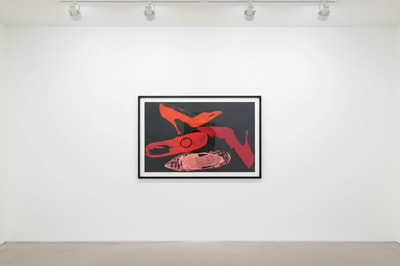
F.S. II 253, 254, 255, 256, and 257 form the core editioned portfolio. These works feature arrangements of women's shoes—pumps, heels, sandals—rendered in saturated colour combinations with diamond dust overlay. Collectors typically gravitate toward specific colourways based on installation requirements, though from a market perspective, these editions trade within comparable ranges.

Diamond Dust Shoes Black & White (Unique) represents a departure from the portfolio's chromatic intensity. This singular work translates the shoe imagery into monochromatic terms, with diamond dust creating luminosity against the stark tonal contrast. Unique works from Warhol's print practice command significant premiums; serious collectors pursue these as portfolio anchors.

Diamond Dust Shoes (Unique), an additional singular work, offers similar scarcity appeal. Both unique variants attract institutional buyers and collectors seeking differentiation from editioned holdings.

In Guy Hepner's experience, collectors acquiring multiple Warhol series often include a Diamond Dust Shoes as a textural counterpoint to flatter printed works. The physical dimensionality distinguishes these pieces in collection presentations.

Authentication & Condition Considerations

Authentication follows established Warhol print protocols. Works should appear in the Andy Warhol Catalogue Raisonné of Prints, compiled under Frayda Feldman's editorial direction, with corresponding Feldman-Schellmann reference numbers (F.S. II 253-257). The Andy Warhol Foundation for the Visual Arts maintains authentication authority, though the Foundation's authentication board closed to new submissions in 2011—making provenance documentation and catalogue raisonné inclusion essential.

Condition assessment for Diamond Dust Shoes requires specialized attention. The diamond dust application sits atop the printed surface and remains vulnerable to handling damage. Collectors should examine works under raking light to assess dust adhesion and identify any areas of loss. Even minor diamond dust displacement affects both visual presentation and market value.

Arches Aquarelle paper, while archival quality, shows foxing and toning if stored improperly. Examination of sheet edges and margins reveals storage history. Works should be framed with UV-filtering glazing and maintained at stable humidity levels.

Guy Hepner provides condition reports prepared to auction house standards for all Diamond Dust Shoes offerings.

Investment Analysis & 2026 Acquisition Strategy

The Diamond Dust Shoes occupy a productive position within Warhol's print market. They trade below the Marilyn, Mao, and Campbell's Soup portfolios in absolute terms, yet demonstrate comparable percentage appreciation over holding periods. For collectors building diversified Warhol positions, the series offers material distinction without the liquidity constraints affecting eight-figure unique works.

The 2025 auction results—consistent with 2023 pricing when adjusted for currency fluctuation—suggest market stabilisation rather than speculative volatility. Institutional collectors and family offices increasingly favour assets demonstrating this pricing predictability.

Acquisition strategy for 2026 should prioritise condition and provenance over aggressive price negotiation. Supply of exhibition-quality examples remains limited; works with minor condition issues trade at discounts that often prove difficult to recover at resale. Unique variants, when available, merit immediate consideration given their scarcity.

Collectors holding Diamond Dust Shoes should maintain comprehensive documentation, including exhibition history and publication references, to support future market positioning.

Acquire Diamond Dust Shoes Through Guy Hepner

Guy Hepner maintains rotating inventory of Diamond Dust Shoes editions and actively sources unique variants for committed collectors. Our 478 Warhol transactions across 292 collectors provide market intelligence unavailable through auction participation alone.

Contact our New York team to discuss current availability, commissioning parameters for collection placement, and acquisition timing aligned with your collecting objectives.

Andy Warhol Diamond Dust Shoes