-
The love heart is one of the most disarming and persistent symbols in Banksy’s visual language. Stripped of sentimentality and sharpened by context, it becomes less a token of romance and more a tool of emotional resistance. In Banksy’s hands, the heart is fragile, fleeting, and often under threat—yet stubbornly present.
-

-
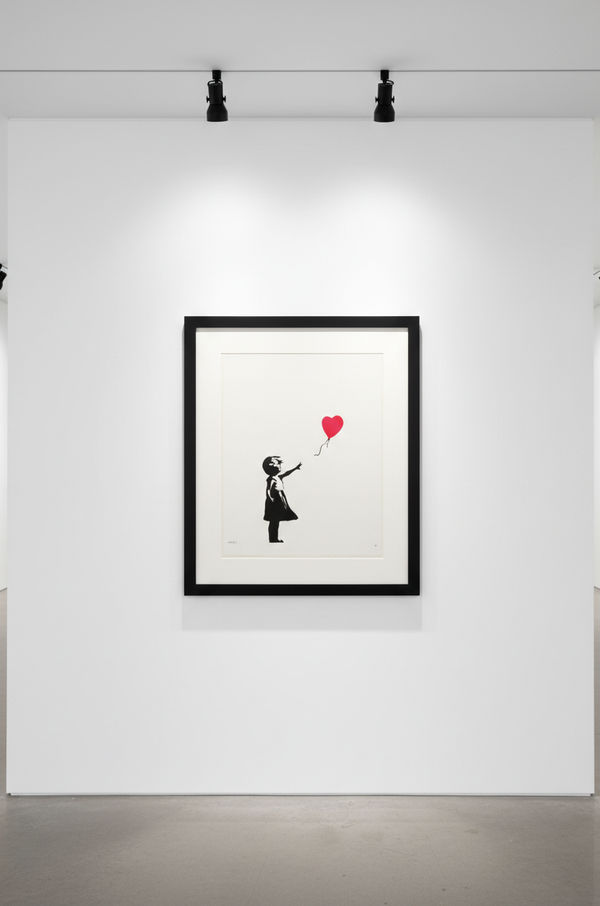
Perhaps most famously, the heart appears as a balloon, slipping from a child’s grasp. This image captures a central tension in Banksy’s work: the collision between innocence and loss, hope and inevitability. The heart floats just out of reach, symbolising ideals—love, freedom, optimism—that are easily lost in a world shaped by politics, conflict, and control. It is not naïve hope, but hard-won hope, defined by its vulnerability.
-
-
Elsewhere, the heart is implied rather than literal, embedded in acts of defiance. When aggression is replaced with tenderness, or protest with poetry, the heart becomes a quiet counterforce to violence and authority. Banksy repeatedly positions love as an alternative form of power—one that does not dominate, but endures. This inversion is key: love is not weak, it is radical.
-
-
-
Crucially, the simplicity of the heart allows Banksy’s message to travel. Universally legible and emotionally immediate, it bypasses language, borders, and class. Yet its meaning is never fixed. Depending on setting, scale, and moment, the heart can signify loss, protest, remembrance, or belief in change. This openness is intentional. By using such a familiar symbol, Banksy invites the viewer in—then asks them to confront what love means in a fractured, surveilled, and often indifferent world.
-
Ultimately, Banksy’s use of the love heart endures because it refuses closure. It is never a neat resolution or a comforting answer, but a question left hanging in public space—what do we protect, what do we allow to slip away, and what are we still willing to believe in? By placing the heart in moments of tension, uncertainty, and quiet rebellion, Banksy reminds us that love is not passive sentiment, but an active choice. In a world shaped by conflict, control, and spectacle, the heart becomes a final, stubborn act of humanity—small, exposed, and impossibly powerful.