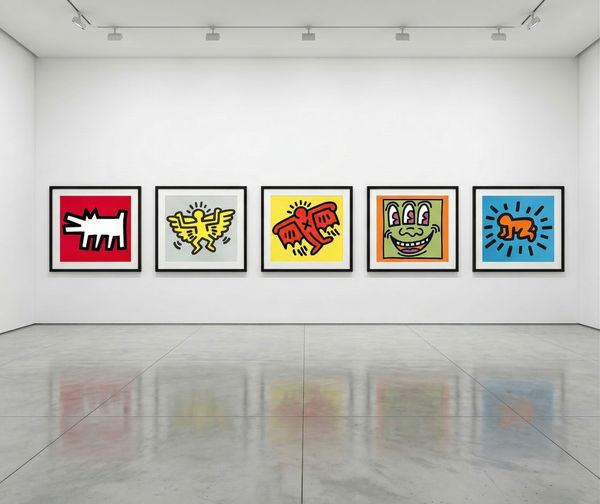
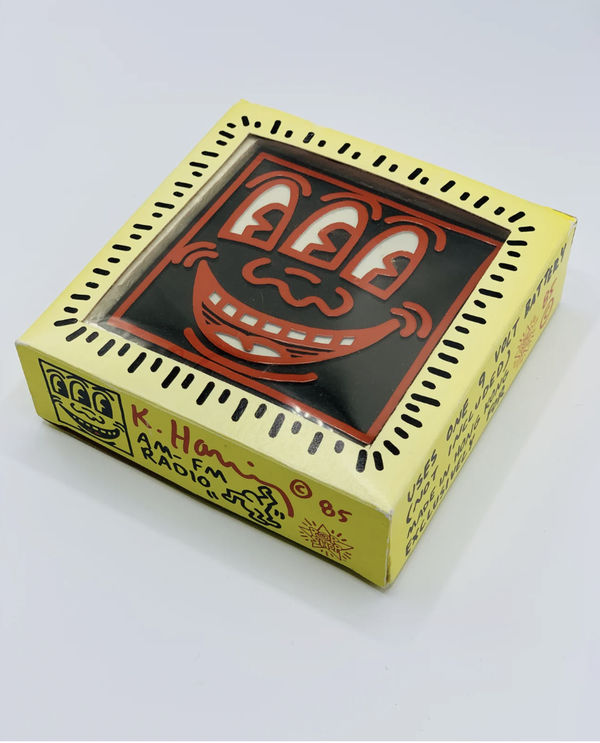
Haring's distinctive artistic vocabulary found perfect expression in the Keith Haring Pop Shop format. His signature style—continuous black outlines forming dancing figures, barking dogs, radiant babies, and flying saucers—translated seamlessly from subway walls to commercial products. The artist's hieroglyphic-inspired symbols carried universal meanings: the radiant baby represented purity and potential, the barking dog suggested loyalty and protection, while dancing figures embodied joy and movement.

The Pop Shop aesthetic maintained Haring's commitment to bold, vibrant colors and simplified forms. Each design utilized his characteristic technique of continuous line drawing, creating images that were immediately recognizable and emotionally accessible. This visual consistency across different media—from t-shirts to posters to buttons—established a cohesive brand identity that reinforced Haring's artistic philosophy.

    • Keith Haring Retrospect (Littmann PP. 120-121), 1989
      Keith Haring
      Retrospect (Littmann PP. 120-121), 1989
    • Keith Haring Icons (Littmann PP. 170-171), 1990
      Keith Haring
      Icons (Littmann PP. 170-171), 1990
    • Keith Haring Pop Shop Quad I (Littmann PP. 81), 1987
      Keith Haring
      Pop Shop Quad I (Littmann PP. 81), 1987
    • Keith Haring Pop Shop Quad II (Littmann PP. 94-95), 1988
      Keith Haring
      Pop Shop Quad II (Littmann PP. 94-95), 1988
    • Keith Haring Pop Shop Quad III (Littmann PP. 142), 1989
      Keith Haring
      Pop Shop Quad III (Littmann PP. 142), 1989
    • Keith Haring Pop Shop Quad IV (Littmann PP. 142), 1989
      Keith Haring
      Pop Shop Quad IV (Littmann PP. 142), 1989
    • Keith Haring Pop Shop Quad V (Littmann PP. 143) , 1989
      Keith Haring
      Pop Shop Quad V (Littmann PP. 143) , 1989
    • Keith Haring Pop Shop Quad VI (Littmann PP. 143), 1989
      Keith Haring
      Pop Shop Quad VI (Littmann PP. 143), 1989
    • Keith Haring Pop Shop I (D) (Littmann PP. 83) , 1987
      Keith Haring
      Pop Shop I (D) (Littmann PP. 83) , 1987
    • Keith Haring Pop Shop II (D) (Littmann PP. 97), 1988
      Keith Haring
      Pop Shop II (D) (Littmann PP. 97), 1988
    • Keith Haring Pop Shop III (A) (Littmann PP. 144) , 1989
      Keith Haring
      Pop Shop III (A) (Littmann PP. 144) , 1989
    • Keith Haring Pop Shop V (C) (Littmann PP. 149) , 1989
      Keith Haring
      Pop Shop V (C) (Littmann PP. 149) , 1989
    • Keith Haring Pop Shop IV (B) (Littmann PP. 146), 1989
      Keith Haring
      Pop Shop IV (B) (Littmann PP. 146), 1989
    • Keith Haring Pop Shop Rado, 1986
      Keith Haring
      Pop Shop Rado, 1986
    • Keith Haring Pop Shop Poster, 1986
      Keith Haring
      Pop Shop Poster, 1986
  • The View

    The market for Keith Haring Pop Shop items reflects both nostalgic appeal and art historical significance. Vintage pieces, particularly rare...

    The market for Keith Haring Pop Shop items reflects both nostalgic appeal and art historical significance. Vintage pieces, particularly rare designs or items in excellent condition, command premium prices among collectors who value their connection to Haring's democratic artistic vision.

    The auction performance of Pop Shop works has shown consistent strength, underpinned by global recognition, strong liquidity, and broad collector demand. Conceived as a democratic extension of Haring’s practice, Pop Shop imagery distilled his visual language into bold, instantly legible symbols that have aged remarkably well in the auction market. These works frequently meet or exceed estimates, attracting competitive bidding from both established collectors and new entrants seeking iconic imagery with proven resale confidence.

    Their appeal lies in clarity and scarcity: while widely recognised, high-quality examples in strong condition remain limited. As a result, demand continues to outpace supply. From a collecting perspective, Pop Shop works sit at a strategic intersection of accessibility and importance. They represent a core chapter in Haring’s philosophy of art as public communication, while offering a comparatively attainable entry point into blue-chip post-war collecting. This balance of cultural significance, visual impact, and market resilience makes Pop Shop works a compelling and enduring addition to any serious collection.