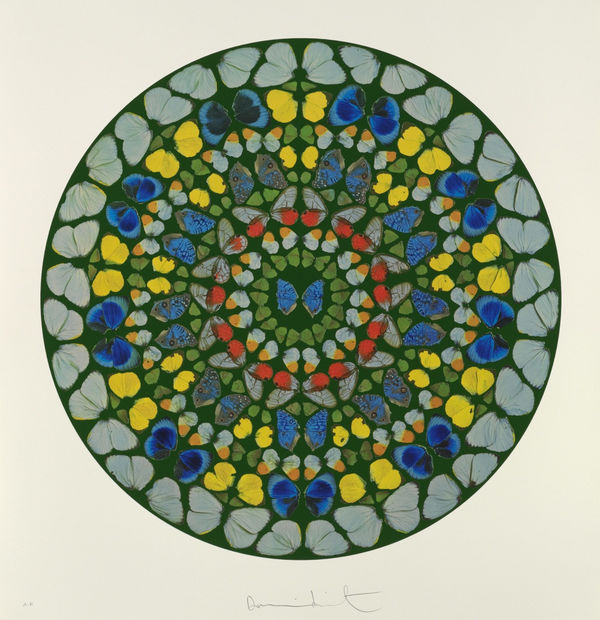
Damien Hirst is one of the most influential and polarizing figures in contemporary art. Emerging from London’s Young British Artists movement in the late 1980s, Hirst redefined what it meant to shock, provoke, and engage with the realities of life and death. His practice spans installation, painting, sculpture, and conceptual work - often centering on themes of mortality, faith, science, and desire. From the formaldehyde-preserved animals of his early years to his diamond-encrusted skull For the Love of God and his vividly systematic “Spot Paintings,” Hirst transforms the clinical and the commercial into meditations on existence, materialism, and meaning. His works blur the line between the sacred and the sensational, balancing scientific precision with emotional immediacy.
Hirst’s market presence is as formidable as his artistic vision. He famously bypassed traditional gallery models with his 2008 Sotheby’s sale Beautiful Inside My Head Forever, which grossed over $198 million in a single night - solidifying his reputation as both artist and market disruptor. His works have consistently commanded high prices at auction, with major sales including Lullaby Spring and The Physical Impossibility of Death in the Mind of Someone Living. While his market has experienced fluctuations, Hirst’s name recognition, institutional support, and cultural ubiquity have kept him firmly embedded in the upper tier of the contemporary art economy. Collectors value his ability to fuse conceptual rigor with aesthetic appeal, and his work remains highly liquid within the global secondary market.
Beyond the headlines and spectacle, Hirst’s enduring artistic value lies in his unflinching exploration of the human condition. His practice invites viewers to confront their own fears, desires, and contradictions - turning death into a mirror for life, and commerce into a commentary on faith. Whether revered or criticized, Hirst has achieved what few artists manage: to create a visual language that transcends trends and generations. His work continues to hold weight not only as a cultural statement but also as a tangible asset - where intellectual depth meets the undeniable magnetism of contemporary art’s most iconic provocateur.
-
-
-
Why Should Collectors Consider Damien Hirst?