
Market Lessons for Prints, Portfolios, and Works on Paper
In May, Sotheby’s will bring a remarkable group of works to auction from the collection of the late dealer and financier Robert Mnuchin. The sale is expected to exceed $130 million and is led by two paintings by Mark Rothko—Brown and Blacks in Reds (1957), estimated at $70–100 million, and another work from 1949 estimated at $15–20 million.
At first glance, a $100 million Rothko may appear far removed from the market for Keith Haring prints or works on paper. But serious collectors understand that auctions like this are not simply about headline prices. They reveal how the art market evaluates quality, rarity, provenance, and historical importance.
For collectors operating in the $50,000–$500,000 range—the level where much of the serious Haring market sits—the lessons are remarkably applicable.
Whether acquiring a rare sumi ink drawing, a complete print portfolio, or an individual iconic image, the same forces that drive blue-chip painting sales shape the long-term value of works by Keith Haring.
Understanding these principles can help collectors make more strategic decisions in a market that continues to grow in both cultural importance and financial strength.
The Power of the “A” Work
One of the defining characteristics of the Mnuchin collection is its uncompromising focus on quality. Mnuchin did not attempt to collect broadly—he focused on acquiring the very best examples within an artist’s production. This philosophy is directly relevant to the Haring market.
Within Haring’s body of work there is a clear hierarchy between images that fully embody his visual language and those that are more experimental or transitional. Collectors consistently gravitate toward works that feature the imagery most closely associated with the artist’s legacy.
These include:
-
The Radiant Baby
-
Barking Dog
-
Angel figures
-
Dancing figures
-
Flying saucers
-
Pyramids
-
Interlocking human forms
The Radiant Baby, which first appeared in Haring’s early subway drawings, became the most recognizable symbol of the artist’s work, representing energy, innocence, and human potential.
Similarly, the barking dog—one of Haring’s most recurring motifs—symbolizes alertness, rebellion, and social awareness, embodying the artist’s critique of authority and power structures.
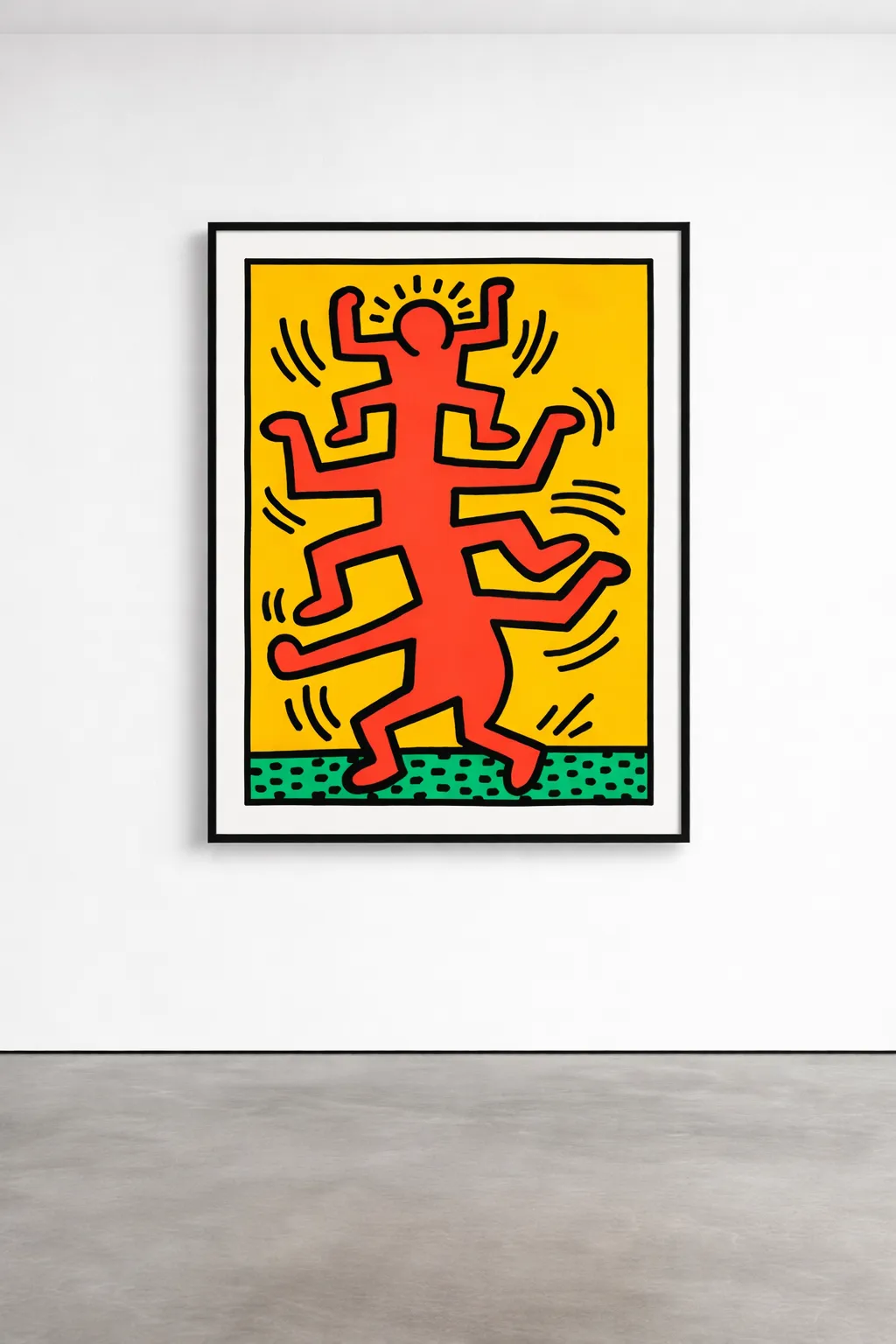
Collectors often notice that works featuring these symbols tend to hold stronger demand across both the primary and secondary markets. The reason is simple: these images represent the core visual DNA of the artist. In the same way that collectors prioritize the most powerful Rothko compositions, Haring collectors tend to focus on works that most clearly articulate the artist’s iconic visual language.
Case Study: The Icons Portfolio
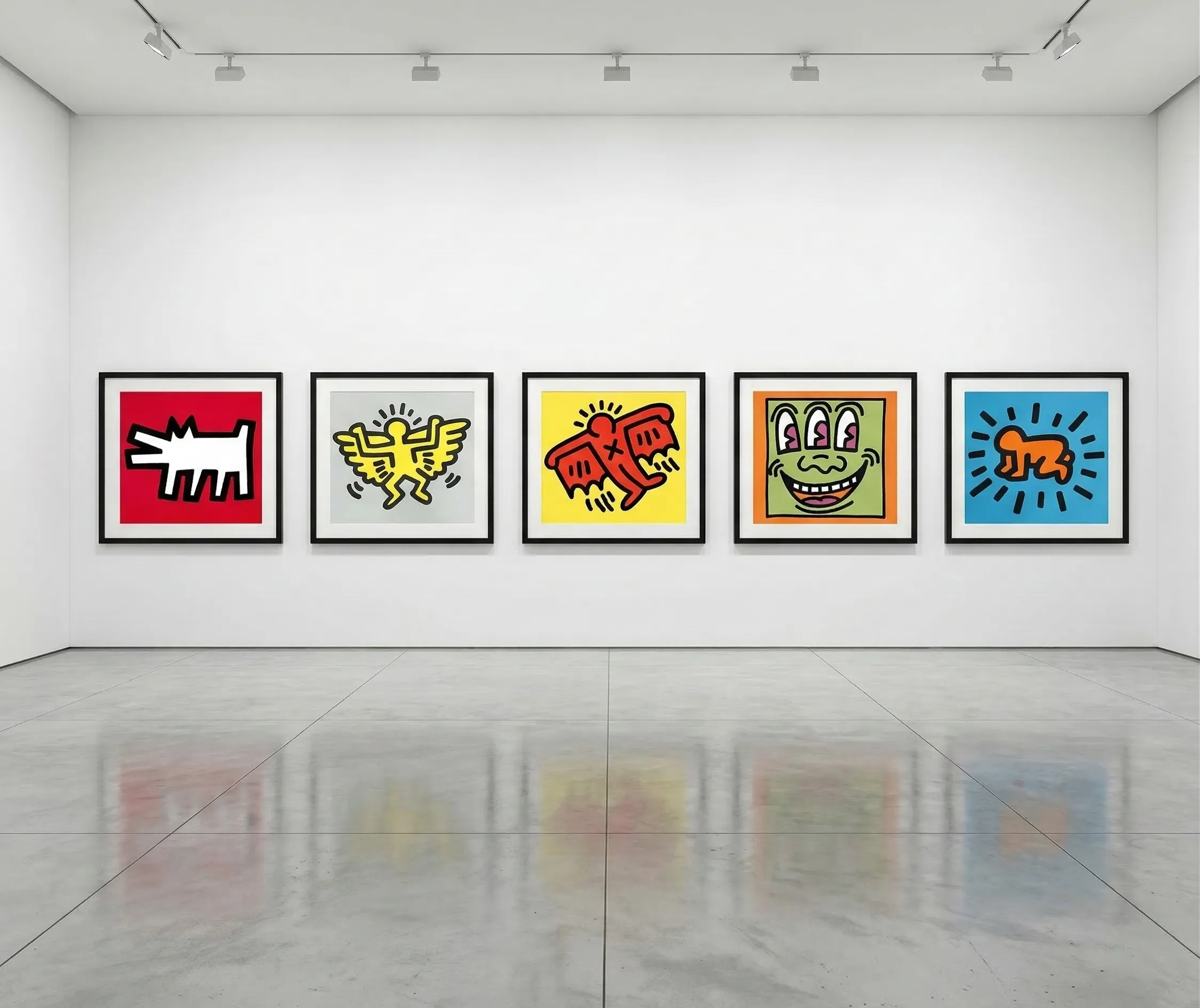
A powerful example of this principle can be seen in Haring’s Icons portfolio, produced in 1990.
The portfolio isolates five of the artist’s most famous symbols—the Radiant Baby, Barking Dog, Angel, Three-Eyed Monster, and Flying Devil—each rendered in bold colors and thick black lines.
Unlike more complex narrative compositions, these prints present the motifs individually, almost like visual emblems. For collectors, this clarity of imagery is extremely important. Each print functions almost like a distilled essence of Haring’s artistic language. Rather than telling a full story, the images present the symbols that defined his career. In many ways, they operate like Warhol’s Marilyn or Campbell’s Soup Can paintings—visual shorthand for an entire artistic movement.
Collectors often find that works featuring this level of iconic imagery maintain consistent demand across generations.
Narrative Through Portfolios
While individual images can hold strong market value, Haring’s portfolios reveal another important dimension of his work: storytelling.
Several of the most desirable Haring print portfolios function almost like visual narratives. Each individual image acts as a vignette within a larger conceptual framework. One example is the Growing portfolio from 1988.
In this suite of five screenprints, Haring depicts human figures climbing, merging, and stacking upon one another in rhythmic compositions. The figures appear to grow organically, intertwining in ways that evoke ideas of community, evolution, and collective energy. Each print can stand alone visually. But when viewed together, the works form a broader meditation on growth—both biological and social. For collectors, this narrative dimension often adds an intellectual depth that increases long-term desirability.
A single print might function as a striking artwork, but a complete portfolio offers something more: a cohesive artistic statement.
The Fertility Suite: Art as Activism
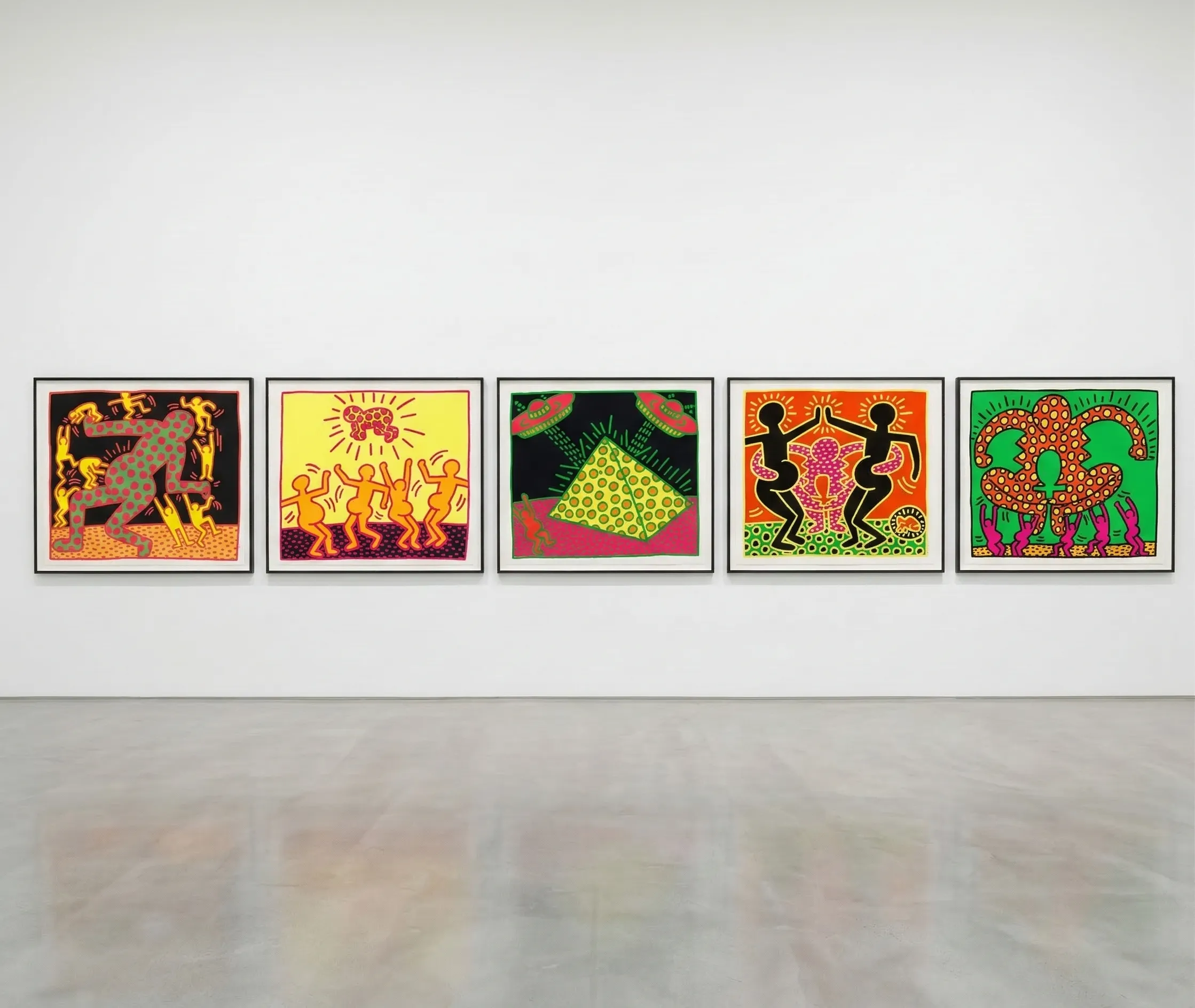
Another example of this narrative approach can be seen in the Fertility Suite from 1983.
The portfolio depicts pregnant figures rendered in Haring’s signature matchstick style, often shown in ritualistic or communal formations.
Created during the early years of the AIDS crisis, the suite reflects Haring’s growing engagement with social activism and public health awareness. The works reference the impact of the HIV/AIDS epidemic and its effects on vulnerable communities.
For collectors, works that intersect with major cultural or political moments often carry additional historical weight. Just as certain Rothko paintings represent pivotal moments within Abstract Expressionism, portfolios like Fertility capture the moment when Haring’s art became explicitly tied to activism and global social issues. This kind of historical context often strengthens the long-term significance of a work.
Composition and Energy: The Pop Shop Quads
Haring’s Pop Shop Quads offer a different perspective on his visual language. These works combine four separate panels into a single composition, bringing together many of Haring’s recurring symbols within one energetic arrangement. Radiant babies, barking dogs, dancing figures, and abstract symbols collide across the four panels, creating compositions that feel almost musical in their rhythm and movement. Unlike the isolated symbols of the Icons portfolio, the Pop Shop Quads emphasize interaction between figures.
This sense of movement and interconnectedness reflects one of Haring’s central themes: the idea that human beings exist within dynamic networks of social energy. For collectors, these compositions often appeal because they contain multiple iconic elements within a single work. Rather than choosing between motifs, the collector acquires a work that reflects the full complexity of Haring’s visual language.
Scarcity and the Importance of Complete Sets
One of the key lessons from high-end auctions like the Mnuchin sale is that scarcity drives value. The most valuable works are not only important—they are difficult to replace.The same principle applies to Haring portfolios. Over time, many portfolios become separated as individual prints are sold independently. As a result, complete sets become increasingly rare.For collectors, the acquisition of a full portfolio offers several advantages:
- First, it preserves the conceptual integrity of the work.
- Second, it creates a more compelling narrative within a collection.
- Third, it introduces scarcity that may not exist when works are sold individually.
This is particularly true for portfolios produced in relatively small editions. As these prints enter collections around the world, intact sets become increasingly difficult to assemble. Collectors who prioritize completeness are often rewarded with stronger long-term demand.
Works on Paper: Direct Access to the Artist’s Hand
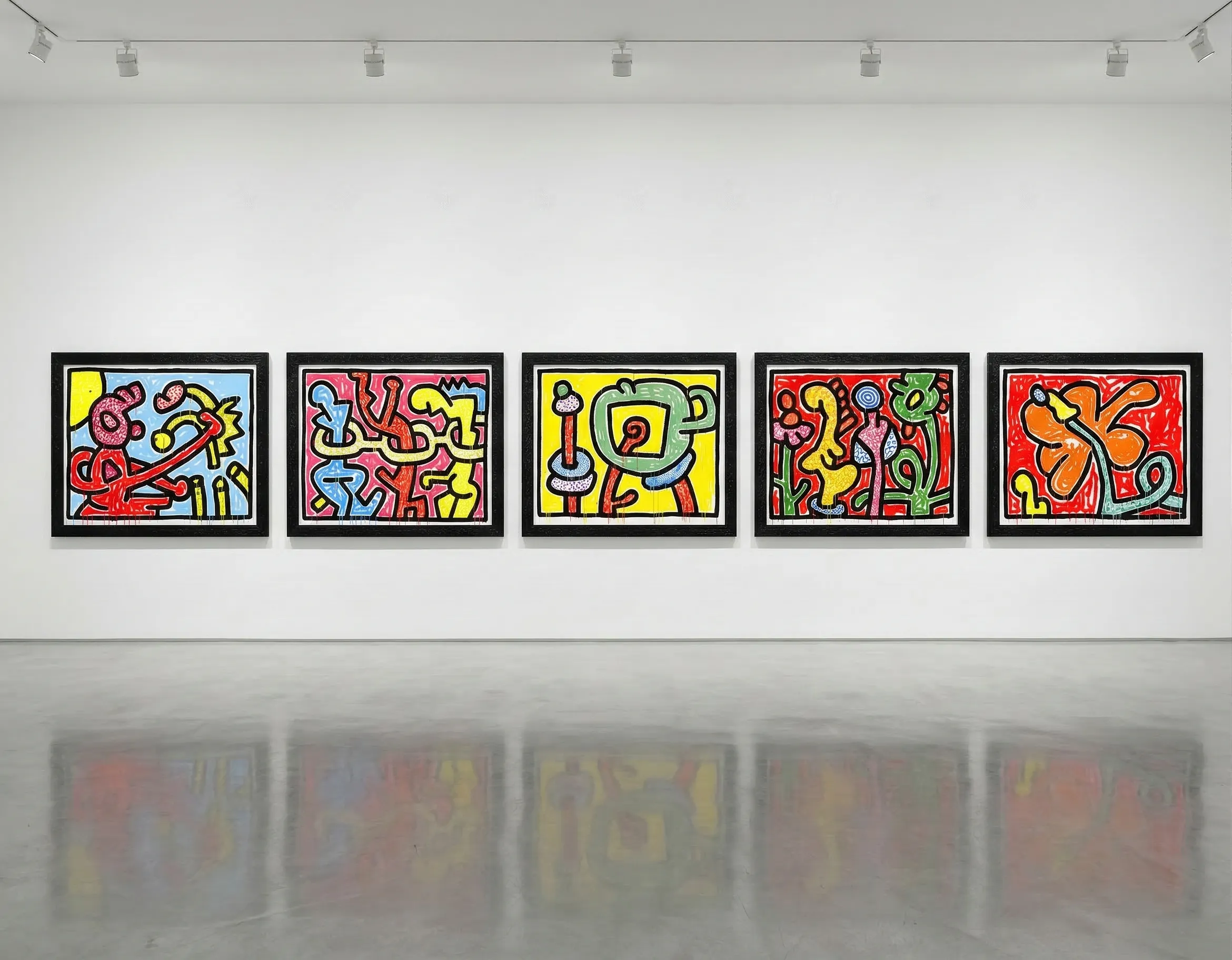
Beyond prints, one of the most compelling areas of the Haring market lies in works on paper.
Haring was a remarkably prolific draftsman. Many of his most powerful compositions began as rapid drawings executed in marker or sumi ink. These works possess a raw immediacy that is sometimes softened in the translation to print. The fluidity of Haring’s line—the speed, the rhythm, the sense of movement—becomes especially visible in these drawings.
Sumi ink drawings are particularly sought after.
Executed with brush and ink on paper, they reveal the influence of East Asian calligraphy on Haring’s practice. The brushstroke becomes both drawing and gesture, transforming the figure into a kind of visual calligraphy.
Because these works were often created quickly and sometimes on fragile paper, survival rates are relatively limited.
As a result, strong examples—particularly those featuring iconic imagery—have become increasingly desirable.
Provenance: The Silent Multiplier
Another important lesson from the Mnuchin collection is the importance of provenance. When works emerge from a respected collection, buyers feel greater confidence in their authenticity, quality, and historical significance.
In the Haring market, strong provenance may include:
- Early acquisition from Tony Shafrazi Gallery
- Direct purchase during the artist’s lifetime
- Documentation connecting the work to exhibitions or publications
- Acquisition from the Keith Haring Foundation
Collectors who prioritize well-documented works often find that these pieces hold stronger appeal when they eventually return to the market.

Condition: An Often Overlooked Factor
Condition plays an especially important role in the market for works on paper. Unlike paintings, works on paper are more susceptible to environmental damage.Common issues include:
- Light fading
- Paper discoloration
- Foxing
- Creases or edge wear
- Improper framing
Two prints from the same edition may differ dramatically in value depending on condition. Collectors who focus on well-preserved examples—especially those that have been professionally framed with archival materials—are far more likely to see sustained demand.
The $50K Market: Where Serious Collecting Begins
While the art market often focuses on eight-figure paintings, much of the most active collecting takes place in the $50,000–$250,000 range. This is the level where collectors begin building coherent collections rather than making isolated purchases. Within the Haring market, this price range includes:
-
Iconic individual prints
-
Key works from major portfolios
-
Smaller works on paper
-
Select rare editions
A Market Built on Cultural Power
Perhaps the most important factor underpinning Haring’s market is cultural relevance. Few artists have created a visual language as universally recognizable as Haring’s. His bold lines, simplified figures, and energetic compositions emerged from the streets of New York in the early 1980s, where he used empty advertising panels in subway stations as his canvas. The images spread rapidly throughout the city, becoming symbols of a generation defined by music, activism, and urban culture. More than three decades after his death, those images remain deeply embedded in global visual culture. Iconic imagery does not fade easily.

The Long-Term View
Major auctions often serve as reminders of how the art market ultimately rewards patience and quality. The collectors who achieve the greatest success are rarely those chasing short-term trends. They are the ones who focus on acquiring exceptional works—pieces that embody the artist’s vision, historical importance, and visual power.
Whether acquiring a single iconic print, a complete portfolio, or a rare work on paper, the same principles that drive $100 million Rothko sales also shape the market at the $50,000 level.
- Focus on the strongest imagery.
- Prioritize rarity and completeness.
- Seek works with clear provenance and strong condition.
Above all, collect works that capture the energy and vision that made Keith Haring one of the most important artists of the twentieth century. Because in the end, the works that truly define an artist are the ones that collectors return to again and again.
Explore signed Keith Haring prints for sale and contact our gallery via info@guyhepner.com for further information. Looking to sell? We can help! Find out how to sell Keith Haring prints with Guy Hepner. Read more about Keith Haring in our articles on Keith Haring most expensive artworks, Guide to Collecting Keith Haring and Keith Haring's most popular works.