
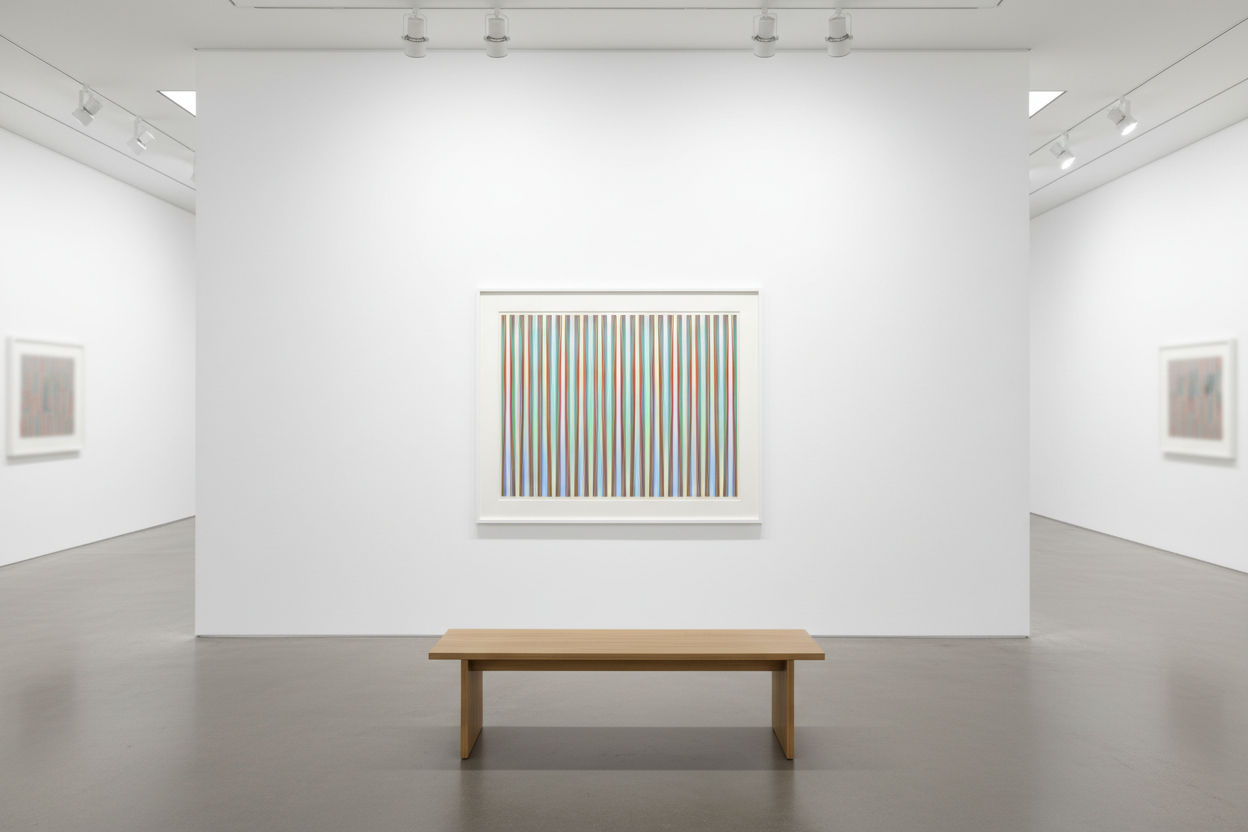
Bridget Riley Stripes represent one of the most revolutionary developments in post-war British art, establishing the visual vocabulary that would define the Op Art movement. Through her meticulous use of parallel lines, geometric precision, and optical phenomena, Riley transformed simple stripes into complex perceptual experiences that challenge how we see and understand visual space.
Riley's approach to Bridget Riley Stripes emerged from her deep study of Georges Seurat's Pointillist techniques and her fascination with the science of perception. Beginning in the early 1960s, she developed a systematic method of creating optical effects through the careful manipulation of line width, spacing, and rhythm. These works demonstrate how fundamental geometric elements can generate profound visual sensations—movement, vibration, and spatial depth—without relying on traditional perspective or modeling.
The technical mastery behind Bridget Riley Stripes reveals Riley's extraordinary understanding of visual perception. Each composition is precisely calculated, with every line measured and positioned to create specific optical effects. Riley works with assistants to execute these large-scale paintings, but every decision about spacing, width, and curvature originates from her detailed preparatory drawings and color studies.
The Evolution of Bridget Riley Stripes
The development of Bridget Riley Stripes spans over five decades, evolving from her early black-and-white works to her vibrant color compositions. Her breakthrough painting "Movement in Squares" (1961) established the foundation for her stripe investigations, but it was works like "Blaze 1" (1962) and "Current" (1964) that fully realized the potential of linear repetition to create optical movement.
During the 1960s, Riley's black-and-white Bridget Riley Stripes gained international recognition, particularly through her inclusion in the seminal "The Responsive Eye" exhibition at the Museum of Modern Art in 1965. These monochromatic works demonstrated how contrast and rhythm alone could generate powerful visual effects, establishing Riley as a leading figure in the Op Art movement.
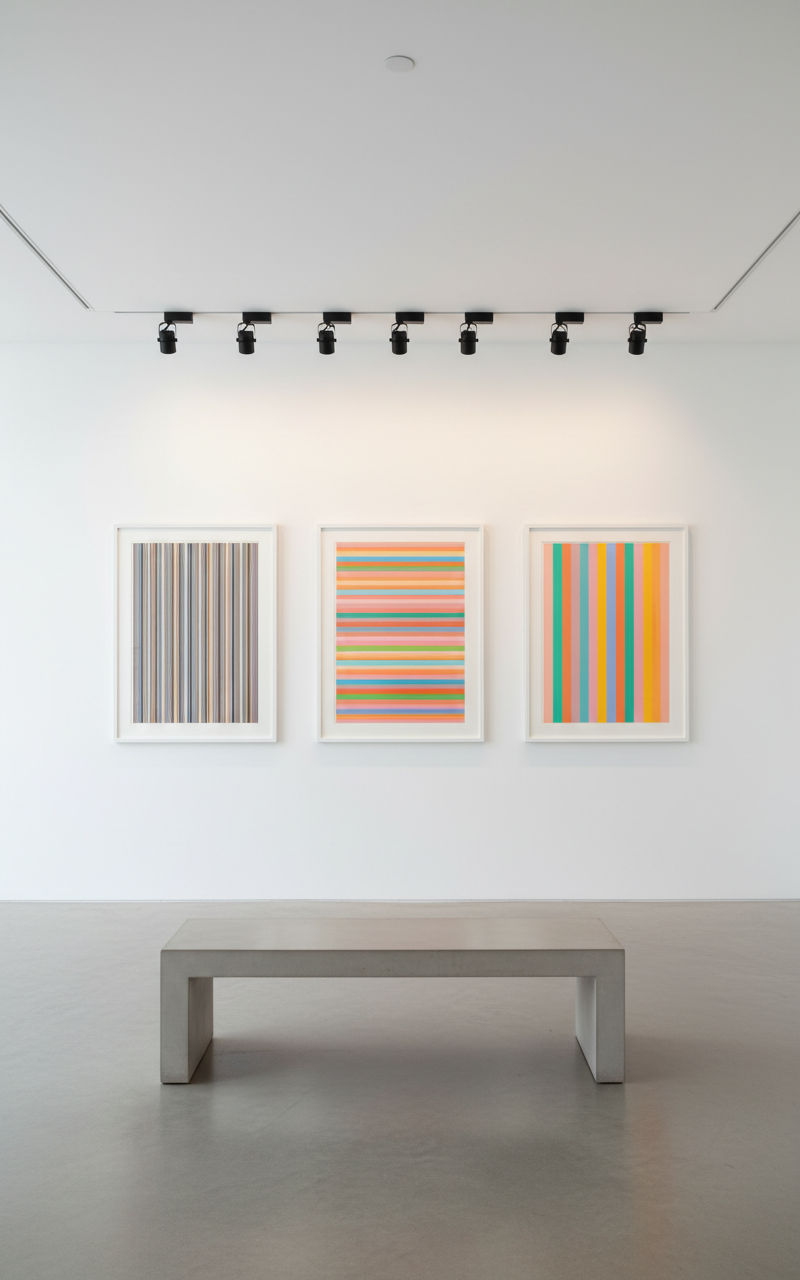
The introduction of color in the 1970s marked a significant evolution in Bridget Riley Stripes. Works from series like "Nineteen Greys" and her Egyptian-inspired color investigations showed how chromatic relationships could enhance the optical effects achieved through linear structure. Riley's color stripes maintain the same rigorous systematic approach while introducing new dimensions of visual complexity.
Collecting Bridget Riley Stripes: Authentication and Editions
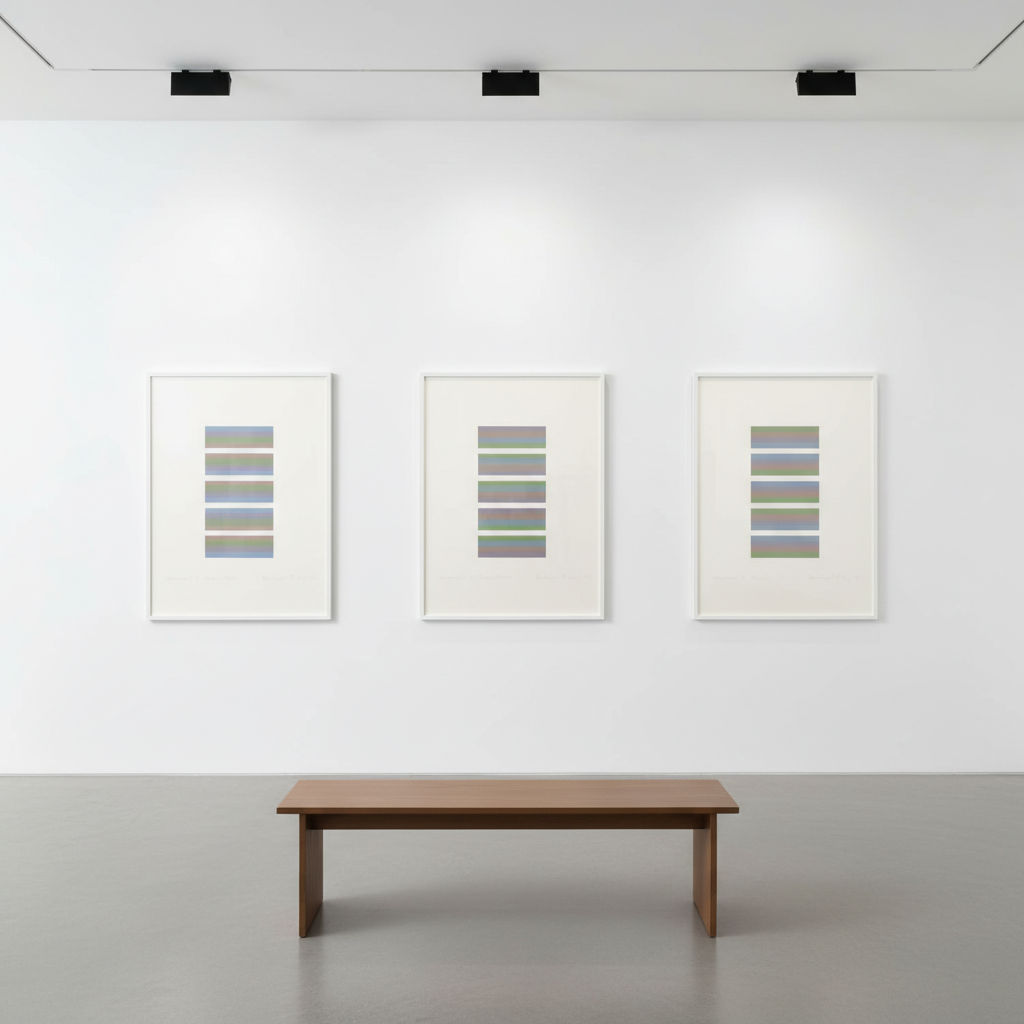
For collectors interested in Bridget Riley Stripes, authentication represents a critical consideration. Riley's systematic working methods and the involvement of assistants in execution make provenance documentation essential. The artist maintains detailed records of all works, and authentic pieces should be accompanied by proper documentation from recognized sources.
Riley's print editions of Bridget Riley Stripes offer collectors access to her optical investigations in multiple media. Her screenprints, published by institutions like Petersburg Press and Karsten Schubert, maintain the precision and visual impact of her paintings while making her work accessible to a broader collecting base. These editions are carefully supervised by the artist and produced to exacting standards.
The market for Bridget Riley Stripes reflects sustained institutional and collector interest. Major museums worldwide house examples of her stripe works, including the Tate Modern, the Museum of Modern Art, and the Centre Pompidou. This institutional validation, combined with Riley's continued productivity and international exhibition record, has established a stable collector base for her optical investigations.
Contemporary collectors are particularly drawn to the way Bridget Riley Stripes function both as historical documents of the Op Art movement and as contemporary investigations into perception and visual experience. The works' ability to generate immediate, physical responses in viewers makes them compelling for both private and institutional collections.
The Lasting Impact of Riley's Linear Investigations
The influence of Bridget Riley Stripes extends far beyond the Op Art movement, informing contemporary discussions about digital art, virtual reality, and interactive media. Riley's understanding of how simple geometric elements can generate complex perceptual experiences anticipates many developments in technology-based art, while her systematic approach to color and form continues to influence painters worldwide.
Riley's stripe works also demonstrate the continuing relevance of painting as a medium for investigating fundamental questions about vision and perception. In an era dominated by digital imagery, Bridget Riley Stripes offer direct, physical encounters with optical phenomena that cannot be replicated through reproduction or digital display.
The enduring appeal of these works lies in their ability to generate fresh visual experiences with each viewing. Unlike representational art, which can become familiar through repeated exposure, Bridget Riley Stripes maintain their capacity to surprise and engage viewers through their systematic manipulation of perception.
Frequently Asked Questions
What makes Bridget Riley Stripes different from other geometric art?
Bridget Riley Stripes are distinguished by their systematic investigation of optical effects through precise manipulation of line, spacing, and rhythm. Unlike decorative geometric patterns, Riley's stripes are calculated to generate specific perceptual experiences—movement, vibration, spatial depth—through the science of vision. Each work represents a unique experiment in how simple elements can create complex visual sensations.
How can collectors authenticate Bridget Riley stripe works?
Authentication of Riley's works requires proper provenance documentation from recognized galleries, auction houses, or the artist's representatives. Riley maintains detailed records of all works, and authentic pieces should include documentation of their creation process, exhibition history, and chain of ownership. The systematic nature of her working methods makes detailed documentation particularly important for verification.
What should collectors know about caring for optical art?
Riley's stripe works require careful attention to lighting and display conditions, as the optical effects depend on proper illumination. Works should be displayed in stable lighting conditions away from direct sunlight, and the viewing distance should allow the optical effects to function properly. Conservation of these works requires specialists familiar with Riley's materials and techniques.
The significance of Bridget Riley Stripes in contemporary art cannot be overstated. These works represent a unique fusion of artistic intuition and scientific investigation, creating a body of work that continues to challenge and engage viewers decades after their creation. For collectors, they offer the opportunity to own pieces that are both historically significant and perpetually surprising in their visual effects.
Guy Hepner in New York and London has extensive experience with Bridget Riley works and can assist collectors seeking pieces from this series.
