
Why does Banksy use love hearts? The question points to the tension that sits at the centre of his work. Few artists have taken such a universally recognisable symbol and loaded it with as much emotional and political complexity. In Banksy’s hands, the heart is never decorative. It becomes a device for examining how love, empathy, and vulnerability survive in a world shaped by violence, consumerism, and social fracture.
Banksy’s visual language relies on clarity, speed, and contrast. His stencil technique, developed out of necessity during illegal street interventions, allows him to communicate instantly while retaining precision and nuance. The heart motif recurs throughout his practice, sometimes as a focal point, sometimes embedded within a wider scene, but always in service of a broader critique. What looks simple at first glance rarely is.
The Heart as Strategy
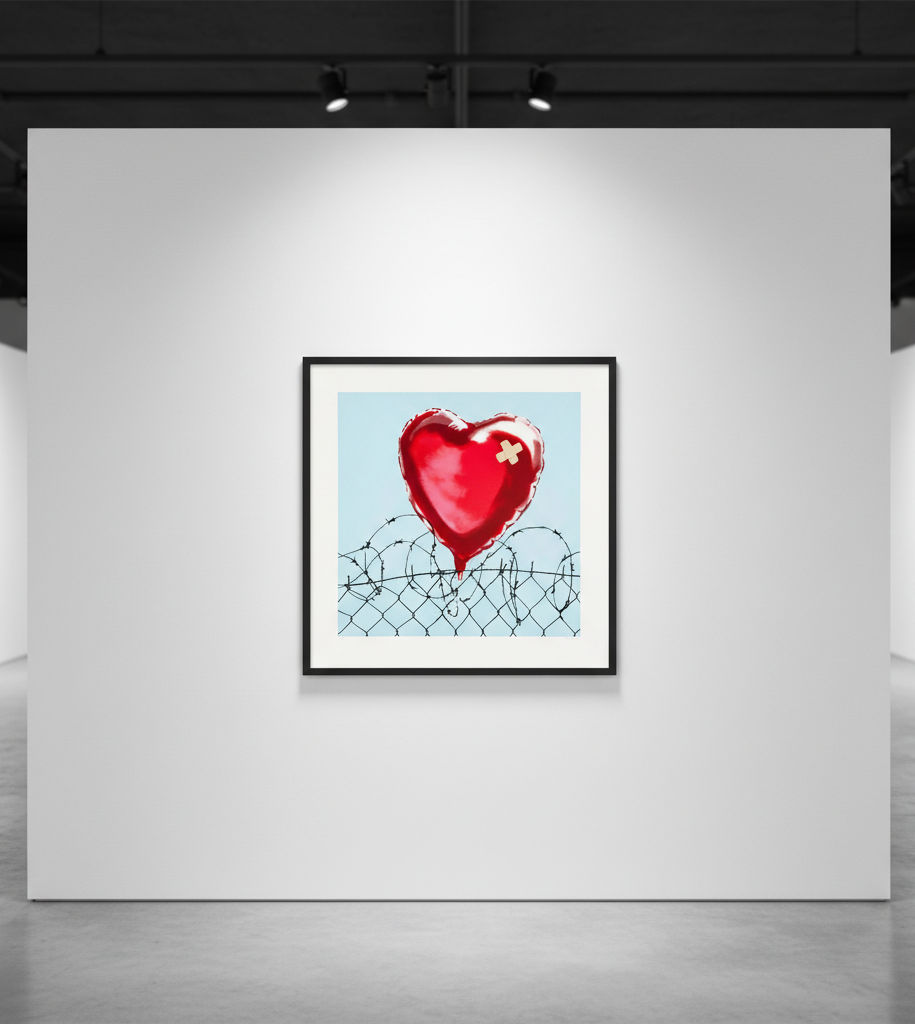
To understand Banksy’s use of hearts, it helps to see them as instruments rather than expressions. They are not sentimental gestures but tools of irony. In works such as Love Hurts, a heart wrapped in bandages and pierced by an arrow becomes a meditation on emotional damage and endurance. Banksy has described the image as a reflection on surviving heartbreak, an image that feels intimate on the surface, yet resonates far beyond personal experience.
This approach runs throughout his work. Hearts act as familiar entry points, disarming viewers before delivering something more unsettling. The symbolism is instantly legible, which allows the message to circulate widely, but the context complicates its meaning. Banksy understands that recognisable imagery travels further than overt political slogans, particularly in public space.
That strategy is visible in works related to , where gestures associated with protest and violence are softened, or sharpened, by symbols of affection. The collision of these ideas forces a reconsideration of how resistance, aggression, and compassion coexist. The heart becomes a quiet provocation rather than a declaration.
Subversion Through Familiar Symbols
The meaning of hearts in Banksy’s work operates on several levels at once. They represent love, care, and emotional openness, but they are consistently shown under threat, wounded, displaced, or compromised. By pairing an innocent symbol with darker realities, Banksy exposes the contradictions embedded in contemporary life.
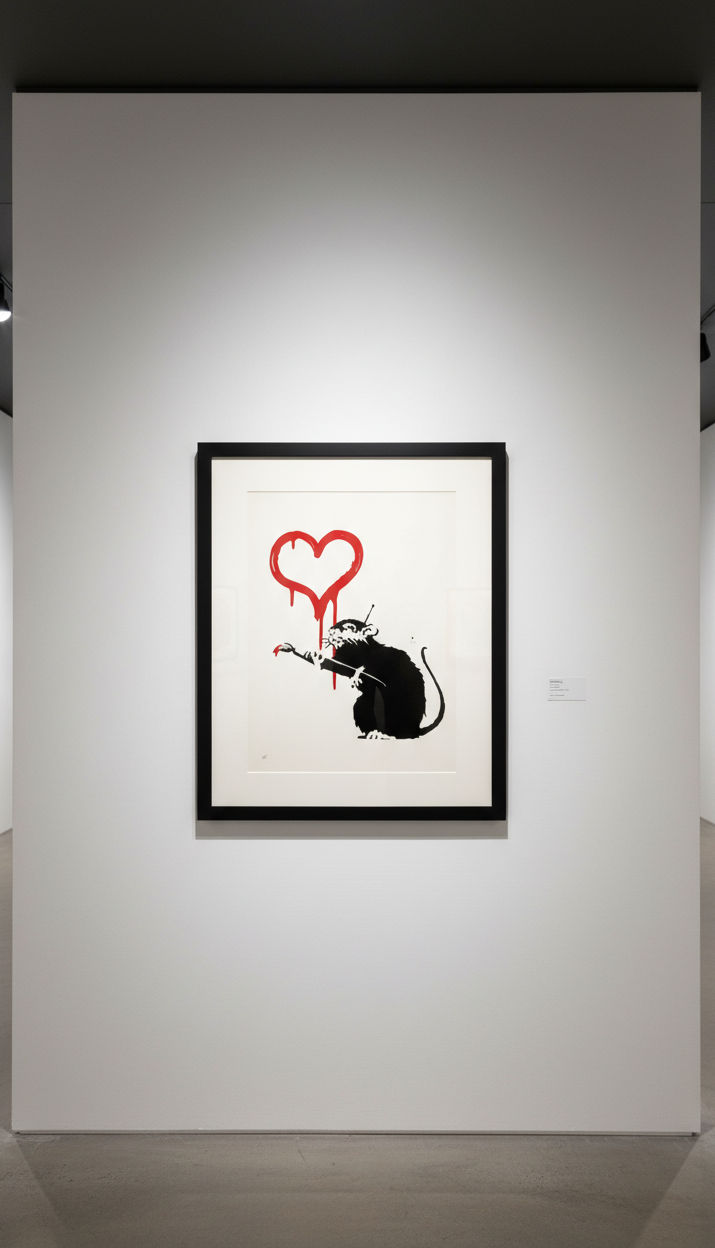
In works such as Love Rat, romantic imagery collides with urban decay and pest symbolism. The effect is deliberately uncomfortable. Love appears contaminated, reduced to something fragile or transactional. These images suggest a world in which sincerity struggles to survive systems built around consumption, control, and inequality.
This layered symbolism places Banksy firmly within a broader contemporary tradition: artists using shared visual language to critique globalised culture. His hearts are rarely whole or triumphant. Instead, they reflect a society in which emotional values are constantly tested by political and economic pressures.
Technique and Reach
Technically, Banksy’s heart imagery demonstrates a sophisticated command of stencil practice. Creating a heart that reads instantly, even when sprayed quickly and under pressure, requires careful planning of positive and negative space. The simplicity of the form masks the complexity of its execution.
Beyond the street, these images have achieved extraordinary cultural reach. They circulate as prints, photographs, and digital reproductions, yet retain their conceptual charge. Over time, heart motifs have become shorthand for Banksy’s wider worldview, symbols capable of carrying meaning across contexts without losing their edge.
Institutional recognition has further complicated this trajectory. Museums and major collections now include works featuring heart imagery, acknowledging their importance within contemporary art history. This shift from street intervention to institutional object inevitably raises questions about whether radical intent can survive formal validation, a tension that mirrors the contradictions Banksy often highlights.
Evolution Within the Practice
Tracing the appearance of hearts across Banksy’s career reveals how his concerns have evolved. Early works tend to integrate the symbol quietly, while later pieces place it at the centre of the composition. Over time, the heart becomes more direct, more damaged, and more politically charged.
What remains consistent is its adaptability. Banksy has used heart imagery to respond to shifting social conditions, from political division to public health crises. The symbol’s emotional universality allows it to remain relevant without becoming fixed to a single message.
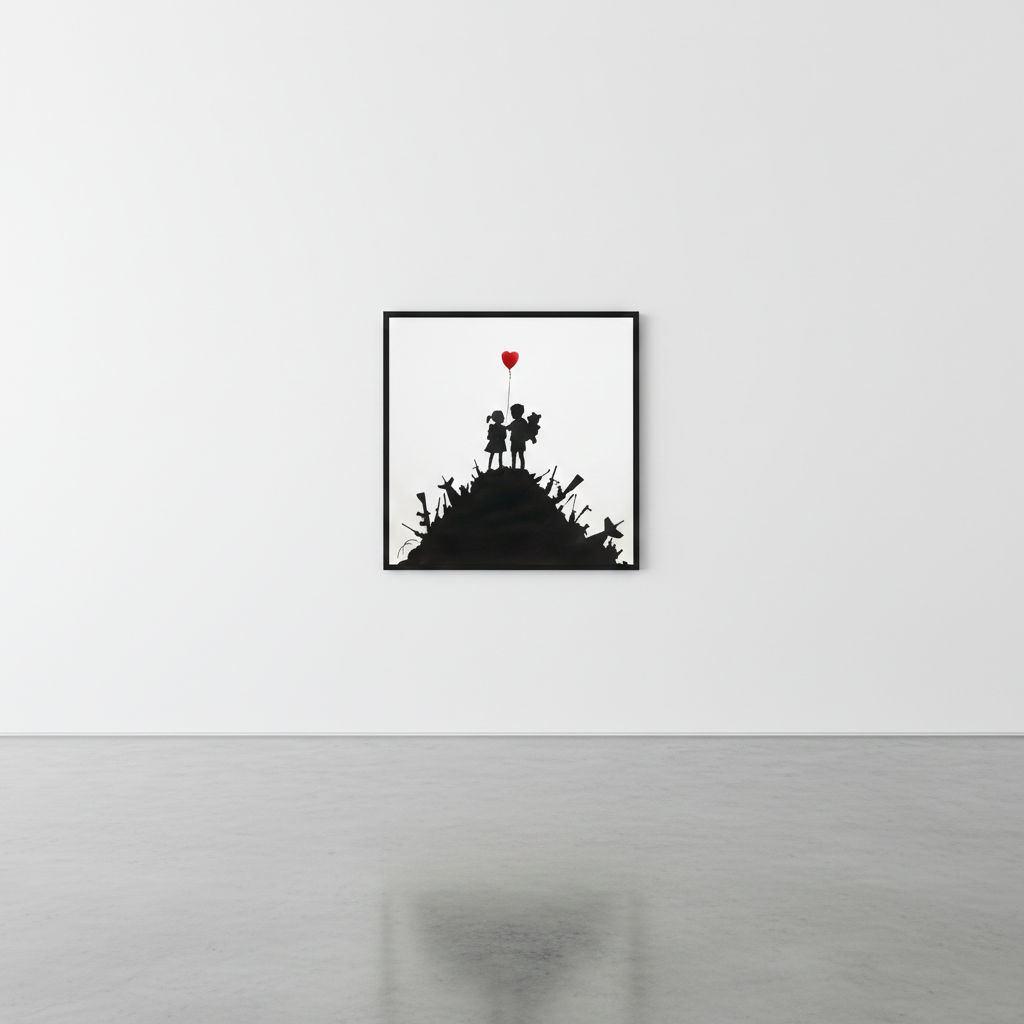
In works depicting children with weapons, often referred to as Kids on Guns, Banksy heightens the tension between innocence and violence. By placing firearms in the hands of children, he forces an immediate moral reckoning. The images are unsettling precisely because they violate deeply held assumptions about childhood as a protected space. When hearts or symbols of affection appear in these contexts, they underscore the tragedy of lost innocence and the normalization of conflict. The message is not subtle: a society that allows violence to shape the world of children has already failed in its most basic responsibility.
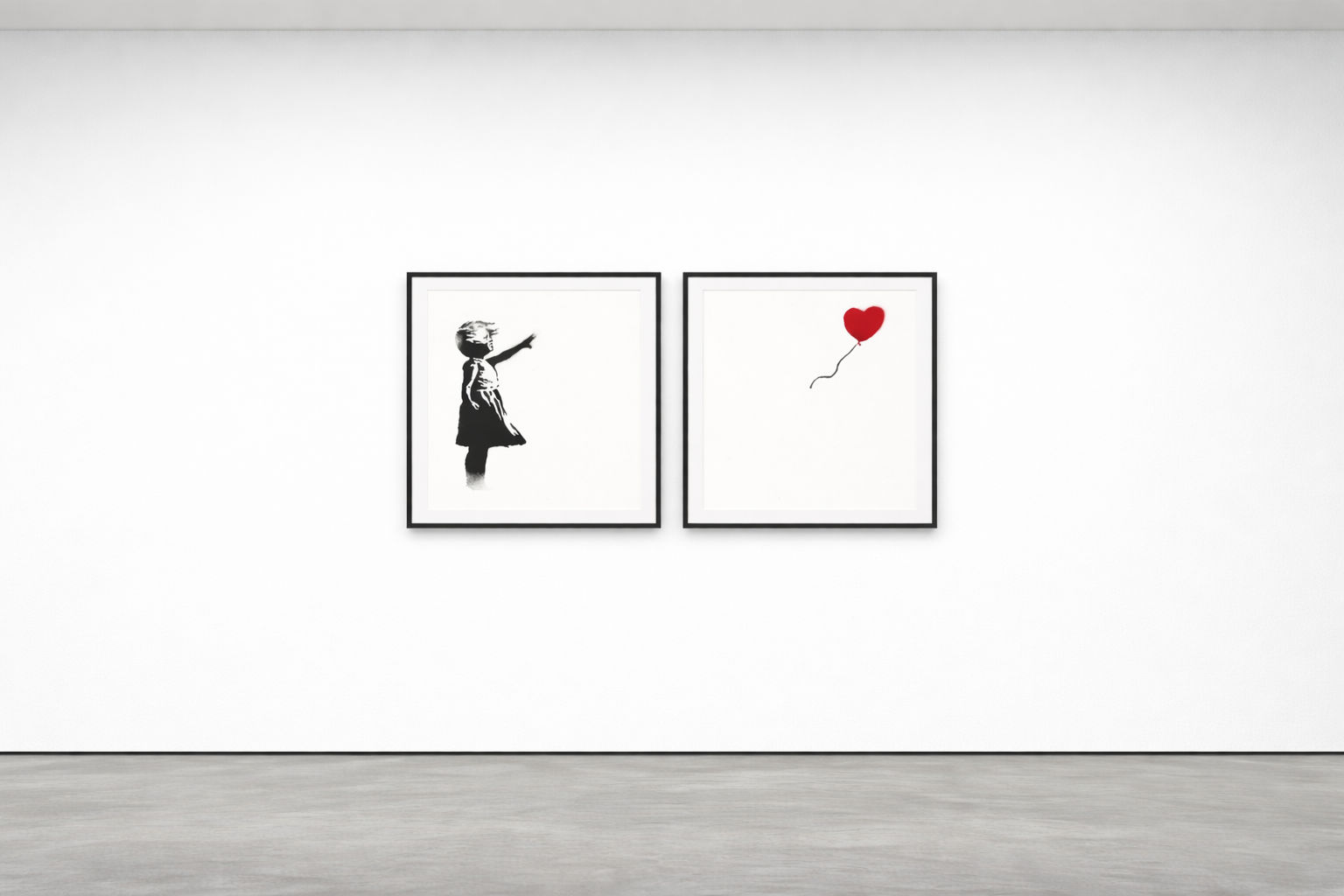
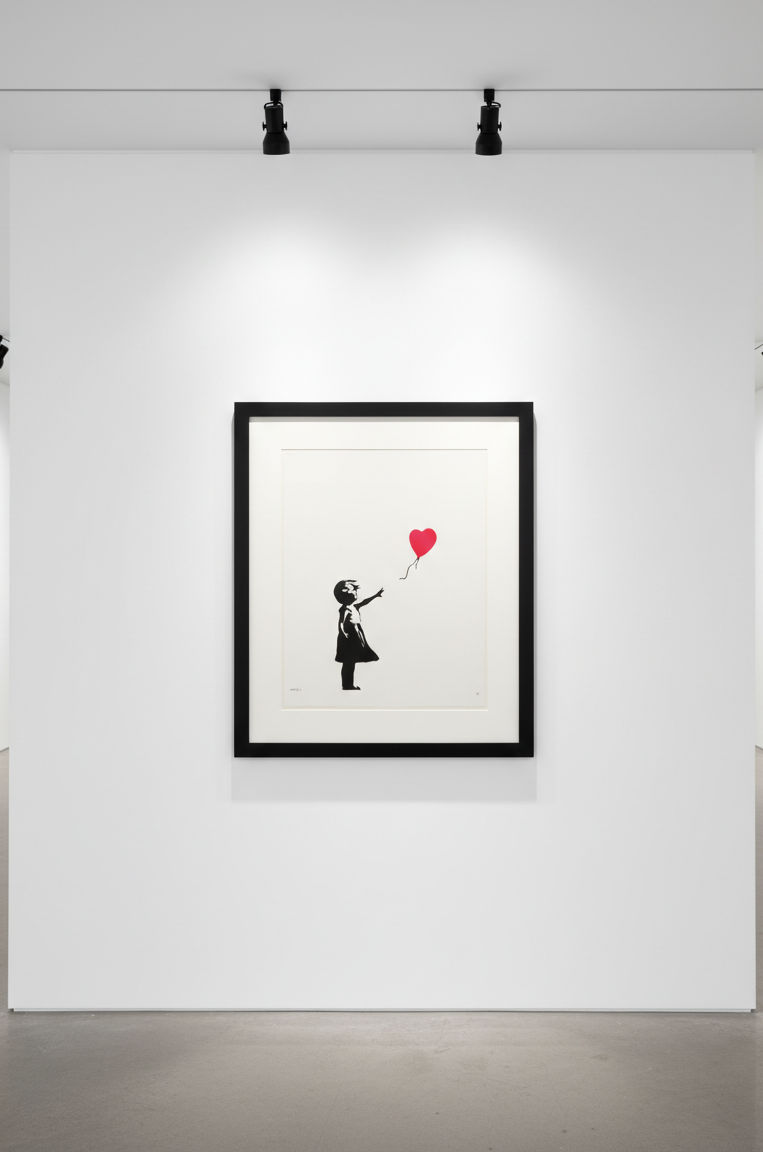
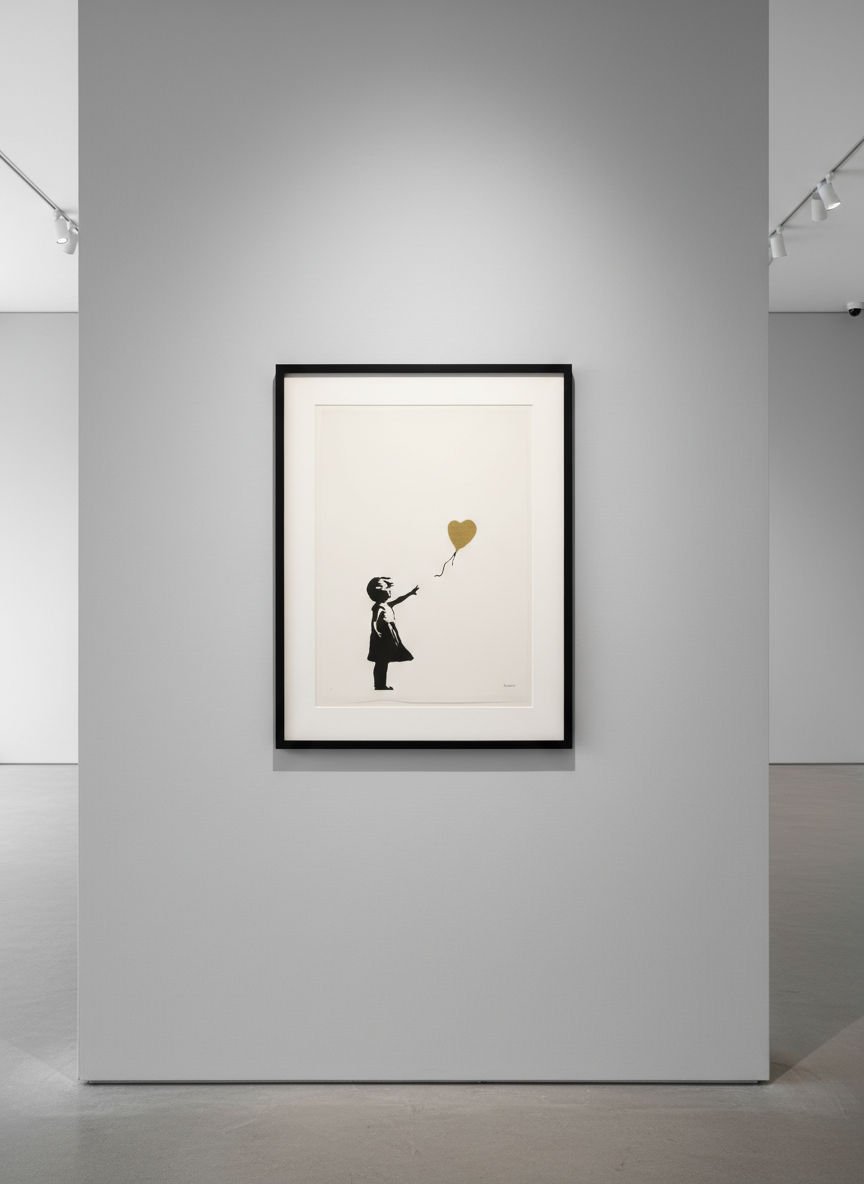
Girl with Balloon represents a quieter, more intimate expression of the same emotional territory. The image of a young girl reaching toward a drifting heart-shaped balloon captures a moment suspended between hope and loss. The balloon functions as a fragile stand-in for love, opportunity, or innocence itself—something desired, briefly held, and easily taken away. Unlike Banksy’s more confrontational works, this image relies on restraint. Its power comes from emotional recognition rather than shock, making it one of his most widely resonant and enduring compositions.
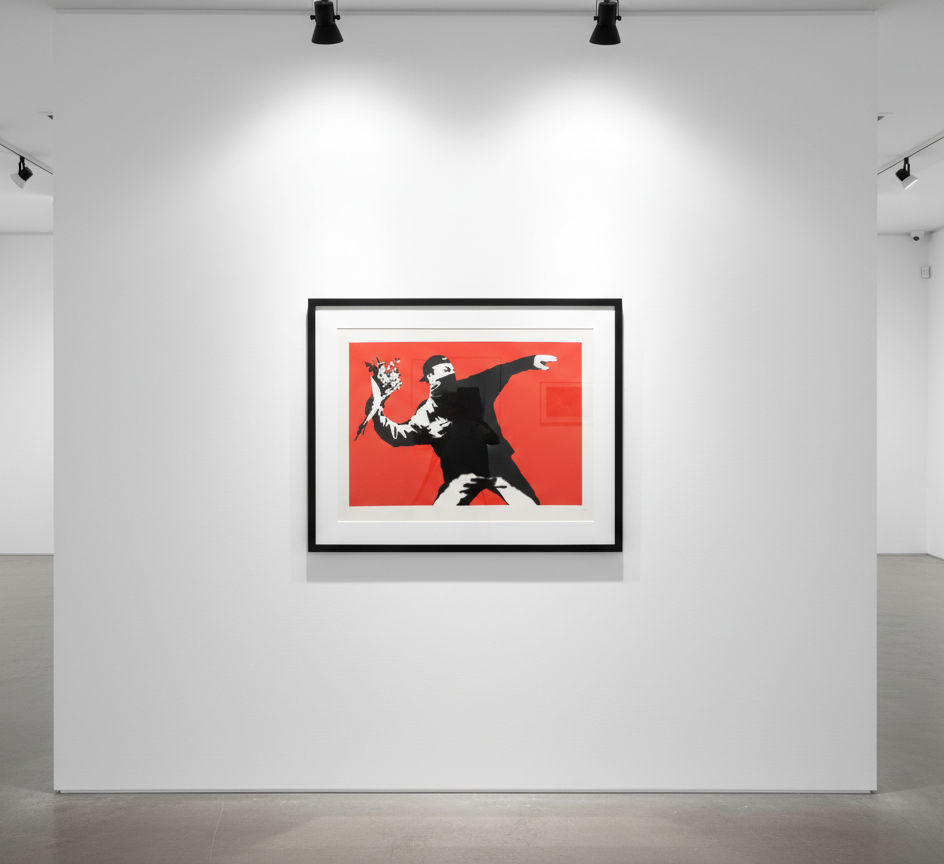
Flower Thrower, also known as Love Is in the Air, expands this language into the realm of political protest. A masked figure adopts the stance of a rioter about to hurl a weapon, yet what leaves his hand is a bouquet of flowers. The substitution reframes aggression as an act of hope and resistance as an expression of care. When read alongside Banksy’s recurring heart imagery, the work suggests that love and empathy are not passive forces but radical alternatives to violence. The gesture is both defiant and idealistic, proposing that meaningful change begins not with destruction, but with a refusal to abandon humanity.
Collecting and Authentication
For collectors, works featuring heart imagery present both opportunity and risk. Banksy’s anonymity and global popularity have produced a market saturated with reproductions and unauthorised works. Authentication through Pest Control Office remains essential, particularly for heart-themed pieces that are widely imitated.
Editioned prints such as Love Hurts offer a more accessible and secure entry point, provided they are accompanied by proper documentation. As with all Banksy works, clear provenance and verifiable history are critical.
Market and Institutional Context
Heart-themed works continue to attract sustained interest from both private collectors and institutions. Their emotional immediacy makes them effective in public displays, while their conceptual depth rewards closer engagement. This duality helps explain their enduring appeal.
At auction, authenticated examples consistently perform well, reflecting the strength of demand for works that capture Banksy’s ability to combine visual clarity with cultural critique. Within his broader practice, heart imagery stands as one of the clearest expressions of how personal emotion and political commentary intersect.
Frequently Asked Questions
Why does Banksy use hearts in political works?
Because hearts allow him to communicate complex ideas without alienating the viewer. By embedding critique within a familiar symbol, he creates emotional engagement before intellectual resistance sets in.
What does the heart represent in works like Love Hurts?
It reflects vulnerability and resilience, but also points to wider social pressures that threaten genuine connection. The personal and the political are deliberately intertwined.
How can heart-themed works be authenticated?
Through certification by Pest Control Office and thorough provenance research. Given their popularity, caution is essential.
How have these images influenced street art?
They have helped establish a model for using accessible imagery as a vehicle for serious social commentary, influencing a generation of artists working in public space.
Ultimately, Banksy’s hearts are not symbols of comfort but of tension. They hold together contradiction, love and damage, hope and disillusionment, and in doing so capture something essential about contemporary life. What appears simple is, in fact, doing heavy conceptual work.
Discover Banksy signed prints for sale at our New York and London galleries. Looking to sell your Banksy art? Contact our teams via info@guyhepner.com for more information.
