
Keith Haring’s market in 2025 continued to behave like a true blue-chip segment of Post-War and Contemporary collecting: competitive bidding concentrates at the top for rare, high-impact works, while the broader market—especially prints—benefits from constant global visibility and a steady stream of new buyers entering through recognisable imagery. Haring’s appeal remains unusually “multi-channel.” Museum stature, pop-cultural fluency, and an imagery system that reads instantly at any scale all combine to keep demand resilient, even when the wider contemporary market becomes selective. In practical terms, 2025 showed that collectors will still pay meaningful premiums for early, historically “core” Haring (especially large tarpaulin works and standout examples from the 1980–85 breakthrough years), while works on paper and editions continue to trade actively as the most liquid entry point.
The headline moment: big, early Haring still commands the room
The clearest top-end signal this year came in New York during Sotheby’s November sales. A major Untitled (1981)—notable for its early date and for belonging to the rarer, historically loaded body of large tarpaulin works—sold for $2,246,000 at Sotheby’s on 19 November 2025. This result matters less as a single datapoint than as confirmation of a familiar pattern: when Haring’s medium, scale, and date align with the story of how he reshaped painting via the street, buyers treat it like a “category leader,” not merely an 80s trophy.

Strong secondary support: mid- to upper-six figures keep depth in the market
Beneath the seven-figure peak, Haring’s 2025 auction performance shows a healthy middle market—works that are still unmistakably “serious Haring,” even if not the rarest format.
Sotheby’s also saw Untitled (1987) sell for $482,600 in New York on 19 November 2025. While far below the year’s top tarpaulin result, it reinforces the depth of demand for strong 1980s material, particularly when scale and visual clarity are present and the work “reads” as classic Haring from across a room.

Spring season results at Christie’s added more confirmation that buyers remain willing to compete for signature imagery. In the Post-War and Contemporary Art Day Sale in New York on 15 May 2025, Christie’s recorded $403,200 for Red Dog, alongside another Haring Untitled at $327,600. These are not the kinds of prices that make headlines outside the trade, but they are exactly the prices that keep a market structurally strong: they show that demand is not limited to one “hero” lot a year, and that iconic motifs (the barking dog especially) remain bankable at auction.

Phillips and the role of “format”: when a work behaves like a statement piece
Phillips’ New York season also delivered a notable outcome in May, led by a large-scale Haring: the Phillips Day Sale press release highlights Two works: (i–ii) Untitled (1984) selling for $698,500 on 14 May 2025. Diptych formats and paired works can behave like “statement” objects in collections—they take wall space like a single major work, but offer the sense of a more substantial hold. The price suggests collectors continue to value “installation presence,” not just the recognisability of the motifs.

Works on paper: a quieter engine that still produces real momentum
Not every meaningful result is a six- or seven-figure event. Haring’s works on paper and smaller-format pieces often act as the market’s proving ground for liquidity and confidence.
In May, Untitled (1988) selling for $190,500 at Sotheby’s New York on 16 May 2025. This is a useful type of comp because it reflects what committed buyers will pay for strong works on paper when condition and scale are attractive. That price range tends to pull buyers upward from prints and, in many cases, becomes the next step after a collector builds a meaningful edition portfolio.
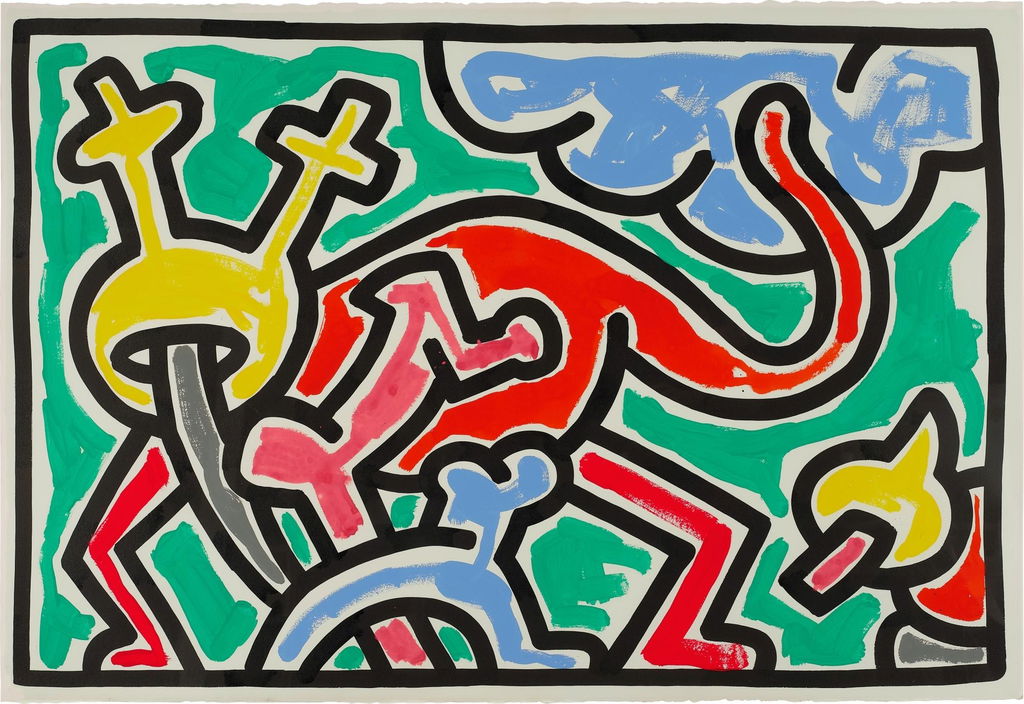
Prints in 2025: steady churn, global demand, and selective price pressure at the top
Haring’s print market isn’t one thing; it’s a ladder. At the entry end, buyers chase iconic images with clean colour and solid condition. At the top end, the market is driven by lifetime-signed examples, rare proofs, and complete sets that function like “mini retrospectives.”
Importantly, the broader data narrative for 2025 prints points toward tightening supply and better prices when quality is there. with Haring higher total sales value year-on-year and a rising average price, attributing it to a combination of reduced supply and stronger buyer competition.
What 2025 means for Haring’s market in 2026, with a focus on prints
The most likely 2026 dynamic is not a dramatic re-pricing of the entire market, but an intensification of selectivity—especially in editions. 2025’s auction story tells collectors that the top end is alive and well (tarpaulins and major 1980s works still bring the strongest bids), and that the middle market has depth (day sale results remain consistent). That combination usually benefits prints in two ways.
First, it keeps new buyers entering the category. When major works make strong prices, the “next best” route into the artist becomes editions, because they offer recognisable imagery, manageable price points, and easier logistics. Second, it pushes experienced collectors to upgrade. In 2026, expect continued premiums for lifetime-signed prints, complete sets, and rare proofs—while more common edition works will likely trade in a tighter band where condition, colour strength, and documentation decide the outcome.
If you’re thinking about Haring prints specifically going into 2026, the market is effectively asking for quality: buy the best example you can (clean margins, strong colour, correct paperwork), and where possible prioritise works that behave like “collection anchors”. That is where 2025’s auction results point most clearly: the demand is there, but it is increasingly disciplined—and that’s usually the healthiest kind of demand for a print market. Explore Keith Haring prints for sale and contact info@guyhepner.com for further details and latest availabilities.
