
Tracey Emin’s market is a useful case study in how autobiography, material specificity, and cultural impact can translate into durable value. Emerging from the Young British Artists (YBA) moment of the 1990s yet never fully contained by it, Emin built a practice in which lived experience is not simply subject matter but structure: confession becomes form, handwriting becomes image, and vulnerability becomes an aesthetic position. That consistency across media is one reason her market behaves differently from artists whose value is concentrated in a single “signature” format. Emin’s most expensive works—especially the very top auction outcomes—tend to be the ones where personal myth, art-historical framing, and rarity align most clearly.
Emin’s early life and formation matter to collecting strategy because her market repeatedly rewards works that feel inseparable from biography without collapsing into gossip. She grew up in Margate and trained at Maidstone College of Art and the Royal College of Art, and her practice developed alongside a broader British resurgence in which artists used everyday materials, found objects, and direct language to challenge what art could be. Her work often sits in dialogue with the legacy of the readymade and with confessional traditions in writing and performance; this is not an “add-on” to the art but a key to why certain objects carry more market weight than others. When a work delivers that charge—an object that looks like a private fact turned public—it tends to command stronger long-term demand than a piece that only borrows the surface look of Emin’s handwriting or erotics without the same emotional necessity.
Her market has also been shaped by a widely discussed narrative arc: a notorious public breakthrough in the late 1990s, a period where the work’s celebrity sometimes overshadowed its formal intelligence, and then a later phase in which painting, sculpture, and large-scale neons consolidated her position as an artist with a long horizon rather than a moment. Following her bladder cancer diagnosis in 2020, the public reception of her work increasingly emphasized survival, endurance, and seriousness—an interpretive shift that has coincided with meaningful market strength in major paintings.
The price ceiling: My Bed and the power of a cultural icon
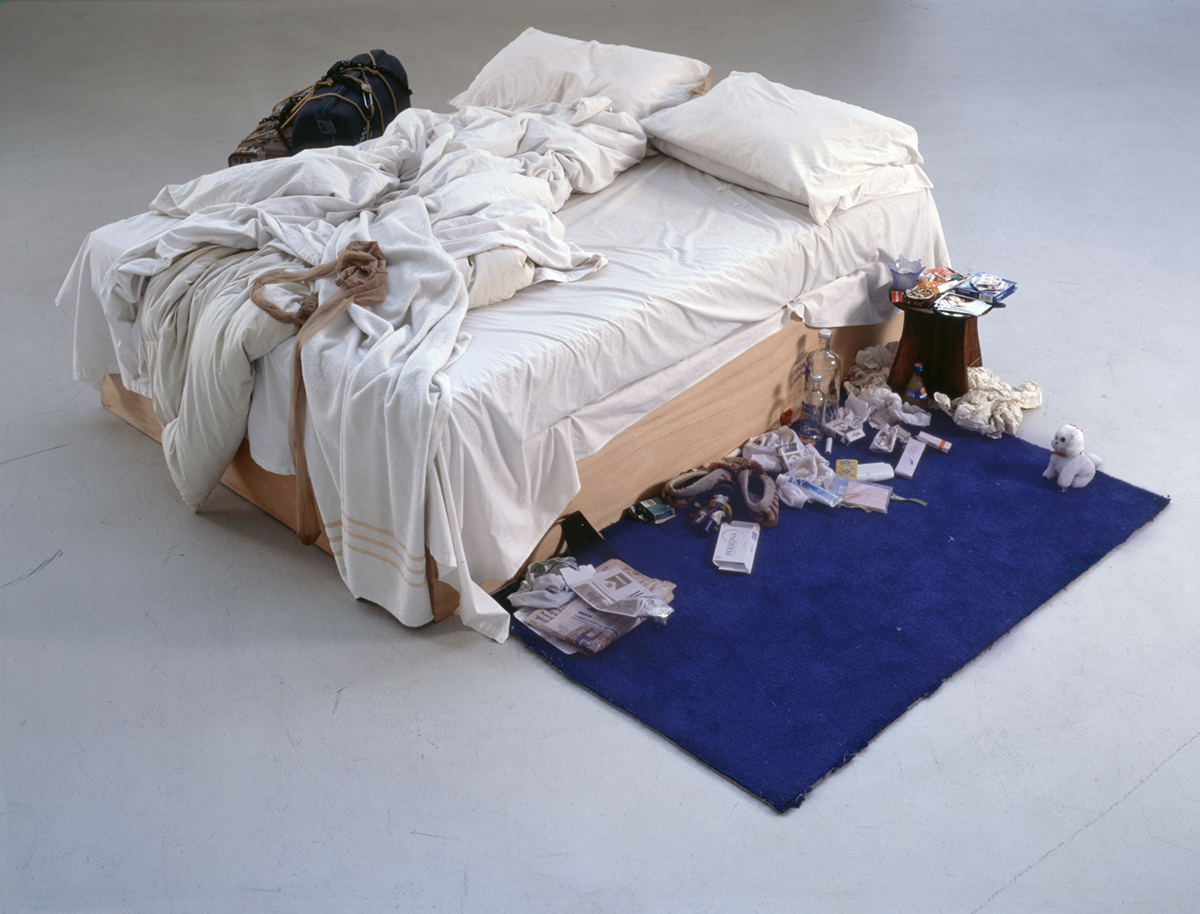
Emin’s auction record remains the work that most clearly demonstrates how cultural saturation can become market power when the object is historically fixed and materially specific. My Bed (1998)—the infamous installation featuring Emin’s own unmade bed and surrounding debris—sold at Christie’s London on 1 July 2014 for approximately $3.23 million USD (with premium), establishing a world auction record for the artist. The work’s public life is inseparable from its valuation: it was shortlisted for the Turner Prize in 1999, debated as scandal and defended as an unflinching portrait of depression and bodily reality. That decades-long “pressure test” is exactly what collectors often want at the top end: a work that has already been argued over, institutionalized, and reinterpreted, yet still reads with immediacy.
What My Bed demonstrates for collecting strategy is that Emin’s most expensive works tend to be those that cannot be “faked” by style alone. The value is not primarily in craft, finish, or optical pleasure; it is in provenance of experience and the historical fact of the work. For collectors, this helps separate two different pursuits. One is the hunt for the canonical, museum-grade objects (often unique works or extremely small editions with hard institutional visibility). The other is collecting the “Emin language”—handwriting, neon aphorisms, erotic line—through more available media like works on paper and prints. Both can be valid, but they behave differently. The record prices cluster around the first category because the scarcity is absolute and the cultural footprint is unmatched.
The post-2020 painting surge: Like A Cloud of Blood and the market for survival narratives
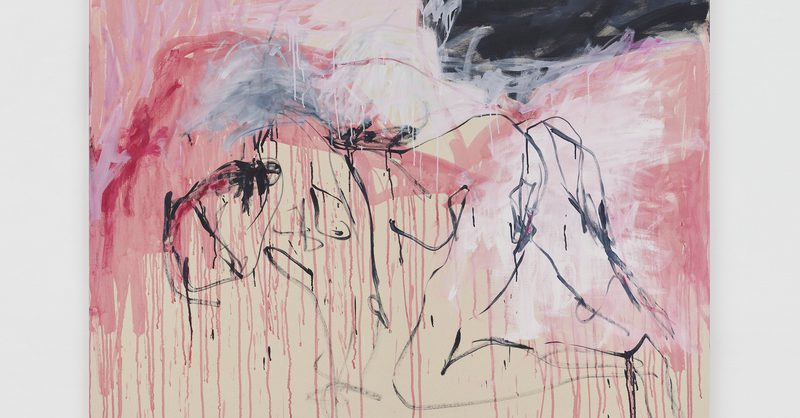
If My Bed is the archetype of Emin as confessional provocateur, her strongest recent headline result points to Emin as a mature painter whose market is supported by collectors looking for late-period urgency. In October 2022, Emin’s painting Like A Cloud of Blood (2022) sold at Christie’s London for approximately $2.95 million USD (with fees). The Art Newspaper reported the hammer at roughly $2.4 million USD, underscoring how close the result came to her auction record and emphasizing the work’s position as one of the first major paintings she made following gruelling cancer treatment.
For collectors, this sale is instructive because it signals that Emin’s market is not frozen in the 1990s. The work’s value was not driven by notoriety in the way My Bed was; it was driven by a convergence of narrative, timing, and painting’s broader status as the highest-value medium. Contemporary collectors often pay premiums for paintings that read as turning points—works that feel like they arrive after crisis, when the artist’s voice is clarified by necessity. Emin’s late painting is frequently described in those terms, and the market has shown a willingness to treat it as “major Emin,” not as a secondary category behind the iconic installations.
Six-figure validation: The Shower and the institutionalization of the painting market
A market becomes investable when there is not only a record, but a meaningful ladder of strong secondary results beneath it. Emin’s painting The Shower (2019) realized approximately $640,000 USD at Christie’s on 10 October 2024. While far below the two multi-million-dollar peaks, this result matters because it demonstrates repeatable six-figure demand for her paintings, not just a one-off headline sale. It also suggests that collectors are differentiating between paintings based on scale, period, and intensity rather than treating them as interchangeable “Emin canvases.”
Strategically, this is where sophisticated collecting begins: tracking which periods are being priced as foundational and which are priced as transitional. A collector building a position in Emin paintings can use results like The Shower as evidence of depth—proof that demand exists below the trophy level.

Textiles and the premium on labor, intimacy, and scarcity: Super Drunk Bitch
Emin’s appliquéd blankets sit at the intersection of text, craft, and bodily confession, and the market has periodically rewarded the strongest examples with major prices. At Christie’s in February 2014, her appliqué blanket Super Drunk Bitch (2005) sold for approximately $460,000 USD, cited at the time as a record for Emin in that medium. The work’s appeal is not only its rawness but its material logic: it takes the “Emin handwriting” that often appears as quick neon or drawing and embeds it in slow, domestic labor. For collectors, this medium can function as a bridge between the objecthood of installations and the portability of works on paper—often rarer than prints, more bodily than paintings, and more distinctive than editioned neons.
The collecting lesson here is that Emin’s market frequently pays up when the medium reinforces the emotional claim. In blankets, the softness and the labor intensify the vulnerability; the work feels physically made and physically lived. That alignment—medium and message reinforcing each other—is a consistent trait of Emin works that age well.

Neons: editioning, language, and why the best examples behave like sculpture
Emin’s neon works are among her most recognizable formats because they literalize her gift for language: brief phrases that oscillate between desire, shame, tenderness, and confrontation. But the top prices depend heavily on edition size, scale, and the cultural “stickiness” of the phrase. Christie’s data shows, for example, that the neon Is Legal Sex Anal? (1998) sold far above estimate in February 2014, realizing approximately $95,000 USD. These are not the artist’s highest prices, but they are important because they demonstrate how Emin’s words can function as sculptural objects with competitive bidding—even when editioned.
There is also a crucial nuance for collecting strategy: neons sit between unique work and print-like reproducibility. Small editions (often of three, sometimes with artist’s proofs) can behave more like sculpture than multiples, especially when the work has clear exhibition history and the phrase is strongly associated with Emin’s wider mythos. Auction data also shows the format’s continued market presence across different phrases and dates, reinforcing that neon is not a one-hit category for her, even if individual works vary widely in value.

What “most expensive” really means in Emin: the hierarchy of significance
Looking across Emin’s highest-profile prices, a pattern emerges. The ceiling is held by works that meet three conditions at once: they are historically central to her story, materially specific in a way that resists substitution, and rare enough that collectors feel the urgency of “this is the one.” My Bed is the clearest example. Like A Cloud of Blood shows that major paintings—especially those anchored to pivotal life events—can join that top tier. Below that, strong paintings such as The Shower establish a robust middle market that can matter as much to a collector’s long-term outcome as the headline records do. Textiles and neons form supporting pillars: they can be expensive when they are exceptional, but they are also more variable and therefore more sensitive to connoisseurship.
This hierarchy should shape how collectors allocate budgets. If the goal is “blue-chip Emin,” the focus tends to be museum-grade installations and major paintings with high visibility. If the goal is building a meaningful, emotionally coherent collection, works on paper, neons, and textiles can offer a fuller map of the artist’s language—often at prices that allow for selectivity across periods rather than all-in concentration on a single trophy.
Market structure, narrative, and collecting with conviction
Emin’s market is supported by a combination of institutional validation and sustained primary-market attention. Just as importantly, her story remains legible to new collectors. In a global market where attention is fragmented, legibility is a form of liquidity: collectors understand what an Emin is “about,” even when they have not followed the work closely. That does not mean the art is simple; it means the emotional stakes are direct. When a market is built around direct emotional recognition, the works that best deliver that recognition—without feeling mannered—tend to outperform over time.
Ultimately, collecting Tracey Emin well is less about chasing a medium and more about chasing necessity. Her market consistently rewards works where the medium is the only way the content could exist, where biography becomes formal intelligence, and where the object has enough specificity to keep producing meaning long after the headlines fade.
Discover Tracey Emin prints for sale and contact info@guyhepner.com for latest availabilities.
