
George Condo has become one of the defining figurative painters of the last four decades, and the price trajectory of his best works tells a clear story: collectors pay the most for scale, psychological intensity, and pictures that feel like “major statements” rather than variations on a familiar face. Condo’s signature language—at once learned and anarchic—sits at a rare crossroads where the Old Masters, Picasso-era Cubism, American Pop, cartoons, and the improvisational logic of music collide. Christie’s neatly captures the essence of his appeal: distorted portraiture, “polyphonic” style, and a practice driven by what Condo calls “psychological cubism,” a way of showing multiple emotional states at once rather than multiple viewpoints of an object.
That idea matters because it is exactly what the market is buying at the top end: paintings that compress contradiction—beauty and grotesque, elegance and slapstick, tenderness and menace—into a single image that still feels formally sophisticated. Condo came of age in 1980s New York as painting returned to the foreground; he moved in circles that included Basquiat and Haring, and he spent time around Warhol’s Factory, all while absorbing European art history with unusual seriousness for a downtown painter.This dual education—street-level immediacy and museum-level tradition—helps explain why his strongest canvases can read simultaneously as contemporary culture and as a knowing continuation of the history of portraiture.
The headline record: “Force Field” (2010)
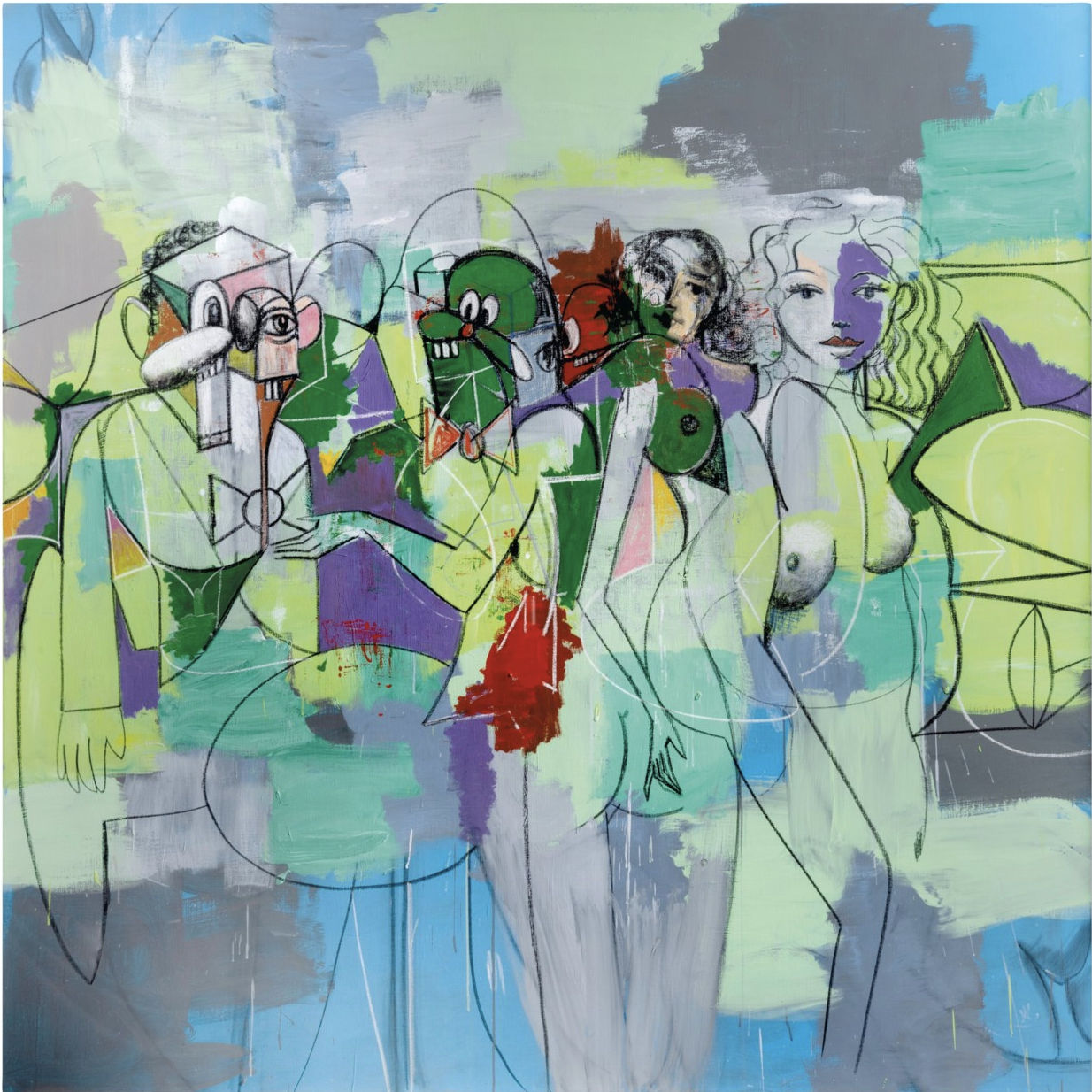
When people talk about Condo’s most expensive artworks, the conversation typically starts with one picture: Force Field (2010). In July 2020, Christie’s Hong Kong sold Force Field for HK$53.15 million, an auction record widely cited as roughly $6.85 million at the time.Christie’s own artist page lists the same realized price, and frames the artist’s late paintings as among the most in-demand at auction.
Why did Force Field break away from the pack? First, it is monumental—roughly 82 by 82 inches (208.3 x 208.3 cm) in Christie’s cataloging—so it competes visually with the kind of “museum scale” canvases that anchor serious collections. Second, it delivers the “Condo universe” at full volume: an orchestration of faces, limbs, motifs, and painterly registers, arranged less as a narrative than as a compositional engine. Christie’s lot essay describes it as a “banquet” of color and form with a density that feels symphonic.
In market terms, Force Field also represents a sweet spot in date and style. The 2010s are now widely recognized as an era in which Condo’s language is fully matured: confident line, elastic anatomy, and a deliberately “postmodern” fluency that can quote Picasso, de Kooning, and Pop without becoming derivative. Works from this period are also often executed in mixed media on linen—acrylic with charcoal and pastel—an approach that emphasizes drawing as much as painting and gives the surface the speed and snap collectors associate with Condo at his best.
What tends to sit just below the record: large multi-figure “drawing paintings” and complex compositions
If Force Field is the apex, the tier just below it is populated by big, ambitious compositions that expand beyond the “single head” format. These are the works that feel like complete ecosystems: multiple characters, stacked emotions, and a sense of the artist moving between abstraction and figuration with ease. Christie’s highlights one such example in its own cataloguing of Condo: Prescription for the Clinically Normal (2012), a monumental diptych in acrylic, charcoal, and pastel on linen, with each panel measuring 90 by 65 inches.
Even without quoting a specific realized price for that painting here, its presence on Christie’s curated list of key Condo lots is telling. It represents the characteristics the high market repeatedly rewards: scale, complexity, and the feeling that Condo is pushing his method to a limit—packing the canvas with interlocking faces and gestures that don’t simply “illustrate” psychology but embody it through structure, rhythm, and collision. The visual experience is closer to listening to densely layered music than reading a portrait, which ties back to Condo’s long-standing relationship with music and improvisation noted in Christie’s biographical overview.

Million-dollar territory: standout heads and “icon” portraits
The next category of expensive Condo works is the one most collectors encounter first at auction: large, high-impact head paintings and portrait compositions that distill Condo’s distortions into a single protagonist. These can be ferocious or comic, elegant or monstrous, but the best examples keep a balance between caricature and classical composition.
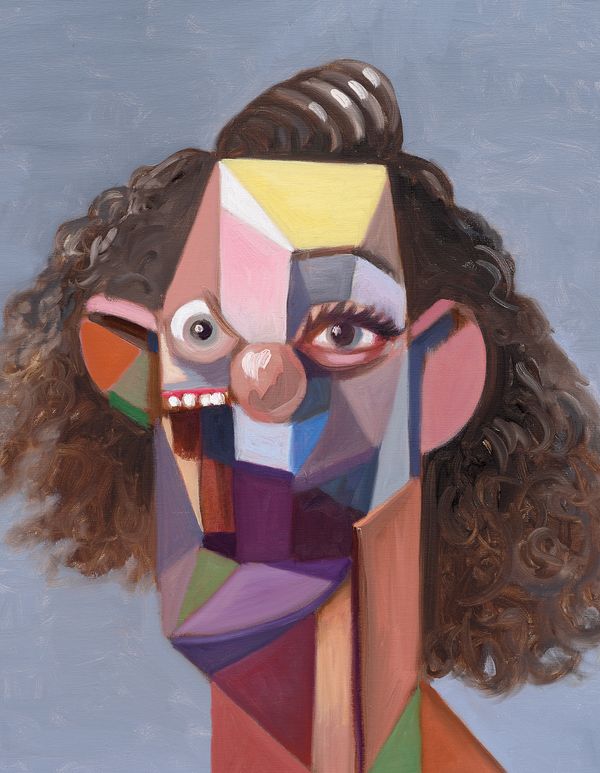
A clear example of the market’s appetite for this format appeared during the London season in June 2024, when Green and Purple Head Composition (2018) sold at Phillips for £1 million (about $1.28 million as reported). This result is meaningful not just because it crossed the million-dollar line, but because it shows continued demand for strong 2010s works even in a more cautious auction climate. The same Artsy report that mentions the sale also notes that London’s totals were “moderate,” reinforcing a key point: Condo can still command standout prices within a softer broader market when the painting has the right combination of date, scale, and visual punch.

It is also worth noting that the broader auction environment has increasingly favored what might be called the “upper middle” of the market—works that are expensive, but not trophy-level eight-figure material. Artnet’s reporting on 2024 market segmentation describes the $100,000 to $1 million bracket as the most robust by total sales value, even as higher tiers contracted more dramatically. Condo is particularly well positioned in this landscape because his market has depth: there are enough works trading (and enough stylistic variety within the recognizable brand of “a Condo”) to create liquidity across multiple price points, from works on paper all the way to seven-figure paintings.
Asia’s role in the top end: why Hong Kong mattered for the record
The Force Field result also underlines how important Asian evening sales have been to Condo’s peak pricing. Before Force Field, Asia had already demonstrated strong appetite: one market report notes that Condo’s Young Girl with Blue Dress exceeded estimates in Hong Kong in 2017 and helped set a regional benchmark, and then Force Field leapt far beyond that to establish the global record in 2020.
This is not simply about geography; it is about auction theater. Evening sales in Hong Kong, London, and New York are where global bidding pools converge, where guarantees reduce consignor risk, and where contemporary collectors often chase “statement paintings” that signal both taste and market awareness. Christie’s own write-up of the 2020 ONE sale explicitly frames Force Field as one of the standout results, and emphasizes it as a record price at auction. In practical terms, when a Condo has the size and presence of Force Field, the most competitive arena is usually an evening sale platform with international reach.
What the “most expensive” Condos have in common
Across the record and the near-record tier, several characteristics repeat so consistently that they function like an informal valuation framework.
The first is scale. Condo’s most expensive paintings tend to be large enough to dominate a room and hold their own against blue-chip neighbors. That does not mean smaller works cannot be valuable, but the market’s upper ceiling is reserved for paintings that look and feel like institutional anchors.
The second is a synthesis of drawing and painting. Christie’s bio emphasizes Condo’s practice of combining acrylic, charcoal, and pastel, and the market often treats this hybrid surface as particularly “authentic” to his mature voice.This matters because collectors are not only buying an image; they are buying the performance of the artist’s hand—speed, revision, aggression, finesse—visible in the surface.
The third is psychological density. The best works do not simply present distortion as a style; they use distortion as structure. Condo’s “psychological cubism” is a market keyword as much as an artistic one, because it gives a conceptual reason for the visual complexity and ties the work back to Picasso without collapsing into homage.
The fourth is date and “period.” While strong works exist across Condo’s career, the market has shown particular enthusiasm for major paintings from the late 2000s through the 2010s, when his method is both recognizable and expansive. The record itself—Force Field (2010)—sits right in that zone.
Market structure: primary demand, secondary velocity, and the risk factor collectors must price in
Condo’s market is also shaped by the realities of access. When an artist is heavily collected and selectively placed on the primary market, pressure builds on the secondary market, where auctions become the public stage for price discovery. That dynamic can create rapid appreciation—but it also creates incentives for forgery and misattribution, particularly in categories where connoisseurship is harder for casual buyers.
In Condo’s case, the problem has been well documented. A Vanity Fair investigation describes how, as Condo’s market surged, a ring of forgeries circulated, particularly involving works on paper, and how the artist and his representation took steps to challenge the problem through legal channels and coordination with authorities. This has two implications for collectors. First, it helps explain why “bulletproof” provenance and clean exhibition history can matter even more for Condo than for some peers: buyers are willing to pay up for certainty. Second, it suggests why the very top of the market concentrates in major, widely published paintings with clear histories—exactly the kind of work that can convincingly command record prices.
Reading Condo’s top prices as signals, not just numbers
It is tempting to treat auction records as a scoreboard, but the more useful approach is to treat them as signals about what sophisticated buyers believe will endure. The Force Field record signaled that Condo’s market had matured into a place where a major canvas could compete at a level once reserved for a smaller set of postwar names. The 2024 Phillips result for Green and Purple Head Composition signaled that even when broader sale totals cool, strong Condos can still rise above estimate and hold attention.
Those signals align with what Christie’s emphasizes in its own positioning of Condo: a painter deeply engaged with art history, but also fearless about collapsing high and low cultural registers; an artist whose portraits absorb Rembrandt and cartoons, Picasso and Pop, and turn them into something contemporary and psychologically sharp.

A collector’s takeaway: how “most expensive” translates into “most important”
In practice, the Condos that become the most expensive are the ones that read as unavoidable. They feel like they had to exist: not a clever variation, not a market-friendly head, but a painting in which Condo’s entire logic is at stake. They tend to be big. They tend to be complex. They tend to show his command of both painterly tradition and irreverent invention. And crucially, they tend to be legible as art-historical arguments as much as images—arguments about portraiture, about the instability of the self, about the comedy and horror of consciousness, rendered with the confidence of someone who knows exactly what he is doing.
If you want, I can write a companion piece focused specifically on the “high six-figure to low seven-figure” Condo segment—works that trade most often, what differentiates a $250k canvas from a $900k canvas, and how provenance and medium affect pricing—using recent public auction reporting as the backbone.

Explore George Condo prints for sale and contact info@guyhepner.com for latest availabilities.
