Chris Levine occupies a distinctive position in contemporary art because his practice treats light not simply as illumination, but as a primary medium with psychological and spiritual charge. Across portraiture, installation, photography, holography, and laser works, Levine repeatedly returns to the idea that perception can be engineered: that stillness, frequency, colour, optics, and scale can shift the viewer’s internal state. His work therefore sits at an intersection that new collectors sometimes find difficult to categorise. It can read as photography, but Levine has consistently framed himself as an artist “who works with light” and uses photography as one tool among many, rather than as an end in itself.
For collecting purposes, this hybridity is an advantage. Levine’s market spans unique works, limited edition lightboxes and lenticulars, and more accessible print editions, all tied to a recognisable visual language: iconic sitters suspended in a luminous hush, and immersive light environments designed to be experienced bodily rather than decoded intellectually. Gazelli Art House describes his practice as technologically expansive and philosophically driven, with the aim of “revealing the ways in which light is fundamental to human experience” and encouraging “a meditative engagement with the present moment.”

Influences, education, and the formation of his language
Levine’s background helps explain why his work feels at once contemporary and strangely timeless. He studied graphic design at Chelsea School of Art and later completed an MA in computer graphics at Central Saint Martins, training that naturally privileges image construction, optical effects, and the mechanics of seeing. This foundation, paired with a career spent working across disciplines, underpins his comfort with technologies that many artists treat as specialist or secondary.
Just as important is Levine’s recurring interest in the metaphysical dimension of light. His own studio statements emphasise a synthesis of technology and spirituality, with lasers and sound frequencies used to “craft environments” that operate on sensory and contemplative levels. In more recent commentary and press coverage, he has spoken about sacred geometry and cosmic alignment as guiding frameworks for installations, which helps collectors understand why his work often includes geometric projections, carefully tuned atmospheres, and an almost devotional tone.
For a new collector, the practical takeaway is that Levine’s best works tend to be those where concept and mechanism are inseparable. If the technology is merely decorative, the work can feel like product. When the technology is doing something essential—altering time, attention, or emotional temperature—the work is typically stronger, more historically legible, and more robust within the market.

Career overview and where Levine sits art-historically
Although Levine is widely known for portrait images that circulate as cultural icons, his career is best understood as part of a broader lineage of light art and perceptual practice. His work aligns with late twentieth-century and contemporary movements that treat experience as material: installation art, new media, and strands of conceptual and minimal practice that privilege atmosphere and viewer encounter. Levine’s output also connects to the history of holography and optical imaging as art forms, and to the tradition of portraiture that uses technical innovation to reframe power, celebrity, and aura.
Institutional validation is a meaningful component of his profile. The National Portrait Gallery holds works by Levine in its collection and has written about his royal portraiture in language that signals the cultural importance of the images rather than treating them as mere celebrity photography. This matters because Levine’s most recognisable works sit close to popular culture, and institutional framing helps keep them anchored in the art-historical conversation.
At the same time, Levine’s practice is often collaborative in its execution, particularly when complex optics or large-scale engineering are involved. Collectors should be aware that collaborative production has become a visible topic in relation to the authorship and commercialisation of certain royal portraits, with legal disputes reported in the press. This does not negate the works’ significance, but it does raise due diligence expectations around edition legitimacy, licensing, and documentary clarity.

Understanding Levine’s main collecting categories
A useful way to approach Levine is to divide his market into three broad categories: iconic portrait works presented as lenticulars and lightboxes; editioned prints and “open” or higher-volume releases tied to those icons; and immersive light installations or sculptural works that appear primarily in institutional or commissioned contexts.
The first category tends to be the most recognisable and, historically, the most liquid on the secondary market. These works often use lenticular imaging, holographic methods, or lightbox presentation to create a living shift between states: open and closed eyes, a flicker of presence, a soft movement across the facial plane. The second category offers entry points that share imagery but not always the same physical experience. The third category is less common in private collecting simply because of scale, complexity, and installation requirements, but it is crucial to Levine’s seriousness as an artist and often feeds demand for the portrait works.
The “Lightness of Being” and “Equanimity” works
Levine’s royal portraiture is the gravitational centre of his market, and it is the first place most collectors encounter him. The National Portrait Gallery describes Queen Elizabeth II (‘Lightness of Being’) as an intimate and unguarded moment, created with a lenticular lens, in which the monarch appears suspended in a reflective stillness.

In collecting terms, you will encounter multiple manifestations linked to this imagery: earlier works tied to the original commission and subsequent presentations, lightbox and lenticular editions, and later interpretations or variations. Auction house records show that lightbox/lenticular editions appear with clear specifications on size, date, and format, which makes them easier to evaluate when documentation is complete. For example, Phillips has offered lightbox works connected to Lightness of Being with detailed cataloguing, and Christie’s has catalogued She’s Light lightbox works with edition information and certificates referenced in the listing.
Because these images have been widely reproduced and reinterpreted, the collector’s priority should be provenance and edition certainty. You want a clean line of paperwork that clarifies what, exactly, you are buying: the edition size, the production method, the date of execution, and whether the signature is handwritten, digitally printed, on-label, or otherwise. Reputable cataloguing and direct gallery sourcing reduce risk, particularly given the public reporting around licensing and authorship disputes connected to the royal works.

“She’s Light” and the cult of contemporary iconography
If the royal portraits are Levine’s institutional anchor, the She’s Light works are his most visible bridge into fashion, celebrity, and contemporary “icon” collecting. These works frequently depict sitters such as Kate Moss in a luminous, pared-back register, often presented as lenticular images or lightboxes that heighten the sense of suspended time. Market-facing platforms and auction catalogues describe She’s Light works explicitly as 3D lenticular prints in lightboxes, frequently accompanied by certificates of authenticity and produced in small editions in certain variants.
For new collectors, She’s Light is often an ideal entry because it combines strong recognisability with a format that feels sculptural and finished. It also rewards careful selection. The most compelling examples tend to balance Levine’s technical finesse with restraint, avoiding effects that feel cosmetic. When colour interventions are heavy-handed, the work can drift toward décor; when the presentation is controlled and the optical effect is integral, the work reads closer to a contemporary devotional image, which is where Levine is most distinctive.
Lightworks, lasers, and immersive installation practice
Levine’s portraiture can overshadow the fact that he is deeply invested in installation and participatory experience. His studio material emphasises lasers, sound frequencies, and immersive environments as central to the practice, explicitly describing work designed to engage viewers “on both sensory and contemplative levels.”
A useful reference point is his large-scale exhibition 528 Hz Love Frequency at Houghton Hall, presented as a suite of holographic works, prints, and immersive laser and LED installations created for the site.The exhibition included a monumental sculptural centrepiece, Molecule of Light, engineered and installed at significant scale, reinforcing that Levine’s ambition extends far beyond the wall.
Related to this is Levine’s ongoing interest in sound-and-light collaboration, including projects developed with major musical figures and presented as meditative experiences for large audiences. Sotheby’s coverage describes the iy_project as a collaborative sound and vision work born out of the Eden Project, explicitly aimed at creating a meditative space using sound, light, and nature.
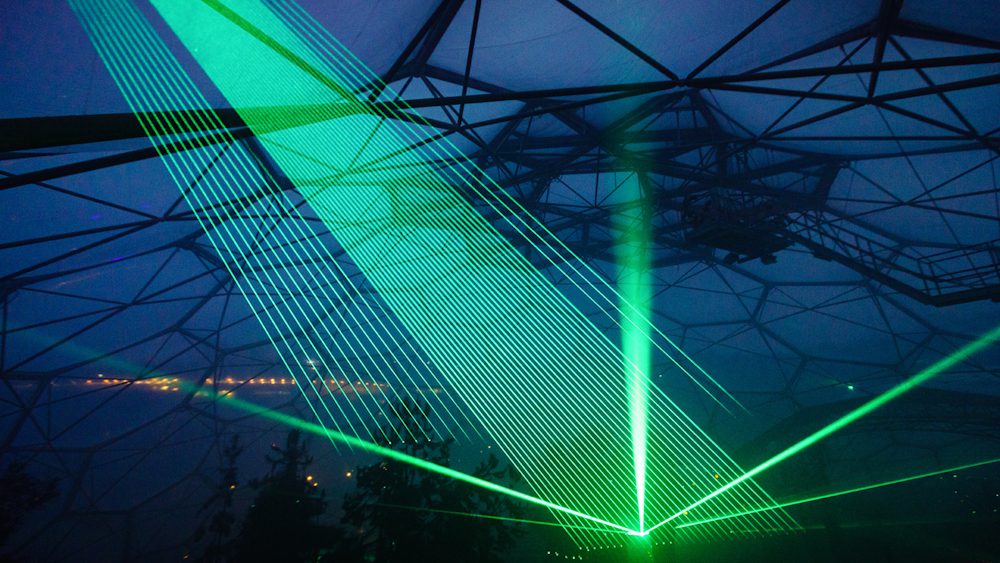
For collectors, these projects matter even if you never intend to own an installation. They explain why Levine’s portraits work the way they do. The portraits are not only images of people; they are controlled perceptual events. Collecting the best portrait works is, in part, collecting the residue of a practice that is fundamentally experiential.
What to look for when selecting a work
A strong Levine typically has three qualities: an image that can hold stillness without sentimentality; a production method that supports the concept rather than merely decorating it; and a presentation format that preserves the work’s intended optical and spatial behaviour.
Stillness is the signature. Whether it is the closed-eyed monarch or the suspended calm of a fashion icon, Levine’s best works make quiet feel monumental. This is where condition becomes unusually important. Lenticular surfaces, diasec mounts, acrylic skins, and lightbox components can degrade in ways that ordinary prints do not. Scratches, edge knocks, delamination, colour shift, or inconsistent illumination can meaningfully change the work’s effect. If the piece is a lightbox, you should treat the electronics as part of the artwork’s condition, not as an afterthought, and you should ask what components are original, what has been replaced, and whether the artist studio or authorised fabricators can service it.
You should also pay close attention to edition structure. Some works exist in very small editions, others in larger public-facing editions, and still others as unique or near-unique objects. Listings for Levine editions often specify whether signatures are digitally printed, on-label, or hand-signed, and whether there are artist’s proofs. These details affect both collectability and resale clarity.
Finally, consider scale and viewing distance. Many lenticular works perform differently depending on where you stand and how the ambient light hits the surface. A piece that looks dramatic in a gallery can flatten in a poorly lit home corridor. When possible, view works in person, or at minimum request installation images in comparable lighting conditions.

Provenance, authenticity, and due diligence
With Levine, documentation is not busywork; it is part of responsible collecting. You want invoices, gallery letters, certificates where applicable, and clear information about edition numbers and production dates. Reputable galleries and auction houses commonly reference certificates of authenticity for Levine lightbox works, and those documents should be matched to the physical work’s labels and identifiers.
Given recent reporting around disputes involving authorship credit and licensing connected to royal portraits, collectors should be especially careful with works that claim a direct relationship to Equanimity and Lightness of Being. The press coverage indicates ongoing legal contention over co-authorship claims and prior contractual disputes with the commissioning body, which makes it prudent to prioritise works with unimpeachable provenance and established market visibility. This is not an argument against collecting these works; rather, it is an argument for collecting them properly.
If you are buying privately, insist on a written warranty of title and authenticity, and ensure any resale restrictions or licensing terms are understood. If you are buying at auction, read the condition report and the specialist notes closely, because lenticular and lightbox works can have issues that are not obvious in catalogue images.
Market positioning and how to build a coherent collection
Levine’s market is fuelled by recognisable images and by the appeal of works that feel both contemporary and iconic. The most liquid segment tends to be the portrait-based lenticular and lightbox works, especially those tied to sitters with enduring cultural presence. However, a thoughtful Levine collection benefits from variety in format and intent.
One sensible approach for a new collector is to begin with a portrait work that demonstrates Levine’s core language, then add a second work that shows a different register, such as a more abstract lightwork or a print edition connected to an installation programme. This allows you to collect the “image” and the “practice” together, rather than building a set of similar-looking icons. When collectors focus only on the most reproduced images, they risk owning the recognisable surface of Levine without owning the deeper logic that gives it lasting power.
Another approach is to collect by technology. You might focus on lenticular works as a coherent sculptural-photographic category, paying close attention to edition scarcity, scale, and presentation. Alternatively, you might focus on prints and diasec-mounted works as a more practical category, while still insisting on works where light is doing something conceptually necessary.
In all cases, it is worth remembering that Levine’s work is unusually sensitive to context. Lighting, placement, and maintenance are not merely practical concerns; they are aesthetic variables. A well-installed Levine can feel transcendent. A poorly installed one can feel inert.

Collecting Chris Levine is, ultimately, collecting a proposition about perception. His best works use contemporary tools—lasers, lenses, holographic processes, digital imaging—not to advertise technology, but to produce a human effect: calm, suspension, presence, and a sense that the image is less an object than an encounter. His education in design and computer graphics helps explain the precision of this approach, while his persistent philosophical framing explains why the work aims for something closer to meditation than spectacle.
For new collectors, the path is straightforward if you hold to high standards. Buy works that are optically and conceptually resolved, insist on documentation that removes ambiguity, treat condition and installation as integral, and build a collection that reflects Levine’s range rather than only his most circulated icons. Done carefully, a Levine acquisition can sit comfortably within contemporary photography markets, new media collecting, and the broader history of light-based art, while retaining the rare quality that makes his strongest works endure: the ability to make stillness feel monumental.
Discover Chris Levine original prints for sale and contact info@guyhepner.com for latest availabilities.


