
Ed Ruscha is one of the very few living artists whose market now operates comfortably in the tens of millions of dollars. In November 2024 his monumental gas-station painting Standard Station, Ten-Cent Western Being Torn in Half set a new auction record of roughly $68.3 million at Christie’s in New York, lifting him decisively into the top tier of blue-chip post-war artists. That record caps a decade in which the prices for his most important paintings have risen sharply, particularly for works from the early and mid-1960s. Understanding these top results is a good way to understand not only Ruscha’s art, but also how today’s market values language-based painting, American mythologies, and the intersection of Pop and Conceptual art.
This article looks at the most expensive Ed Ruscha artworks sold at auction to date, using specific examples to analyse what drives demand and how the market has evolved. It focuses on paintings rather than works on paper or prints, since it is the canvases that have reached the highest price levels, but it also touches on the print market where it helps explain broader trends.
The new benchmark: Standard Station, Ten-Cent Western Being Torn in Half (1964)
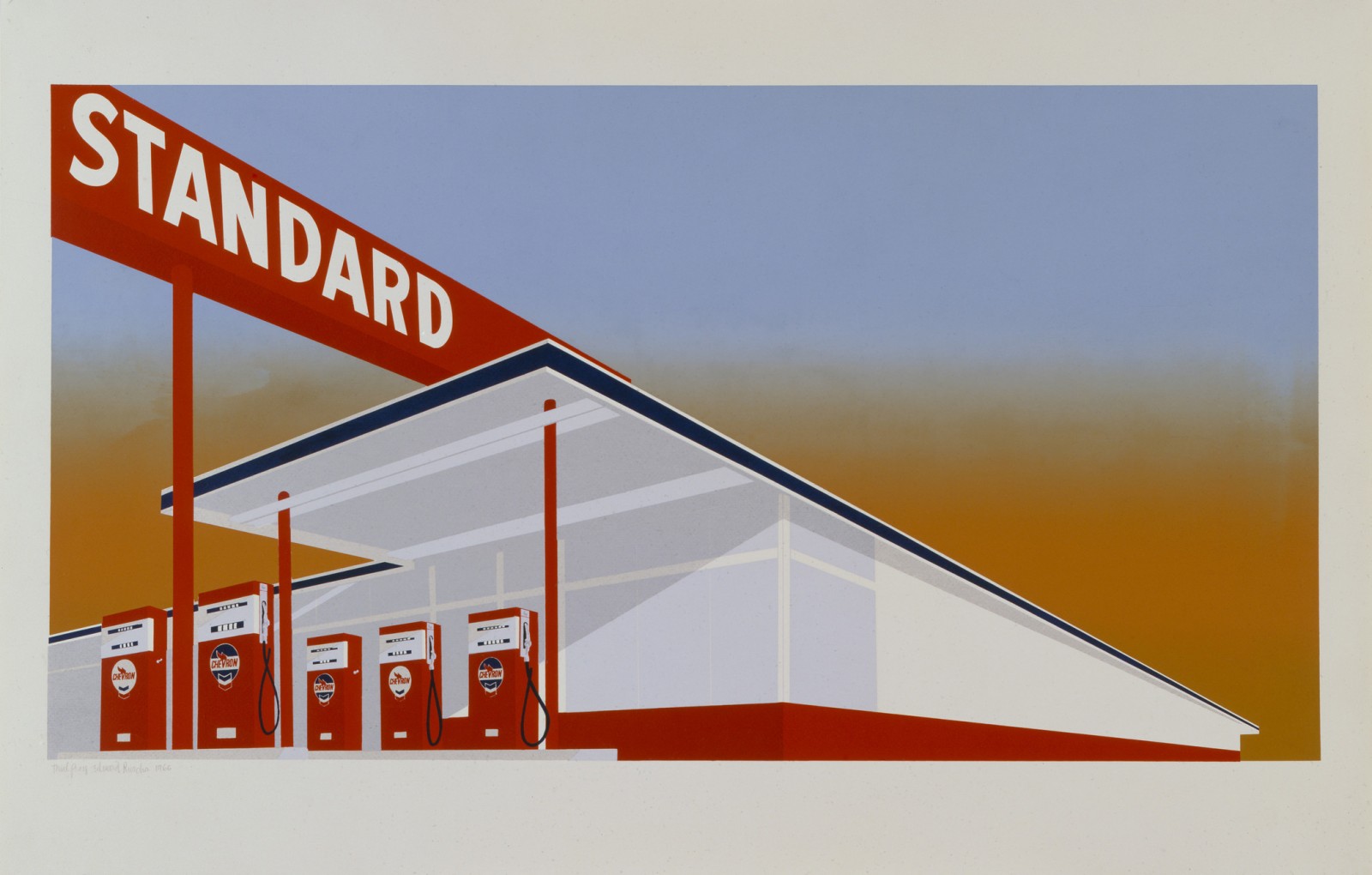
Ruscha’s current auction record is held by Standard Station, Ten-Cent Western Being Torn in Half, a vast 1964 painting of a Standard Oil gas station shot from a dramatically low angle, with a torn Western paperback flying across a cloudless blue sky. In Christie’s 20th Century Evening Sale in New York on 19 November 2024, the work sold for about $68.26 million including fees, far above its already ambitious estimate “in excess of $50 million”.
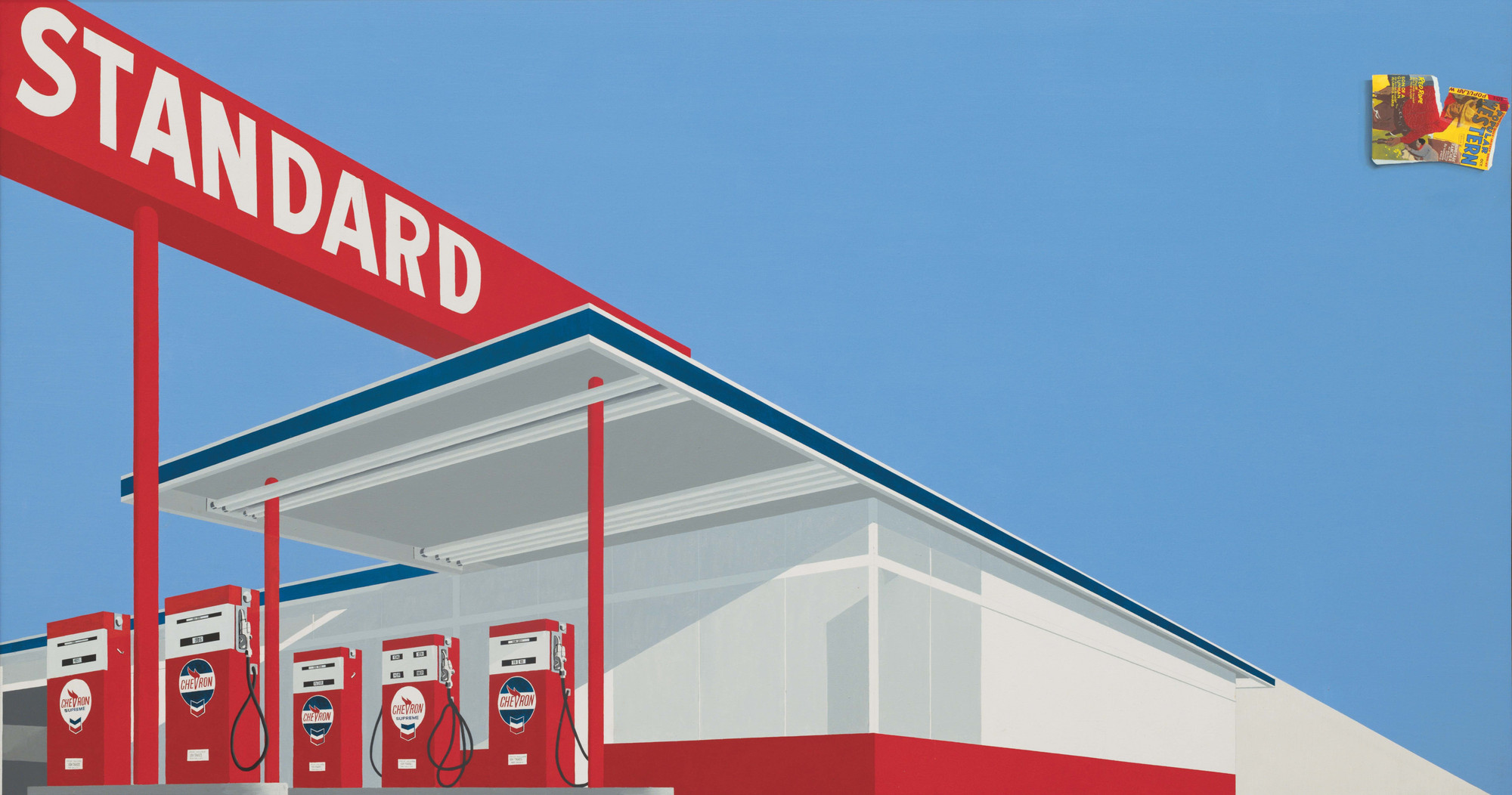
The result more than doubled the hammer price achieved only a year earlier by another major gas-station painting, Burning Standard (1968), which sold for about $22.2 million at Christie’s New York in 2023. It also eclipsed Ruscha’s previous overall record of $52.48 million for Hurting the Word Radio #2, marking roughly a 30% jump at the top of his market.
.jpg?mode=max)
Standard Station concentrates several of Ruscha’s most powerful themes. The gas station comes from his lifelong habit of photographing ordinary sites along Route 66 between Oklahoma and Los Angeles, then amplifying them into icons of American mobility and corporate power. The ripped paperback adds a note of violence and fragility, as if mass-produced entertainment and infrastructure are literally being torn apart. Critics have long regarded this painting as one of his most important works; it has been shown at the Museum of Modern Art, the San Francisco Museum of Modern Art, and other major institutions, and it was a key image in MoMA’s sprawling retrospective “ED RUSCHA / NOW THEN” in 2023–24.When such a celebrated, museum-level work finally re-enters the market after decades in a single distinguished collection, competition among top-tier collectors is almost guaranteed, and that scarcity is visible in the final price.
Language under pressure: Hurting the Word Radio #2 (1964)
Before Standard Station, Ruscha’s record was held by another 1964 canvas, Hurting the Word Radio #2. This painting shows the word “RADIO” in bold yellow capitals against a blue background, with two metal clamps visibly squeezing the letters “R” and “O.” In Christie’s Post-War and Contemporary Art Evening Sale in November 2019, the work sold for about $52.48 million, after a bidding contest that quickly pushed it past a presale estimate of $30–40 million and more than $30.4 million previously paid for Smash.
/edruschab1937hurtingthewordradio219642400new.jpg?h=2400&iar=0&w=2242&rev=8011aff137184c96ae855123f63b448d&hash=acbdf963af6cbbb96c2ec6bc72ac5298a7092ad1)
Hurting the Word Radio #2 belongs to the small group of early “text paintings” that established Ruscha’s reputation in the 1960s. These works treat language as both an image and a physical object, subject to distortion and stress. Here, the clamps literalise the pressure of mass media, compressing the word “RADIO” into something almost corporeal. Contemporary critics already see these paintings as bridging Pop’s fascination with advertising and logos and the emerging concerns of Conceptual art around language and meaning. That dual status helps explain why collectors regard them as career-defining.
The 2019 result sent a strong signal about the depth of demand for best-in-class Ruscha paintings. It was achieved in a relatively mature art market, not at the height of a speculative boom, and it immediately repositioned Ruscha among the world’s most expensive living artists, putting his auction record in the same general bracket as top sales by Hockney and Koons.
The clamp series and the power of single words: Securing the Last Letter (Boss) (1964)
The second-highest price for Ruscha is now Securing the Last Letter (Boss), another 1964 text painting. In November 2023, Sotheby’s sold the canvas from the celebrated Emily Fisher Landau collection in New York for about $39.4 million, with a hammer price of $34 million against an estimate of $35–40 million.

The work shows the word “BOSS” in orange capitals on a deep blue field, with a C-clamp crushing the top of the final “S.” As with Hurting the Word Radio #2, the clamp motif suggests language being physically manipulated, but here the word itself adds a layer of social and psychological tension. Who is the “boss”? Is it a literal authority figure, a brand, or a stand-in for power in general? The ambiguity has made the painting a touchstone in discussions of Ruscha’s deadpan critique of American hierarchies. The fact that it came from one of the most prestigious American private collections, and that it formed part of a highly publicised single-owner sale, added to the competition and final price.
This result confirmed that the most valuable segment of the Ruscha market is a tight cluster of early to mid-1960s word paintings in which language is rendered with crisp graphic force and subjected to some kind of physical stress or unusual material treatment. Collectors are clearly willing to pay a premium for works that combine that conceptual edge with strong provenance and exhibition history.
The earlier record breaker: Smash (1963)
Before 2019, Ruscha’s top auction price was set in 2014 by Smash, a 1963 painting emblazoned with the word “SMASH” in yellow lettering on a dark background. The work realised about $30.4 million at Christie’s New York, at the time a dramatic jump over his previous auction highs.

Smash is another early text painting that draws directly on the language and typography of American advertising and comic books. The single onomatopoeic word can be read as an action, an exclamation, or a metaphor for the shock of mass media images themselves. When this result was achieved, it marked the point at which Ruscha’s market moved decisively into the realm of blue-chip trophies, no longer limited to six- or low seven-figure sums. Looking back from 2025, Smash feels like an early indicator of where top-end demand was heading.
Beyond records: the rest of the top tier
Below these headline results, auction records for Ruscha’s paintings form a remarkably coherent group. According to market analyses, nine of his ten highest auction prices are for works produced between 1962 and 1969, and all are either text paintings, gas-station images, or the closely related series of “liquid word” canvases.
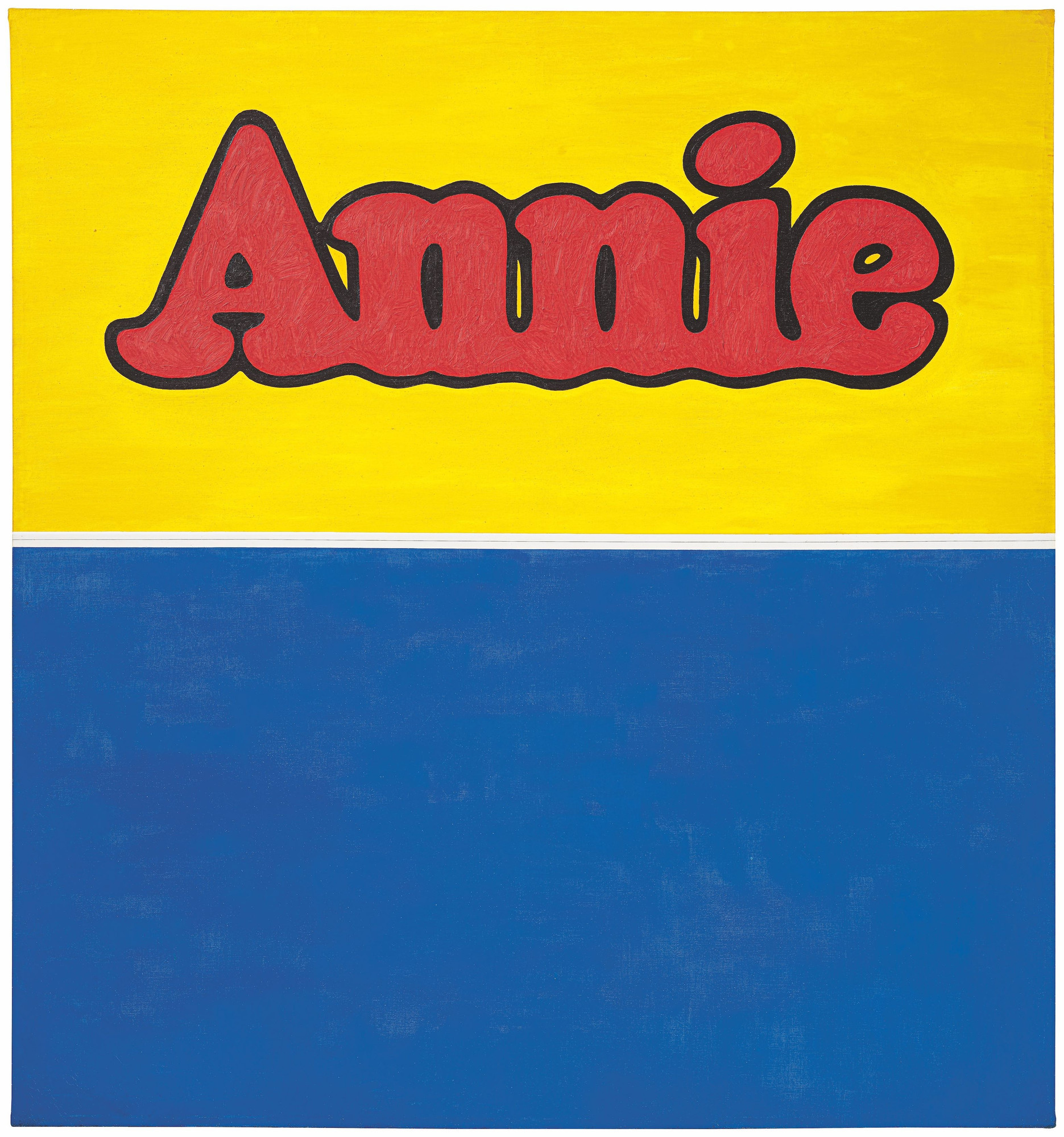
Annie (1962), for example, realised about $22.98 million at Christie’s New York in 2020. The canvas magnifies the logo of the American comic strip “Little Orphan Annie,” with bright red lettering outlined in black against a yellow-and-blue background. The work has long been regarded as a turning point, because it takes a humble comic logo and gives it the monumentality and gravitas of history painting. It also prefigures Ruscha’s later interest in brand names and emblems, from SPAM cans to the Hollywood sign.
Among the gas-station works, Burning Gas Station (1966–69) reached about $22.26 million at Christie’s New York in May 2023, becoming the most expensive gas-station painting sold at auction until Standard Station eclipsed it a year later.The painting shows a white-and-red Standard station engulfed in flames under a sickly green sky, with dark smoke billowing upwards. Here the cool geometry of corporate architecture collides with a very literal form of destruction, echoing the artist’s broader fascination with fire that critics have noted in many works across different media.
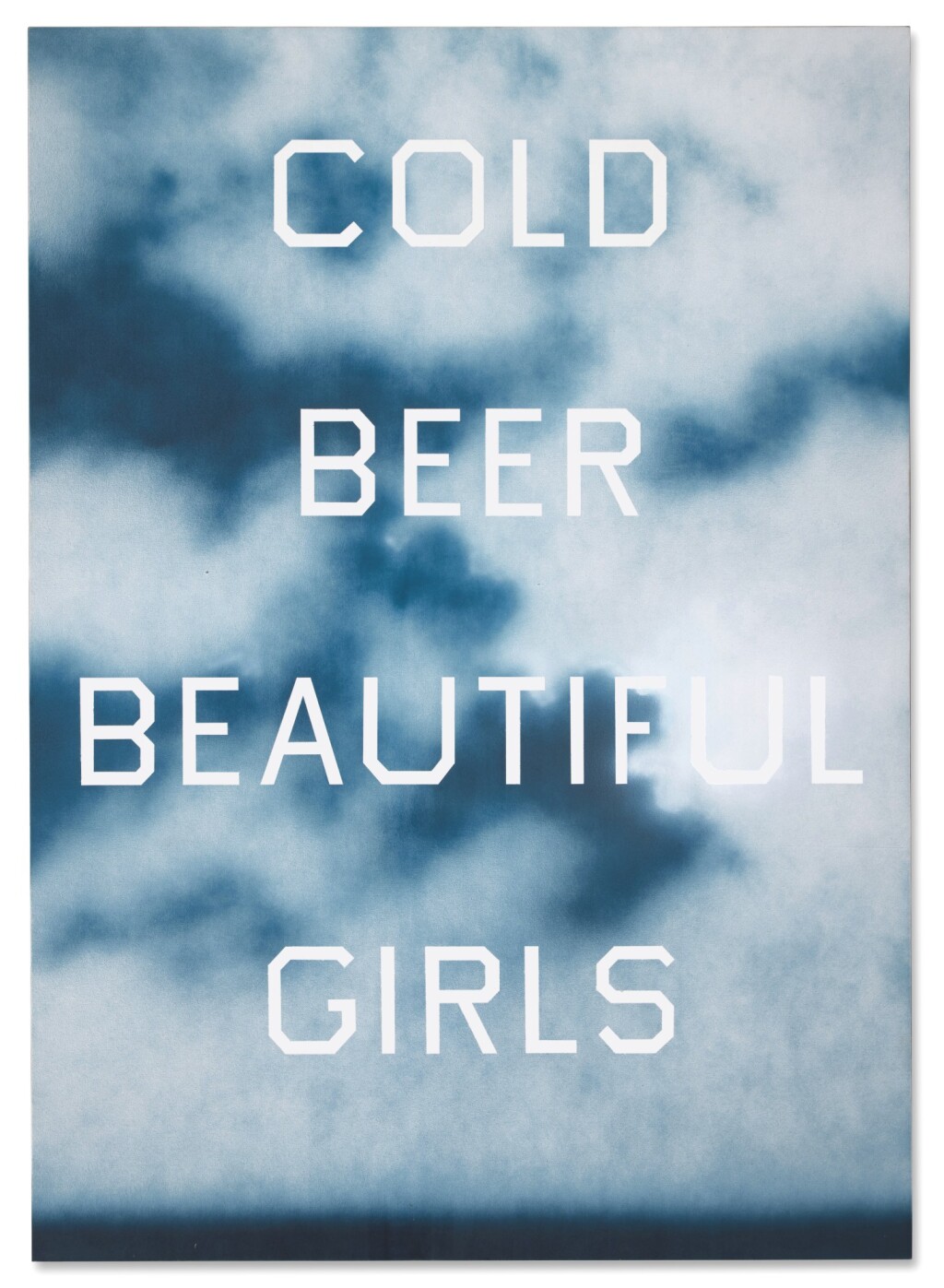
Other high-ranking results include Cold Beer Beautiful Girls (1993), which sold for around $18.8 million in 2022; Ripe (1967), one of the early “liquid word” paintings, which made about $20 million in 2021; and Mint (Green) (1968), another liquid word canvas that achieved roughly $12.97 million in 2023. These results show that while the 1960s remain the core decade, exceptional later works that return to the single-word format and the atmosphere of American advertising can also command very high prices.
Prints and multiples: depth beneath the peaks
The towering prices for Ruscha’s paintings sit atop a surprisingly broad and active market for his prints and multiples. Market studies note that thousands of Ed Ruscha prints have been auctioned, with a strong concentration in screenprints, lithographs, and artist’s books.
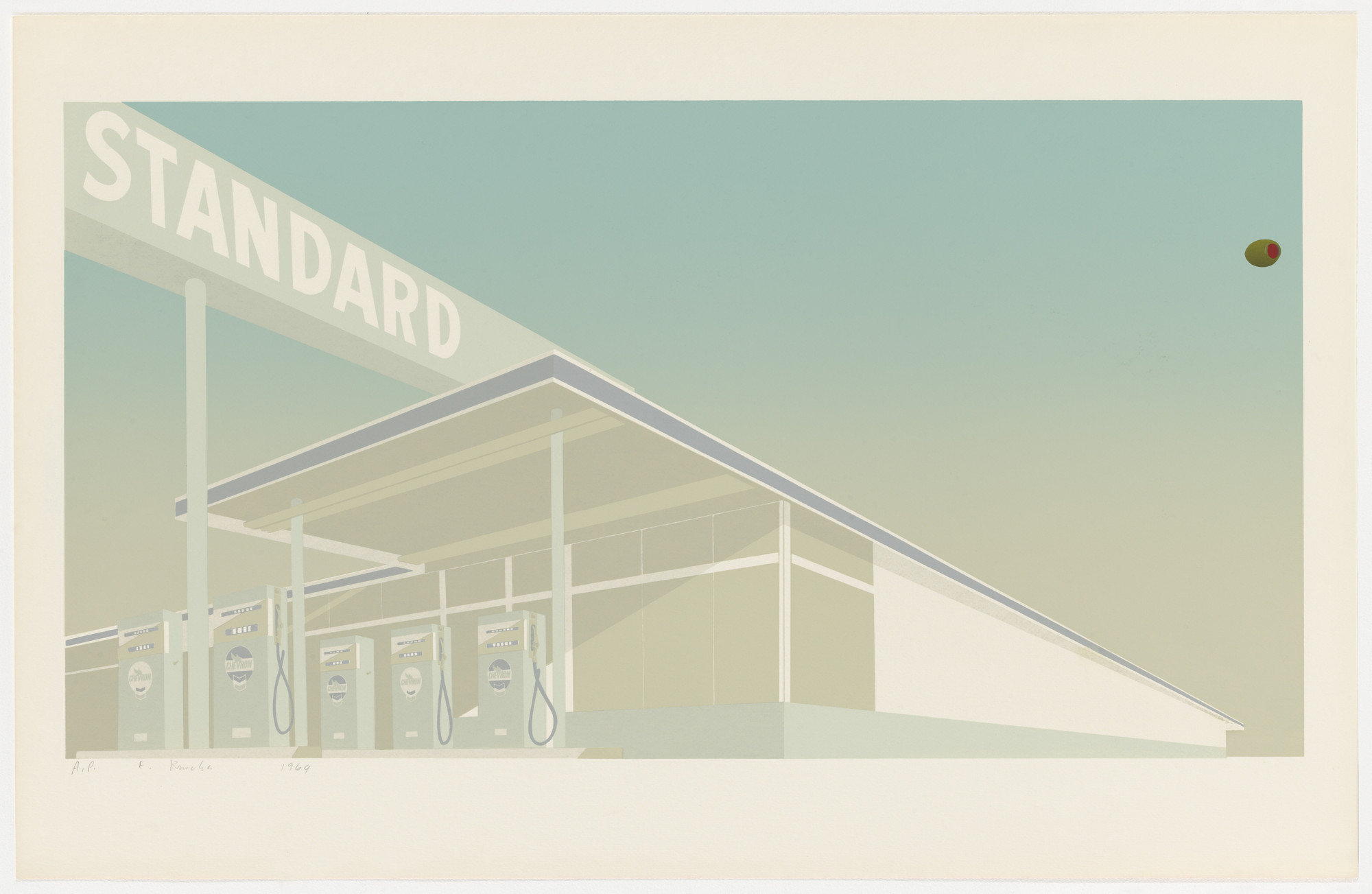
The best-known print is probably the 1968 colour screenprint Hollywood, which translates the famous hillside sign into a broad, cinematic panorama. Examples routinely achieve over £10,000 at auction, and a especially desirable sunset-toned version sold at Bonhams in 2021 for about £118,279 (approximately $160,000–$170,000 at the time). Christie’s has also sold impressions for well over $100,000. More recent analyses estimate signed impressions of Hollywood at between $90,000 and $200,000, with steady annual growth.
Although these numbers are far below the prices for the top paintings, they matter for understanding overall demand. They show that collectors at many price points want access to Ruscha’s imagery and that certain motifs, particularly the Hollywood sign and gas stations, have become instantly recognisable visual brands. This depth helps support the confidence of buyers who are willing to compete fiercely for the rarest and most important canvases.
Museum validation and the MoMA / LACMA retrospective
Museum exhibitions often play a critical role in cementing an artist’s reputation and, indirectly, supporting high valuations. In Ruscha’s case, the MoMA exhibition “ED RUSCHA / NOW THEN,” co-organised with the Los Angeles County Museum of Art and held from September 2023 to January 2024, marked the most comprehensive retrospective of his career to date, with more than 200 works spanning six decades.
Critics across the board emphasised the show’s focus on language, the American road, and the persistent presence of fire, gas stations, and commercial signage. Reviews noted how the exhibition revealed the coherence of Ruscha’s project over time: even when he shifts materials or formats, he keeps returning to the same themes of signage, landscape, and vernacular speech It is no accident that Standard Station, Ten-Cent Western Being Torn in Half was a key image in the show and then reappeared a year later at auction with a price far above its already ambitious estimate. The retrospective helped remind both institutions and collectors that the gas-station paintings are not just stylish Pop images, but canonical works of post-war American art.
Statistical picture: sell-through and ranking
If we move beyond individual works and look at the data, Ruscha’s market appears both deep and resilient. Auction databases tracking his sales show more than 1,400 auction records, with an overall sell-through rate around 80% and the highest price now recorded at $68.26 million for Standard Station. Print-market platforms place him very high in global rankings by auction turnover for 2023, reflecting both the strength of the top paintings and the large number of transactions in the middle market.
This combination of a strong top end and a healthy middle layer matters for long-term value. Artists whose markets are driven only by a handful of trophy works can be vulnerable if fashion changes. Ruscha, by contrast, has a steady flow of works in the five- and six-figure ranges – especially prints, works on paper, and lesser-known paintings – that reinforce the perception of consistent demand.
What collectors are really paying for
If we analyse the most expensive works together, clear patterns emerge. First, chronology is crucial. The highest prices cluster in a roughly eight-year window from 1962 to 1969. Collectors view this as Ruscha’s breakthrough period, when he fused Pop imagery with conceptual investigations of language and began to define his core motifs. This pattern mirrors what we see in markets for many major post-war artists, where early, innovative series command a premium over later variations.
Second, certain categories of imagery are favoured. Text paintings that present a single word or short phrase in a bold, graphic font, especially when combined with physical distortion or “liquid” effects, consistently rank near the top. Works featuring clamps, dripping letters, or unusual textures such as gunpowder or syrup are particularly coveted, perhaps because they visualise the tension between language as a system of signs and language as material substance. Paintings featuring gas stations, whether static or engulfed in flames, form another key cluster, tapping into the mythology of the American West and the romance of the open road.

Third, scale, provenance, and exhibition history play a decisive role. The record-breaking Standard Station is a wall-sized canvas with a long history of museum loans, previously owned by prominent collectors. Hurting the Word Radio #2 and Securing the Last Letter (Boss) are likewise large, early canvases with strong provenance and well-documented exhibition careers. When multiple desirable attributes coincide – early date, iconic motif, large scale, and top-tier provenance – prices rise dramatically.
Finally, timing and macro conditions matter. Many of Ruscha’s highest prices have been achieved in the past decade, a period that has seen an intense global focus on post-war American art and a surge in demand for works that sit at the intersection of Pop and Conceptual practices. Even during periods of broader market uncertainty, such as the years around the Covid-19 pandemic and subsequent economic volatility, his best works have continued to sell strongly, suggesting that top collectors view them as relatively secure long-term stores of value.
Outlook: Ruscha’s market after the gas-station record
With Standard Station, Ten-Cent Western Being Torn in Half now firmly established as a benchmark, the question becomes how much room there is for further growth. In real terms, the jump from about $52.5 million for Hurting the Word Radio #2 in 2019 to roughly $68.3 million in 2024 represents a substantial increase in top-end confidence, especially given the more cautious tenor of parts of the art market in the mid-2020s.
Going forward, it is reasonable to expect that only a handful of works could surpass this record. Likely candidates would include other major gas-station paintings, museum-quality early text works that have remained off the market for decades, or perhaps a truly exceptional “liquid word” canvas with a stellar exhibition and ownership history. The MoMA and LACMA retrospective has already done much of the work of canon formation, solidifying a consensus about which series are most important.
For collectors who are not competing at the level of $20–60 million, the market for prints and works on paper offers entry points that still show meaningful growth, especially for key images such as Hollywood. The connection between these more accessible works and the headline-making paintings should not be underestimated: museums routinely show them together, and the iconography circulates across media in a way that keeps the entire market lively.
In short, the story told by the most expensive Ed Ruscha artworks is a story of an artist whose key ideas have proven remarkably durable. By compressing the language and imagery of post-war America into spare, resonant images – a single word clamped and twisted, a gas station lit like a temple, a comic-strip logo blown up to monumental scale – Ruscha created a set of icons that speak both to their own time and to ours. The market’s willingness to pay tens of millions for those icons reflects not just speculation, but a broad, institutionalised belief that these paintings will remain central to the story of post-war art for decades to come.
Explore Ed Ruscha signed prints for sale and contact our galleries via info@guyhepner.com for current availabilities.