
The market for Yayoi Kusama has undergone a profound transformation over the past two decades, evolving from niche recognition to a globally institutionalised phenomenon characterised by exceptional auction results, museum-level demand, and sustained public visibility. Once considered a pioneering but marginal figure within the post-war avant-garde, Kusama has become one of the most commercially successful artists of her generation, with individual works consistently commanding multi-million-dollar prices and frequently breaking internal records. The rise of her market is not merely the result of speculative enthusiasm; it reflects a convergence of art-historical reassessment, curatorial validation, and the commercial power of culturally legible motifs—dots, pumpkins, Infinity Nets, and flowers—that have attained universal recognition across continents.

The most expensive Kusama works sold at auction provide an instructive lens through which to examine the dynamics of value formation within contemporary art. The top lots reveal a hierarchy of series, formats, and periods that shape collector priorities, with early New York Infinity Net paintings, monumental sculptures, and large-scale late floral works occupying the uppermost tier. At the same time, auction geography has shifted markedly, with Hong Kong emerging as a central arena for record prices, signalling changing patterns of global demand and the growing influence of Asian collectors in the high-end contemporary market. These results also highlight structural issues that continue to define contemporary art economics, including the relationship between brand legibility, institutional representation, scarcity, and the symbolic status of works sold at auction.
This article examines the most expensive Kusama artworks ever sold, analysing individual examples both as cultural artefacts and as market indicators. By considering what these top prices reveal about artistic legacy, collector behaviour, and broader trends in the art economy, the discussion aims to situate Kusama’s auction highs within the larger narrative of 21st-century collecting—where economic value, cultural visibility, and artistic innovation intersect in highly visible and publicly scrutinised ways.
Yayoi Kusama’s auction highs tell a story that’s bigger than just big numbers. They trace the rise of a 96-year-old artist from outsider to the world’s best-selling contemporary artist, and they map how certain motifs – nets, pumpkins, flowers and dots – have become global blue-chip currencies.
Below is an educational walk-through of her most expensive works sold at auction, and what they reveal about series, geography, gender, and where her market may be heading.
From Infinity Nets to Global Records
For years, Kusama’s auction record was held by early New York “Infinity Nets” paintings such as White No. 28 (1960), which sold for $7.11 million at Christie’s New York in 2014. These large, monochrome canvases of obsessive brushwork were created shortly after she arrived in New York in the late 1950s, and they became the core of her critical reputation.
Since then, her market has not only broadened but shifted. A 2025 analysis by MyArtBroker now identifies a 1959 oil painting, Untitled (Nets), selling for £8.5 million (about $10.5 million) at Phillips New York as the current top auction price for Kusama. That sale significantly exceeded its estimate and nudged her record into eight-figure territory in dollars.
At the same time, Kusama has become a phenomenon at a macro level. The Hiscox Artist Top 100 report shows she generated about $80.9 million in auction sales in 2023, making her the top-selling 21st-century artist, ahead of David Hockney. Roughly 80% of those post-2000 works were sold in Hong Kong, highlighting how Asian demand now drives her high end.
So the headline picture is clear: the very top prices still cluster around monumental paintings from the Infinity Nets and related abstraction, but recent years have seen pumpkins, flower canvases, and large bronzes catch up – especially in Asia.
The Current Record: Untitled (Nets), 1959
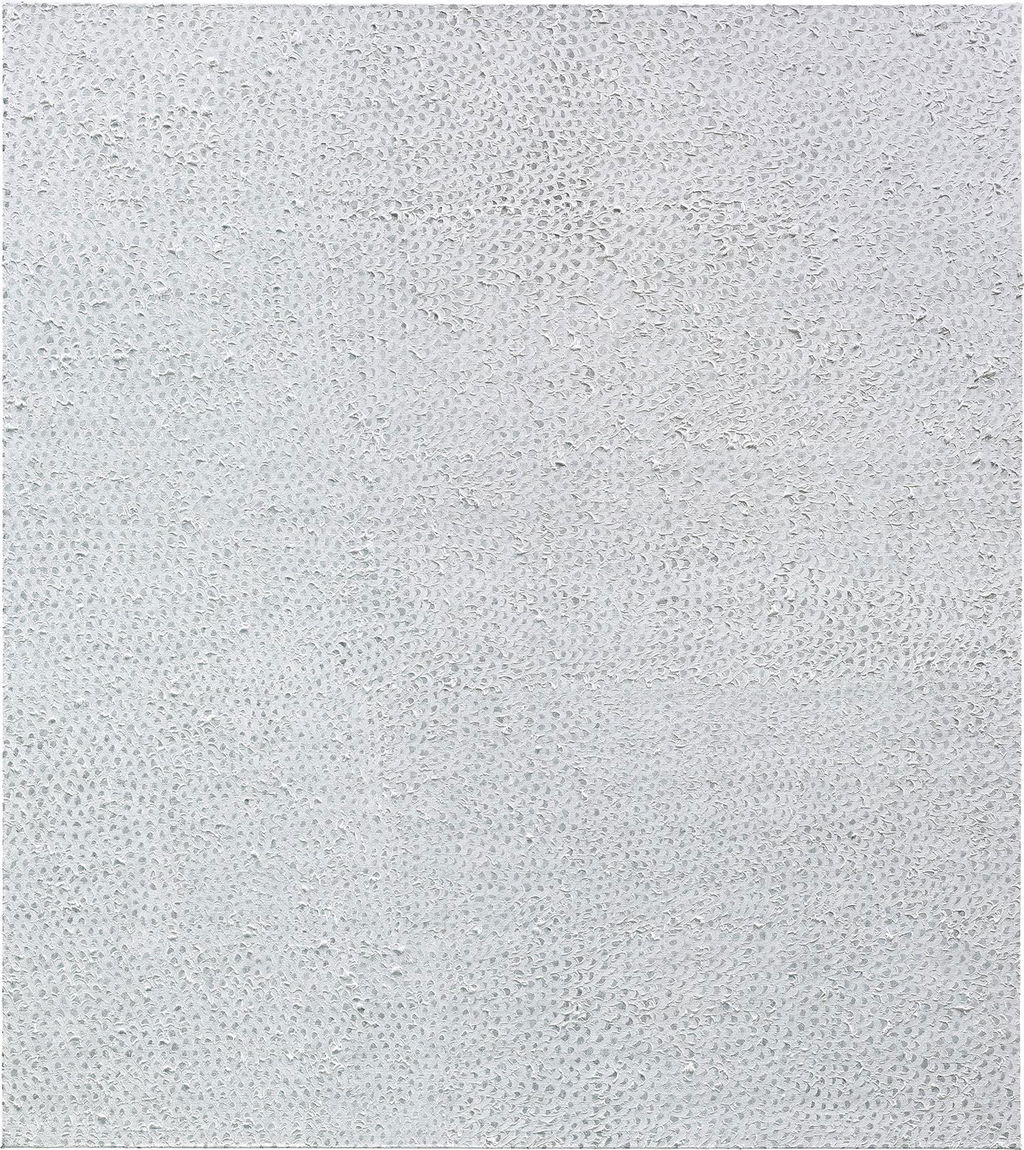
Price: $10.5m USD
Medium: Oil on canvas
Sale: Phillips, 20th Century & Contemporary Art Evening Sale, New York
Date: 2020s (reported in 2025 price survey)
This work sits at the intersection of art history and market logic:
-
It dates from 1959, the moment Kusama is fully consolidating her Infinity Nets language in New York.
-
Visually, it is a dense field of looping, semi-mechanical brushmarks on a pale ground, a kind of proto-minimalism that predates and dialogues with contemporaries like Agnes Martin or early Judd.
-
Conceptually, Kusama described being wrapped in a “magical curtain of mysterious, invisible power” when working on these nets – a mix of obsessive repetition and psychological self-obliteration.
Why does it make sense that Untitled (Nets) is the current record?
-
Art-historical primacy: Early Nets are the foundation of her career and the series most written about in scholarship.
-
Rarity and scale: Large, early canvases are scarce; many are in museums or long-term private collections.
-
Western evening sale context: A major New York evening sale maximises global competition among American and European buyers, not just Asian demand.
The record pushes Kusama firmly into the same pricing tier as many established male contemporaries, which matters symbolically in a market still dominated by men.
White No. 28 (1960): The Long-standing Record

Price: $7.11m USD
Medium: Oil on canvas
Sale: Christie’s New York, Post-War & Contemporary Evening Sale
Date: November 2014
For almost a decade, market commentary routinely cited White No. 28 as Kusama’s auction record. It remains one of the most important benchmarks for her market:
-
It is an archetypal white Infinity Net: hovering between minimalism and psychedelia, yet pre-dating both.
-
The work has impeccable provenance and exhibition history, moving through important New York galleries and entering the secondary market at the precise moment global collectors were revaluing post-war abstraction.
Educationally, White No. 28 is a perfect case study in how value forms around:
-
Series importance: early Infinity Nets are core canon.
-
Provenance: strong gallery or private collection histories reassure buyers.
-
Auction timing: it appeared in a blockbuster evening sale that itself broke records, pulling the price upward.
The New Wave: A Flower and the Rise of Late Floral Paintings
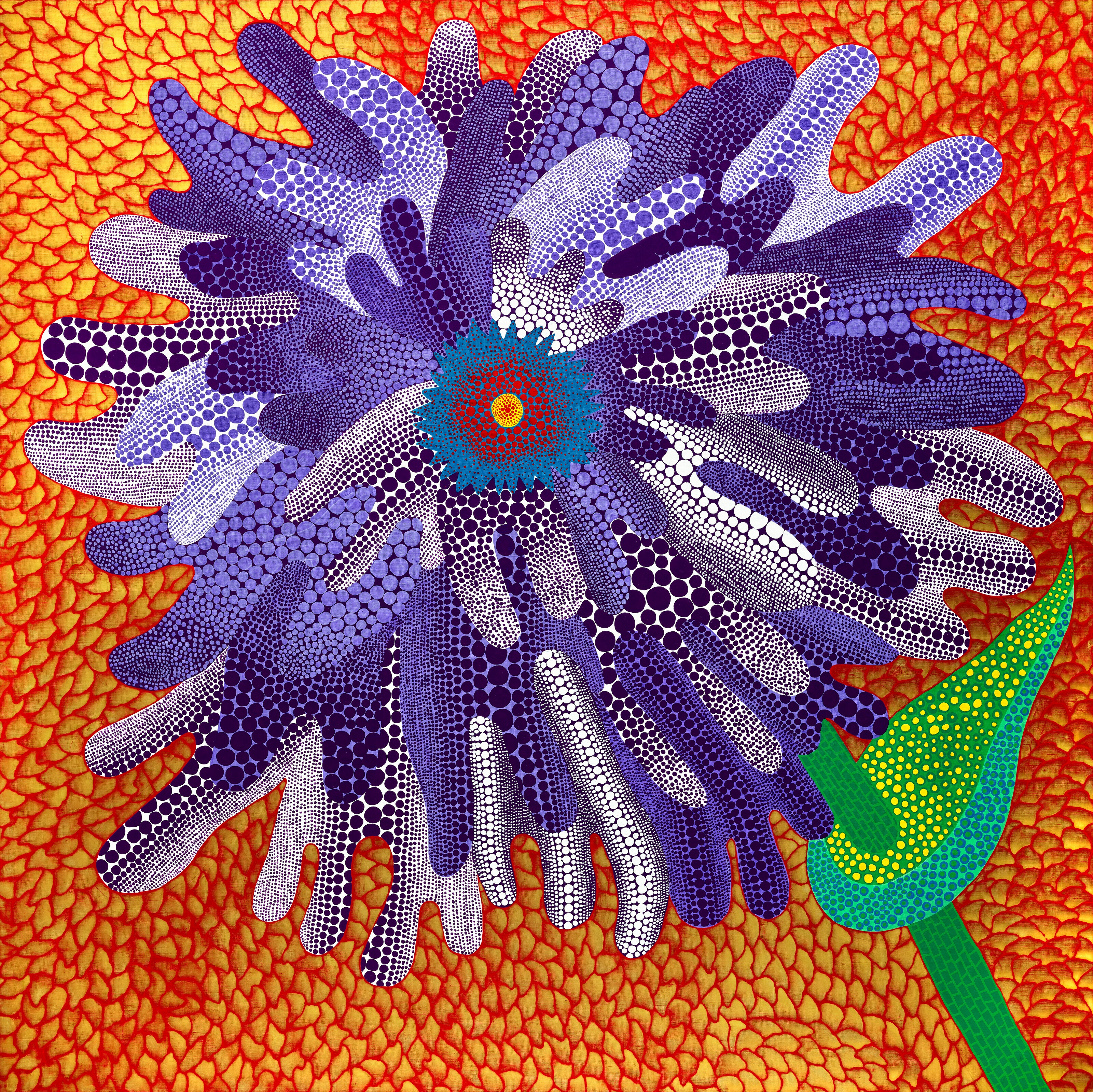
Price: $8.3m USD
Medium: Acrylic on canvas
Sale: Christie’s Hong Kong
Date: 2023
A Flower (2014) is a large, all-over image of a purple dahlia exploding across an orange field, animated by Kusama’s signature dots. It is significant for several reasons:
-
It’s a very late work – painted when Kusama was already in her mid-80s.
-
It is not an Infinity Net canvas but a fully figurative floral picture.
-
It sold in Hong Kong, not New York or London, at a price that rivals her early New York abstractions.
This sale shows how post-2000 works can now compete price-wise with 1960s paintings, provided they are large, visually iconic, and tied to globally recognisable motifs. It also illustrates how the centre of gravity for her high end has shifted to Asian auction rooms, fuelled by major regional retrospectives and Kusama’s huge public visibility.
Monumental Pumpkins: Sculptural Records and Yellow Icons
Pumpkins, which Kusama associates with childhood comfort and self-obliteration, are now some of her most coveted images across painting, sculpture and installation.
Pumpkin (L), 2014 – Record for Sculpture
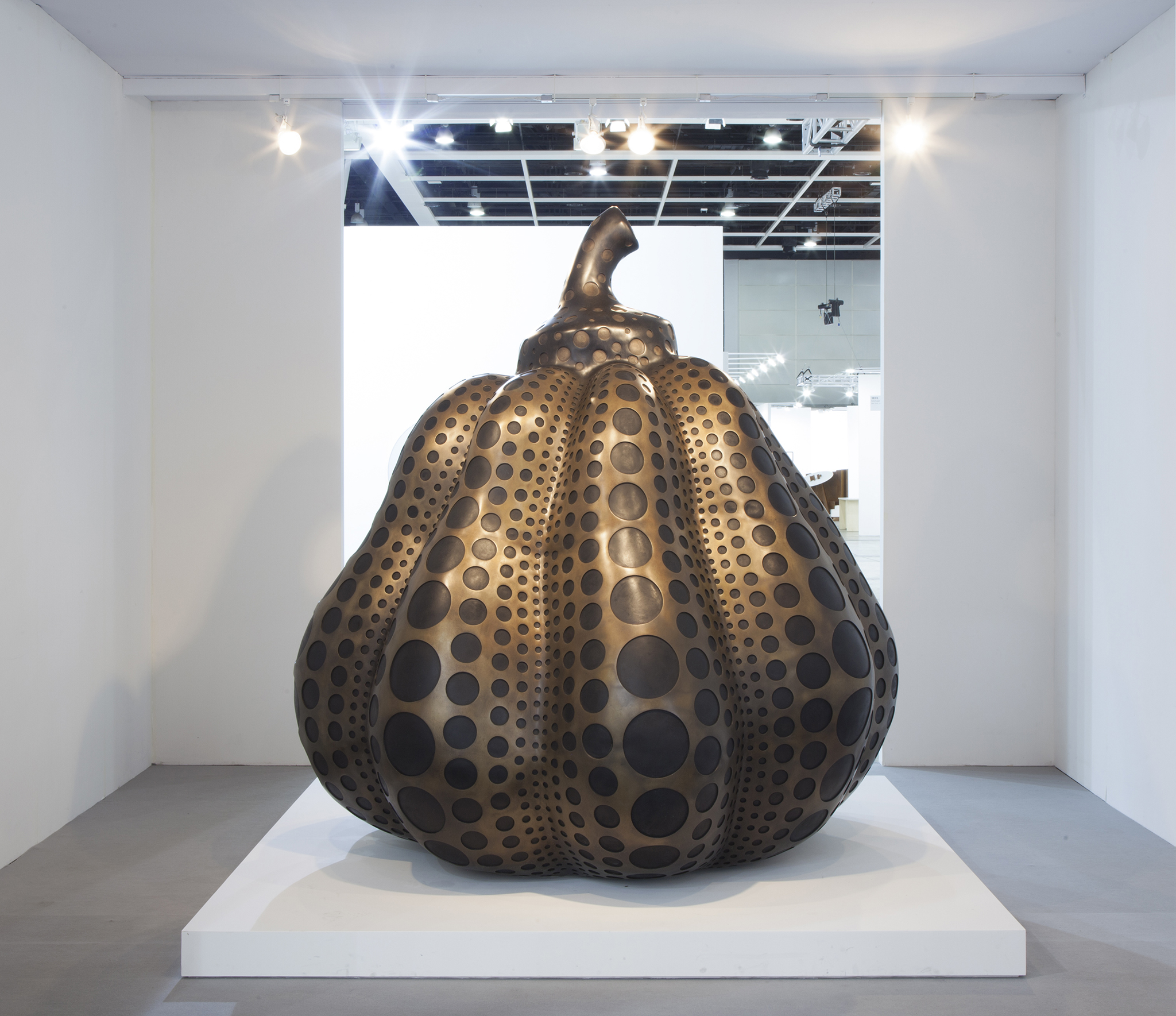
Price: $8.5m USD
Medium: Bronze sculpture, polka-dotted pumpkin
Sale: Sotheby’s Hong Kong, April 2023
This monumental bronze Pumpkin (L) is the largest in a sculptural series (edition of 8 + 2 APs). It set a record for Kusama sculpture at auction:
-
It confirmed that three-dimensional pumpkins have joined paintings at the very top of her market.
-
The work’s monumental presence echoes her outdoor pumpkin installations and mirror rooms, making it both sculpture and brand icon.
-
From a collector’s point of view, it has the feel of a blue-chip “trophy” that can anchor a collection, much like a Jeff Koons balloon dog or a Hirst spot cabinet.
A-Pumpkin (BAGN8), 2011; Pumpkin (M), 2014; Pumpkin (1995)

Other pumpkin works in the current top-ten prices include:
-
A-Pumpkin (BAGN8) (2011), a tall pumpkin canvas set against a netted background, sold for about $7.4m at Sotheby’s in 2023.
-
Pumpkin (M) (2014), a bronze pumpkin from the second-largest sculptural series, realised about $7.2m in New York.
-
A large 1995 pumpkin painting achieved around £7.6m at Phillips in 2023.
When you step back, the pattern is clear: multiple pumpkin works – across painting and sculpture – now sit in the $7–8m band, showing that this motif is not a one-off but an entire price tier of its own.
Other High Flyers: Flowers, Infinity Nets and Hybrids
.jpg?mode=max)
Beyond nets and pumpkins, several works blend Kusama’s core ideas:
-
Interminable Net No. 4 (1959) – sold for about $8.1m at Sotheby’s Hong Kong in 2019, a pure Infinity Net canvas created in New York.
-
Flowers (2015) – a huge floral painting that achieved just over $8m at Christie’s Hong Kong, affirming demand for late floral canvases.
-
Infinity Nets (TWHOQ) (2006) – a gold, triptych net painting that sold for about $7.5m in 2022, more than double its price from a 2019 auction, showing strong repeat-sale growth for key works.
Meanwhile, Artnet’s earlier 2015 list of Kusama’s top auction results still reads like a roll-call of Infinity Nets: No. Red B, Interminable Net #3, No. 2, No. Red A.B.C., No. G.A. White, No. E and others, all in the $2–7m band.These are now part of a deeper, second tier of high-value Nets beneath the latest record.
Prints and Portfolios: The Editioned Market at the Top End
Kusama’s prints and edition market operates at a different price scale but mirrors the same logic: key motifs, strong series, and high-quality production.
One frequently cited benchmark is the portfolio Amour Pour Toujours – a set of ten glittered screenprints. A complete set sold at Phillips in 2021 for about $360,000 USD, a record for her prints. Individual prints from the series often reach five-figure sums.
For collectors, this is crucial: multi-million prices at the top do not exist in isolation. They sit above a deep, liquid market in editions—pumpkin prints, dots, flowers—that give Kusama both breadth and resilience.
Geographic and Demographic Shifts: Why Hong Kong Matters
One of the most striking trends in Kusama’s top prices is where they happen:
-
White No. 28 and some early Nets set records in New York in the 2000s–2010s.
-
Since around 2019, many of the highest prices – Interminable Net No. 4, A Flower, Pumpkin (L), Pumpkin (LPASG) and others – have been achieved in Hong Kong.
The Hiscox Artist Top 100 report and subsequent coverage note that around 80% of auctioned Kusama works created after 2000 are sold in Hong Kong. That reflects:
-
A strong Asian collector base – both regional buyers and Western buyers bidding into Asian sales.
-
The impact of blockbuster exhibitions such as Yayoi Kusama: 1945 to Now at M+ in Hong Kong, and large-scale retrospectives in Tokyo and Melbourne that create huge public demand.
-
The fact that luxury and fashion collaborations – notably her renewed partnership with Louis Vuitton in 2023, complete with giant Kusama figures on Paris and London storefronts – have turned her into a pop-cultural icon whose work feels at home in a luxury-goods capital.
In other words, Kusama’s most expensive works are not just high art; they are status objects in a global luxury ecosystem, and Hong Kong has become a main stage for that.

Gender, Age and Market Power
Kusama’s top auction prices also matter in the context of gender and age:
-
She is one of the few women artists whose best paintings trade in the $7–10m range.
-
Reports show she was the top-selling contemporary artist at auction in 2023 and again in 2024/2025, beating male peers like Hockney and Yoshitomo Nara, even as the broader post-2000 art market has cooled.
-
Cumulative auction sales over the last quarter-century are estimated at over $1.17 billion, underscoring how sustained and deep her market has become.
Educationally, her trajectory shows how long-term consistency, recognisable motifs, and institutional backing can allow a female artist to break through historic ceiling prices, even if the very highest records are still dominated by male names.
What These Top Prices Teach Collectors
Looking across the most expensive Kusama works, several consistent value drivers emerge:
-
Series and Motifs
-
Top prices overwhelmingly belong to Infinity Nets, pumpkins, and large flower canvases.
-
These are the motifs most frequently seen in museum retrospectives and major installations, so they concentrate demand.
- Scale and Presence
-
Monumental canvases and large bronzes dominate the upper tier. Smaller works – even rare ones – typically fall into lower price bands.
-
Sculptural pumpkins benefit from being both public icons and physically imposing.
-
Chronology
-
Late works (2010s–2020s) can now match 1960s paintings when they are large, visually powerful and from key series (pumpkins/flowers).
-
However, early New York Nets still carry an art-historical premium that is difficult to replicate.
-
Geography & Timing
-
Hong Kong evening sales are now a crucial venue for major Kusama works, especially post-2000 paintings and sculpture.
-
Record prices often coincide with major exhibitions or media attention, amplifying visibility and competition at auction.
-
Prints and Editions as On-Ramps
-
High auction records for portfolios like Amour Pour Toujours and steady growth in pumpkin prints show that Kusama’s edition market is both deep and structured, offering multiple entry points for new collectors below painting-level prices.
-
Market Resilience
-
Even as the broader post-2000 market has seen a contraction in high-end speculative flipping, Kusama’s auction totals remain strong, suggesting a collector-driven, rather than trend-driven, market.
Putting It All Together
The story of Kusama’s most expensive artworks is not just a league table of prices. It is, in effect, a map of her entire practice:
-
Infinity Nets represent the psychologically charged, avant-garde New York years and carry the highest auction records.
-
Pumpkins translate that obsessive energy into a universally accessible, sculptural icon – now supported by multi-million prices in both painting and bronze.
-
Flowers and dots bridge abstraction and figuration, showing how late works can rival early canvases when they crystallise her visual language at monumental scale.
-
Prints and multiples widen the market while reinforcing the brand value of the core motifs.
At the macro level, Kusama now exemplifies how a once-marginalised, non-Western, female artist can become the single highest-grossing contemporary artist at auction, with an ecosystem that spans museum blockbusters, fashion collaborations, Instagram-famous installations and serious eight-figure paintings.
For anyone studying or collecting her work, the current top auction results offer a clear framework:
-
At the very top: early Infinity Nets and major late-career pumpkins/flowers.
-
Right beneath: other significant nets and large pumpkins in the $4–6m USD band.
-
Broad base: a thriving market in prints, smaller paintings, sculptures and merchandise that keeps the wider audience engaged.
