
Ed Ruscha is one of the most important artists of the post-war period. For many collectors, his prints are the most compelling—and most accessible—way into his world of gas stations, Hollywood sunsets and deadpan text. This collecting guide looks at how to approach collecting Ruscha prints with an emphasis on influences and history, the key images to know, and what the current market looks like.
Ruscha in context: influences and history
Born in Omaha in 1937 and raised in Oklahoma City, Ruscha moved to Los Angeles in 1956 to study at Chouinard Art Institute (now CalArts). LA’s car culture, billboards, movie industry and low-slung architecture became his lifelong subject matter. He absorbed European modernism and American commercial design in equal measure: his early influences range from Jasper Johns and Robert Rauschenberg to sign-painting, typography manuals and the graphic clarity of advertising.
At the same time, he was watching the emergence of Pop art in New York and London—Warhol, Lichtenstein, Hamilton—but resisted being boxed into “Pop”. His sensibility is cooler, more literary, and more conceptually driven. Where Warhol turned celebrities and products into icons, Ruscha turned words, gas stations and the Hollywood sign into mute, psychological landscapes.
Printmaking and the artist’s book were central from the beginning. In 1963 he published Twentysix Gasoline Stations, a small, self-published photobook documenting gas stations along Route 66. It is now recognized as a landmark of conceptual art and photography, and its imagery—especially Standard Oil stations—fed directly into his paintings and, crucially, his screenprints.

Across six decades he has experimented with nearly every print technique: lithography, screenprint, etching, aquatint, photo-based processes and unconventional materials. A recent catalogue raisonné of his books, prints and photographic editions documents more than 500 graphic works between 1960 and 2022, underscoring how central editions are to his practice.
For collectors, that long trajectory matters. You’re not buying spin-off “merch” from a painter; you’re buying into one of the most sustained and innovative print oeuvres of the late 20th and early 21st centuries.
Why prints are such a strong way to collect Ruscha
A few structural points make Ruscha prints particularly attractive:
Conceptual parity with the paintings. Many key images—Standard Station, Hollywood, the Mountain series—exist in both painting and print form. The prints are not secondary; they’re parallel explorations with their own technical and aesthetic logic.
Graphic punch. Ruscha’s vocabulary—flat colour fields, sharp diagonal perspectives, crisp typography—translates exceptionally well into print media, especially screenprint and lithography. The visual impact of the prints often rivals that of the paintings.
Historical importance of books and editions. As an early pioneer of the artist’s book, Ruscha has always treated reproducibility as an artistic statement, not a compromise. Some prints function almost like pages torn from imaginary books, complete with colophons and typographic notes.
Range of price points. Prints span a broad spectrum: from lower five-figure works to pieces that now command mid- to high-six-figure prices at auction. This allows both new and seasoned collectors to participate.
Key print series and “must-know” works
The Standard Station series (1966 and related)
If there is one image that defines Ruscha’s printmaking, it is Standard Station (1966), a screenprint derived from his earlier painting Standard Station, Amarillo, Texas. The composition is brutally simple: a diagonally foreshortened gas station with the word “STANDARD” screaming across the top, rendered in flat, high-key colour. The result is part CinemaScope, part corporate logo, part roadside apparition.
Why it matters to collectors:
-
It crystallises his early Pop-Conceptual language: the vernacular of American car culture meets cool formalism.
-
It is widely recognised and extensively reproduced, making it an “index” image for the artist.
-
The edition is relatively small (c. 50 plus proofs), and examples have commanded record prices for a Ruscha print.

Closely related are Mocha Standard and Cheese Mold Standard with Olive, further variations on the gas station motif. A complete set of the Standard Station prints is rare and highly coveted.

Hollywood sign works
The Hollywood sign is to Ruscha what Marilyn was to Warhol: a recurring symbol of glamour, decay and illusion.
Key prints include:
Hollywood (1968) – a panoramic, sunset-orange screenprint where the sign stretches across a dark ridge. It is one of his most recognisable images, with a 100-print edition, and currently trades in the low- to mid-six figures at auction.

Hollywood in the Rain (1970) – a grainy lithograph showing the sign dissolving in mist, accompanied by printed exhibition text in orange. The larger edition (around 220) makes it somewhat more attainable, but key examples still command strong results, with estimates often in the $60,000–100,000 range.
These works encapsulate Ruscha’s fascination with filmic atmosphere: the glamour of Hollywood undercut by bad weather, smog and distance.
Word and phrase prints
Ruscha is perhaps best known for his text works—single words or short phrases staged like film titles or slogans against atmospheric grounds. Prints in this category often have strong crossover appeal with both Pop and conceptual collectors.
Examples include:
-
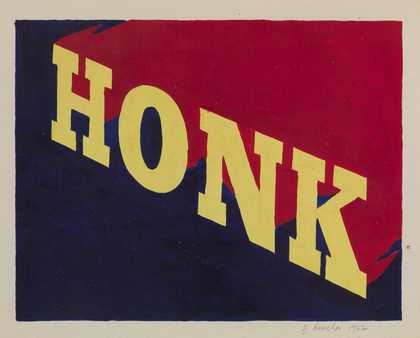
Onomatopoeic words such as HONK, SMASH, OOF (more famous as a painting but echoed in print sensibility).
-
Phrases with philosophical or deadpan bite, like Hollywood is a Verb (various print iterations) or works simply titled Now, Evil, Other, etc., which appear regularly at auction in the $15,000–30,000 range.
Here, typography is everything: Ruscha designs custom letterforms that feel industrial, architectural, or like remnants of mid-century signage.
Landscape and “Mountain” prints
From the 1990s onwards, Ruscha began painting and printing mountains with overlaid text—heroic, kitsch, or banal phrases hovering over sublime peaks. Works such as History Kids (from the Mountain Prints series) and later text-mountain variations show up repeatedly in auction catalogues.
For collectors, these works connect Ruscha’s earlier Hollywood atmospherics with a more overtly romantic landscape tradition, yet the language keeps them sharp and ironic.

Artist’s books and their related prints
While not prints in the strict sense, Ruscha’s early photo-books—Twentysix Gasoline Stations, Every Building on the Sunset Strip, Nine Swimming Pools and a Broken Glass—are crucial context, and some collectors treat them as part of a print portfolio. They are editioned objects and have their own robust market, with desirable early copies and signed examples commanding significant premiums.
Techniques, editions and what to look for
Ruscha has worked with most major print processes; for collectors, understanding the technical aspects helps explain both value and risk.
Techniques you’ll encounter
-
Screenprint: Often used for high-impact works like Standard Station and Hollywood. Expect strong, flat colour; check for even inking and minimal scuffing.
-
Lithography: Favoured for atmospheric pieces like Hollywood in the Rain; can show subtle tonal gradations. Look at the richness of blacks and mid-tones.
-
Etching / aquatint: Less common but used for certain text and line-based works; surface grain and plate tone can be significant.
-
Offset lithograph / photomechanical processes: Some book-related or poster-like works use commercial printing; these can be more affordable but you must be clear about whether you’re dealing with a signed, limited edition or an open “poster” version.
The new Steidl catalogue raisonné of his prints and books is invaluable for verifying technique, edition size, and publishing details.
Edition size and hierarchy
Edition sizes vary widely:
-
Iconic early prints such as Standard Station – edition of 50 (+ proofs).
-
Hollywood – edition of c. 100.
-
Hollywood in the Rain – edition of c. 220.
-
Many later text or mountain prints – often in editions between 30 and 120, depending on the project.
As with most blue-chip print markets:
-
Smaller editions, earlier dates and iconic images sit at the top of the hierarchy.
-
Later, larger-edition prints tend to be more accessibly priced and can be a good entry point, especially if they carry strong themes (Hollywood, language, mountains).

Condition and conservation
Common issues to watch out for in Ruscha prints:
-
Light-fading: particularly in works with delicate colour gradients or large areas of pale tone. Compare colours against good reference images when possible.
-
Paper discolouration or mat burn: many 1960s–70s prints have been poorly framed at some point.
-
Handling creases and scuffs: the flat colour fields of screenprints are unforgiving.
Given how high top prices have gone, collectors increasingly favour works with strong condition reports and minimal restoration.
Market overview: how strong is Ruscha’s print market?
Ruscha’s overall market is firmly blue-chip. Large paintings have achieved prices in the tens of millions; for example, Hurting the Word Radio #2 sold in 2019 for around $52.5 million, underscoring his status among top post-war artists.
Prints are a substantial and growing part of that ecosystem:
-
By some measures, prints account for roughly two-thirds of the works sold at auction by volume, with most examples historically trading between about $1,300 and $6,500, and a significant portion between $6,500 and $66,000.
-
In 2024, a record 199 Ruscha prints were sold at auction in a single year, generating over $1.8 million in turnover—evidence of deep, broad-based demand.
-
Top prints such as Standard Station now sit firmly in the $530,000–790,000+ range, with auction histories stretching back two decades and clear appreciation over time.
Analyses of his auction performance place Ruscha high in global rankings by print-multiple sales volume and turnover—one dataset has him within the top 15 artists worldwide by auction turnover in 2023, with prints forming the majority of those transactions.
Recent high-profile exhibitions and inclusion in major collections (Whitney, MoMA, Tate, LACMA) further support the market. Institutional attention tends to stabilise and deepen demand for works on paper and editions, as museums collect both paintings and print portfolios to tell the full story.
Price bands to think in (approximate, mid-2020s, in USD)
-
Core, recognisable images (Hollywood, Standard Station variants, key word pieces): roughly $80,000–750,000+ depending on icon status, edition size and condition.
-
Strong, mid-tier prints (mountain works, significant word pieces, attractive but less iconic images): about $30,000–150,000.
-
Entry-level or larger-edition works, posters and some book-related pieces: roughly $10,000–30,000 (sometimes lower for unsigned or non-editioned material).
Private sales and dealer pricing can of course run above auction levels, particularly for rare variants, complete sets or works with exceptional provenance.

Collecting strategies: how to build a considered Ruscha print holdings
Decide your thematic focus
Ruscha’s print output is large; a focused strategy helps.
Common collecting “angles”:
-
Gas stations & the road: Standard Station variants, related studies, and gas-station-themed works form a tight narrative around American mobility and corporate branding.
-
Hollywood & LA: Hollywood, Hollywood in the Rain, and other sign/skyline works can anchor a collection about cinema and the city.
-
Language & text: word and phrase prints across decades create an almost literary collection, tracing how his language shifts from punchy onomatopoeia to more enigmatic statements.
-
Mountains & later landscapes: for collectors interested in how his work evolves after the 1990s, focusing on mountains and horizons highlights the tension between romantic landscape and ironic text.
You can, of course, combine these: a “Los Angeles” collection might include gas stations, Hollywood signs and Sunset Strip-related works plus key artist’s books.
Balance icons and discoveries
For most serious collectors, the ideal Ruscha print collection includes at least one clear “headline” image—Standard Station, Hollywood, a pivotal word piece—alongside more exploratory works.
-
Icons tend to be more expensive but also more liquid and widely recognisable.
-
Lesser-known but conceptually rich prints (certain phrase pieces, unusual technical experiments, or works tied to specific books) can be priced more modestly and offer deeper engagement for those who know the oeuvre.
Pay attention to provenance and documentation
Because editioned works circulate widely, provenance and documentation really matter:
-
Check the print against a catalogue raisonné entry (e.g., Edward Ruscha Editions 1959–1999 and the newer Steidl volumes).
-
Confirm signatures, dates and edition numbers match published norms.
-
Favour works with clear provenance (reputable galleries, auction houses, or directly from established collections).
-
For high-value pieces, a condition report from a paper conservator is a worthwhile investment.
Think long-term about conservation and framing
Ruscha prints reward good framing and storage:
-
Use UV-blocking glazing, museum-quality mats and acid-free backing.
-
Avoid hanging in direct sunlight; his subtle gradients and screenprint colours, especially in skies, can be vulnerable.
-
For very high-value works, some collectors keep the print unframed in archival solander boxes and live with a high-quality facsimile on the wall.
Good conservation doesn’t just protect value; it preserves the crispness and clarity that make these works so compelling.

Understand liquidity and resale
Compared to many contemporary print markets, Ruscha’s is relatively liquid:
-
He is represented strongly at major auction houses, with prints regularly appearing in prints & multiples and contemporary sales worldwide.
-
Demand is international but especially concentrated in the US and UK, with a growing base of collectors in Europe and Asia.
-
Highly recognisable images with solid condition and provenance tend to resell more easily and closer to (or above) recent comparables.
-
More niche works may take longer to place but can find strong resonance with specialist collectors, particularly when presented in the right context.
For collectors building a significant Ruscha position, it’s worth tracking repeat-sale data and growth over time for key images like Standard Station and Hollywood.
Final thoughts: why Ruscha prints remain compelling
Collecting Ed Ruscha prints offers a rare combination of conceptual depth, graphic power and market stability:
-
Historically, he stands at the crossroads of Pop, conceptual art and West Coast minimalism, with prints and books at the very centre of his practice—not an afterthought.
-
Visually, the best prints have an immediate, cinematic impact: a gas station sliced open by perspective, a word hovering over a sunset or mountain range, the Hollywood sign disappearing into haze.
-
Conceptually, each print is a meditation on language, place and American mythologies: mobility, cinema, branding, the promise and disappointment of the West.
-
Market-wise, his editioned works are broadly collected, well documented, and actively traded, with clear tiers from accessible entry points to truly museum-grade icons.
For a collector willing to do the homework—reading the catalogues raisonnés, studying auction histories, and looking hard at condition—Ruscha’s printmaking offers one of the most sophisticated and rewarding fields in post-war editions. Whether you start with a more modest word piece or aim immediately for a Standard Station or Hollywood, you’re entering a world where every image sits at the intersection of the road, the movie screen and the printed page. Discover Ed Ruscha art for sale and contact our galleries via info@guyhepner.com for current availabilities.
