
Jean-Michel Basquiat's meteoric rise from street artist to international icon was no accident of timing or luck. His early life — marked by a rich cultural heritage, emotional turbulence, and deep intellectual curiosity — was the crucible in which his artistic vision was forged. His brief but prolific career reflected the complexity of his upbringing, and his unique blend of street energy, academic influence, and emotional depth made his work unmistakably his own. To fully appreciate Basquiat's artistic output, one must understand the early forces that shaped him — and trace how each experience left its mark on the canvases that would go on to define a generation.
A Multicultural Foundation
Born in Brooklyn, New York, on December 22, 1960, Jean-Michel Basquiat was the son of a Haitian father, Gerard Basquiat, and a Puerto Rican mother, Matilde Andrades. This bicultural background profoundly influenced his identity and, later, his work. From an early age, Basquiat was exposed to a rich linguistic and cultural environment — he spoke English, Spanish, and French fluently — which gave him a broad and layered lens through which to view the world.
Themes of colonialism, diaspora, and cultural hybridity would later appear throughout his paintings, often in the form of fragmented words, multilingual phrases, and references to African, Caribbean, and Western histories. His canvases were never simply visual — they were archives, dense with inherited memory and contested identity.
Matilde, who was deeply interested in art, frequently took her son to New York's major cultural institutions, including the Brooklyn Museum and the Museum of Modern Art. These early visits left a lasting impression. At age six, Basquiat was already creating drawings that hinted at his fascination with anatomy, text, and symbolic imagery. This early exposure to classical and modern art helped build the visual vocabulary he would later remix with elements of street culture, African heritage, and personal mythology.
Early Life and the Making of an Artist
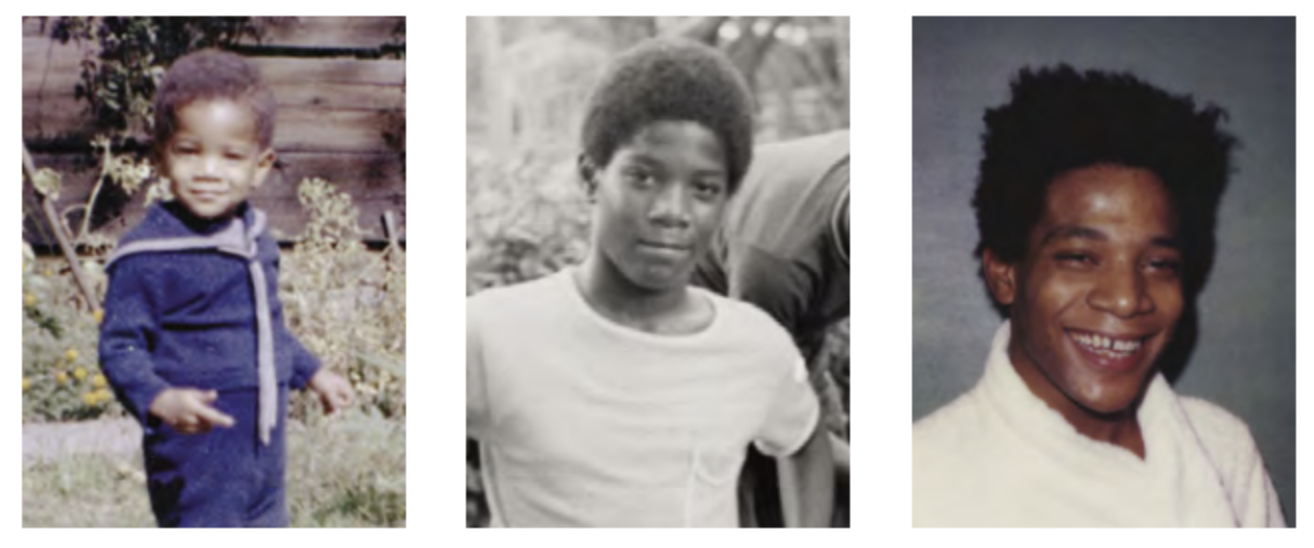
Basquiat's childhood was defined by contradictions. He was intellectually gifted, emotionally sensitive, and deeply attuned to the world around him — yet his home life was marked by instability. His parents separated when he was seven, and his mother, who struggled with mental health issues, was eventually institutionalized. This separation had a profound emotional effect on him, contributing to feelings of abandonment and alienation that would later manifest in his paintings through recurring themes of isolation, mortality, and existential struggle.
His father, Gerard, was a strict and disciplined man of Haitian descent who struggled to connect with his son's increasingly unconventional nature. Despite the tension at home, Gerard exposed Jean-Michel to music, art, and the cultural richness of the Haitian diaspora — an influence that would surface in his son's references to Caribbean and African symbolic systems throughout his career.
By the age of 15, Basquiat had run away from home and spent periods living with friends or on the streets of lower Manhattan. These years forced him into early independence and embedded him more deeply in the countercultural landscape of 1970s New York. The streets, subway stations, and tenements of the Lower East Side became both his studio and his canvas, offering raw material for the language, symbols, and iconography that would later define his style.
He was not simply surviving during this period — he was absorbing everything. He frequented jazz clubs, participated in the underground art scene, and consumed art history, African-American literature, and popular culture with the same ferocious appetite. Even without a formal studio or institutional support, Basquiat was already developing what would be
The Influence of a Car Crash and Gray’s Anatomy
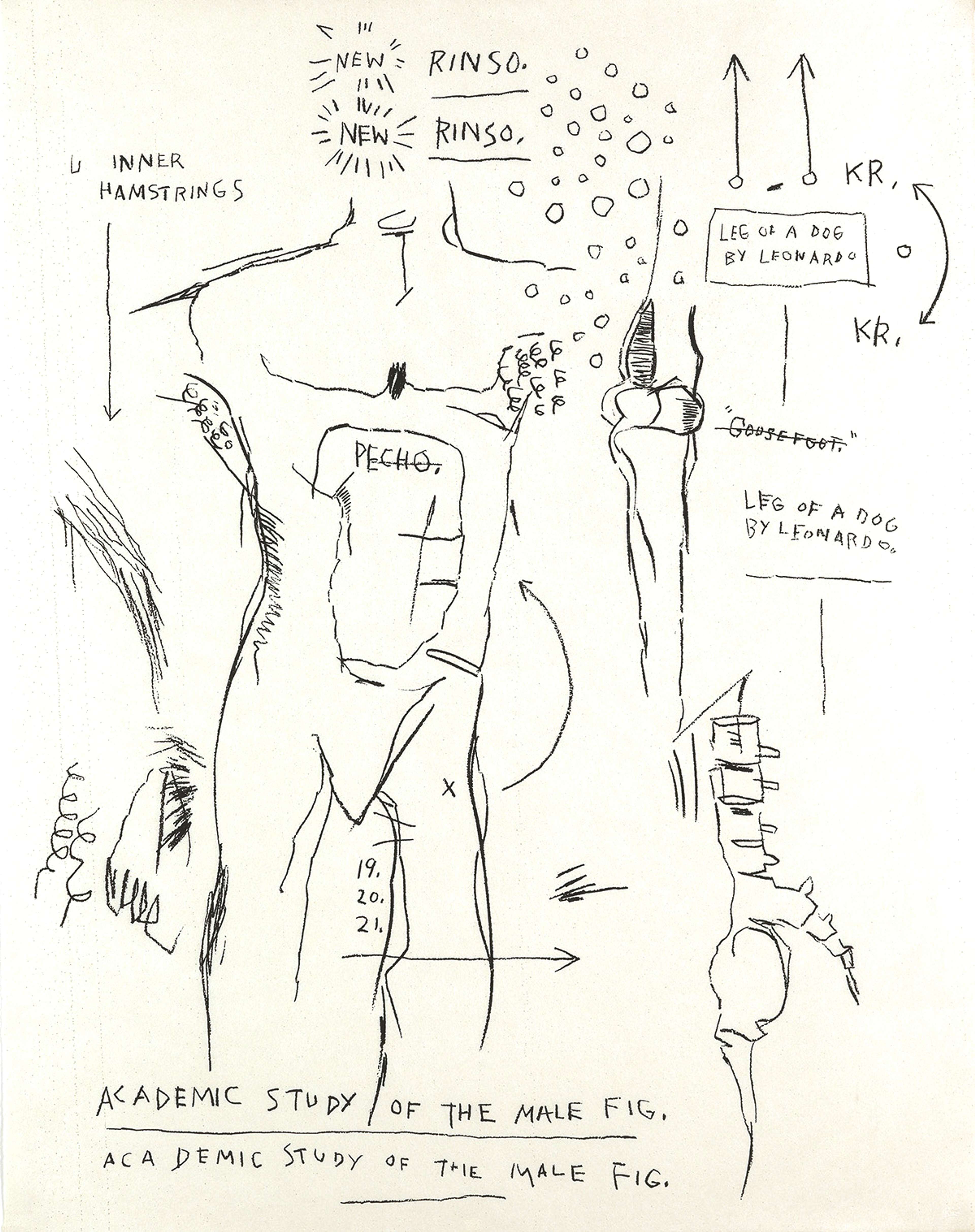
At age seven, Basquiat was hit by a car while playing in the street and suffered a broken arm and internal injuries. During his recovery, his mother gave him a copy of Gray's Anatomy, the classic medical textbook. This book became a lifelong source of inspiration, and its influence on his visual language cannot be overstated.
His fascination with the human body — its internal systems, its mechanisms, its fragility — became a recurring motif throughout his career. Skeletons, skulls, exposed organs, and dissected forms all echo the clinical, diagrammatic style of Gray's Anatomy, fused with Basquiat's raw expressive power and emotional urgency.
These anatomical references were never merely technical. For Basquiat, the body was a site of trauma, resilience, and identity. The exposed figure — whether rendered in charcoal, oil, or acrylic — became a metaphor for spiritual and psychological vulnerability. In depicting the body stripped bare, he was also stripping bare the social and political conditions that shaped Black life in America.
SAMO© and the Language of the Streets
In the late 1970s, Basquiat and his high school friend Al Diaz created a graffiti persona known as SAMO (short for "Same Old Shit"). The pair began spray-painting cryptic, poetic, and often politically charged slogans on buildings and subway cars in lower Manhattan. Phrases like "SAMO as an end to mindwash religion, nowhere politics and bogus philosophy" introduced a new form of graffiti — one that fused street culture with beat poetry and conceptual art.
This period marked Basquiat's entry into the world of public art, where he used language as both protest and poetry. His use of text — often fragmented, crossed out, or repeated — would become a signature element of his mature work. The SAMO project also served as a transition: from anonymous street artist to recognized cultural figure.
By 1979, the identity of SAMO had been revealed in the Village Voice, and Basquiat began to move beyond graffiti into painting, music, and performance art. The notoriety he earned through SAMO opened doors in the downtown New York art scene — galleries, collectors, and critics began to take notice of the young artist with the fierce visual intelligence and something urgent to say.
Intellectual Curiosity and Self-Education
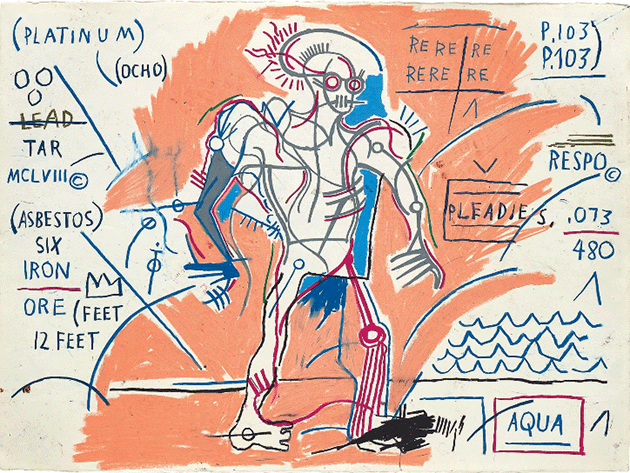
Although he dropped out of high school, Basquiat was intellectually voracious. He educated himself by reading encyclopedias, history books, art theory, and African-American literature. This autodidactic streak was evident in his paintings, which referenced Greek mythology, jazz musicians, anatomical diagrams, African spiritual symbols, and contemporary politics — often all at once.
Unlike many of his contemporaries, Basquiat's paintings were not rooted in formal academic training but in a streetwise synthesis of knowledge gathered through lived experience and independent study. His canvases became spaces of visual dialogue — dense with names, dates, symbols, and phrases that referenced everything from Charlie Parker and Dizzy Gillespie to the brutal history of slavery and racism in America.
This eclectic, layered style challenged the hierarchies of art and intellect. Basquiat refused the binary of high and low culture, collapsing distinctions between graffiti and fine art, street language and Latin text, primal marks and art historical references.
A Collision of Worlds
By the early 1980s, Basquiat had emerged as a prominent figure in the downtown New York art scene. His early experiences helped him navigate — and challenge — the largely white, elitist world of contemporary art. He brought with him the energy of the street, the rage of marginalization, and the urgency of lived experience. His Haitian and Puerto Rican roots, his experience with homelessness, and his deep knowledge of history and art all collided in works that were as intellectually rigorous as they were emotionally raw.
His friendship and later collaboration with Andy Warhol brought him into the uppermost echelons of the art world, yet Basquiat always maintained the tension between insider and outsider. He was celebrated and tokenized in equal measure — a contradiction he addressed directly in his work, confronting racism and commodification with unflinching honesty.
Jean-Michel Basquiat's early life was not a prelude — it was the foundation of his genius. His multicultural upbringing, early trauma, intellectual hunger, and immersion in New York's underground culture shaped every aspect of his career and artistic output. Far from being incidental, these experiences were the engine of his creativity, enabling him to challenge conventions, defy categorization, and speak truth to power in a visual language entirely his own.
Jean-Michel Basquiat: A Timeline
1960 Born December 22 in Brooklyn, New York, to a Haitian father and Puerto Rican mother.
1967 Parents separate. Hit by a car; recovers with a copy of Gray's Anatomy, which becomes a lifelong visual reference.
1968 Mother, Matilde, is institutionalized. Basquiat and his siblings are raised primarily by his father, Gerard.
1974 Enrolls at Edward R. Murrow High School in Brooklyn. His artistic talent begins to attract attention.
1976 Runs away from home at 15, begins living on the streets of lower Manhattan and immersing himself in the New York underground art and music scene.
1977 Begins the SAMO graffiti project with high school friend Al Diaz, spray-painting poetic and political phrases across lower Manhattan.
1978 SAMO writings appear in the Village Voice. The cryptic slogans attract widespread attention from the New York art community.
1979 Identity of SAMO is revealed. Basquiat declares "SAMO is dead" on walls across SoHo, signaling his transition from street art to the gallery world. Begins making mixed-media postcards and selling them in SoHo.
1980 Participates in the Times Square Show, a landmark group exhibition that introduces him to a wider audience. Meets Andy Warhol.
1981 First solo gallery representation. Gains international attention after being featured in the New York/New Wave exhibition at P.S.1.
1982 Explosive year: solo shows in New York, Los Angeles, and Europe. Becomes one of the most talked-about artists in the world at just 21 years old.
1983 Begins formal collaboration with Andy Warhol. Represents the United States at the Sao Paulo Biennial.
1984-86 Continues prolific output. Collaborates with Warhol and Francesco Clemente. Work sells for record prices at auction.
1987 Andy Warhol dies. Basquiat is deeply affected by the loss of his close friend and collaborator.
1988 Dies on August 12 at the age of 27 from a heroin overdose at his studio in New York. His legacy endures as one of the most significant and studied artists of the 20th century.
Frequently Asked Questions
What was Jean-Michel Basquiat's cultural background?
Basquiat was born in Brooklyn, New York, to a Haitian father and a Puerto Rican mother. He grew up speaking English, French, and Spanish, and his multicultural heritage deeply influenced his work — particularly his engagement with themes of colonialism, identity, and the African diaspora.
Why is Gray's Anatomy so significant to understanding Basquiat's work?
After being hit by a car at age seven, Basquiat was given a copy of Gray's Anatomy by his mother during his recovery. The book's detailed illustrations of the human body became a formative visual reference throughout his career. Anatomical imagery, including skulls, skeletons, and exposed organs, appears repeatedly in his paintings as a metaphor for vulnerability, race, and mortality.
What was SAMO and why does it matter?
SAMO (Same Old Shit) was a graffiti persona Basquiat created with his friend Al Diaz in the late 1970s. The project involved spray-painting poetic, politically charged phrases across lower Manhattan, blending street culture with conceptual art. SAMO established Basquiat's reputation in the New York art world and laid the foundation for the text-driven, fragmented language that would define his mature paintings.
Did Basquiat have any formal art training?
No. Basquiat dropped out of high school and never received formal art education. He was largely self-taught, educating himself through reading widely — art history, African-American literature, encyclopedias, and medical textbooks — as well as through direct immersion in New York's underground art and music scene. His lack of formal training was, in many ways, a source of his originality.
How did Basquiat's childhood experiences influence his themes?
His parents' separation, his mother's institutionalization, his experience of homelessness, and his identity as a young Black man in America all left deep marks on his work. Themes of isolation, racial injustice, power, mortality, and resilience run throughout his paintings. His art was not autobiographical in a literal sense, but it was deeply personal — a continuous reckoning with the world as he experienced it.
What is Basquiat's legacy in contemporary art?
Basquiat is widely regarded as one of the most important artists of the 20th century. His work challenged the boundaries between high and low art, brought Black voices and histories into the center of the contemporary art conversation, and helped redefine what painting could be. His influence is visible across visual art, music, fashion, and popular culture. Works by Basquiat regularly achieve record prices at auction, and his life and art continue to be the subject of major museum retrospectives worldwide.
Where can I buy Basquiat prints?
Guy Hepner offers a curated selection of signed Basquiat prints and works on paper. Contact our galleries at info@guyhepner.com or visit guyhepner.com for current availability.
Discover signed Basquiat prints for sale and contact our galleries via info@guyhepner.com or call for latest availabilities. Looking to sell? We can help, find out how to sell Jean-Michel Basquiat prints.