
When Andy Warhol unveiled his Campbell’s Soup Cans in 1962, the art world did not know what had hit it. The debut of thirty-two hand-painted canvases, each depicting a different variety of Campbell’s soup, lined up side by side like a grocery store shelf, was an aesthetic shockwave. The arrangement was uniform, the colours crisp and clean, the imagery instantly recognizable to every American who had ever opened a kitchen cupboard. Yet it was presented not in a supermarket aisle, but in the sanctified, white-walled space of a New York gallery.
For some, the work was an insult to the fine arts — a lazy reproduction of a corporate design, unworthy of serious attention. For others, it was a conceptual coup — a brilliant distillation of post-war American culture into a single, endlessly repeated image. In one stroke, Warhol had managed to merge the language of advertising with the traditions of painting, placing the mundane on the same level as the masterpieces of the past. It was a declaration that anything — even the most ordinary object — could be art, provided it was framed and presented as such.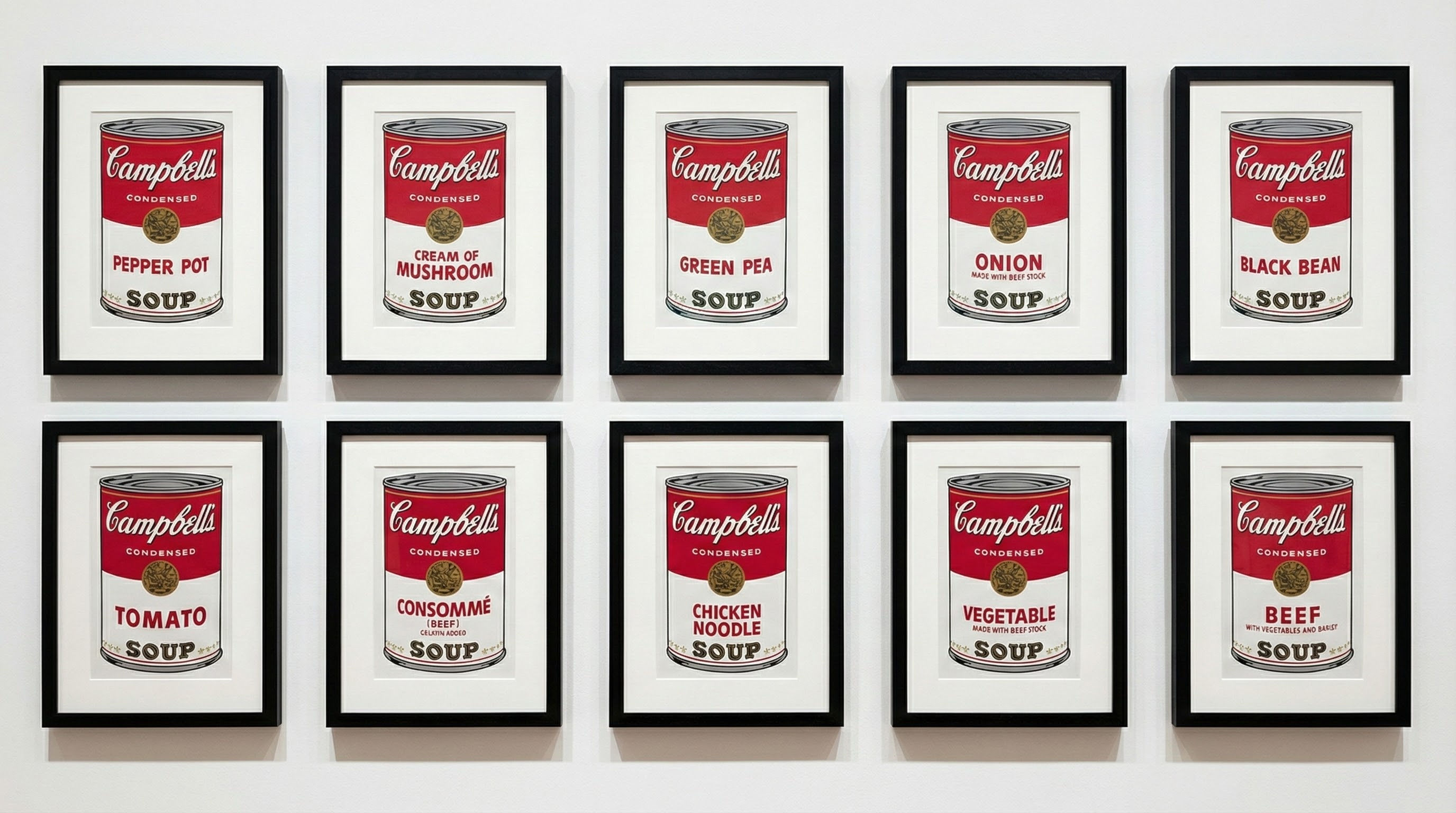
The Origins: Lunch as a Conceptual Framework
Warhol’s choice of subject was deeply personal and deceptively simple. He claimed to have eaten Campbell’s soup for lunch every day for over twenty years. In interviews, he half-joked about this routine, but in reality, it provided a conceptual foundation for the work. The soup can became a symbol not only of his own habits but of the habits of an entire nation — a post-war America where consumer products were standardized, branding was king, and repetition was both a comfort and a marketing strategy.
The Campbell’s label itself, with its red-and-white banding, gold medallion, and cursive script, was a triumph of mid-century design. It was instantly legible from a distance, visually consistent across varieties, and designed to convey reliability. This was precisely what made it so ripe for Warhol’s appropriation: the packaging was already an icon of mass culture before he ever touched a brush.
The Art World in 1962: A Scene Ripe for Disruption
When Warhol entered the fine art world, the dominant force in American painting was Abstract Expressionism. Artists like Jackson Pollock and Willem de Kooning were celebrated for their gestural brushwork, their emphasis on personal expression, and their belief in the canvas as a site of existential struggle. Their paintings were one-of-a-kind, unrepeatable, charged with the physical presence of the artist.
Warhol’s Campbell’s Soup Cans could not have been more different. The brushwork was invisible. The image was borrowed, not invented. The repetition was deliberate and unapologetic. By removing the hand of the artist from the process — or at least concealing it — Warhol undermined the romantic notion of the artist as a heroic, solitary genius. Instead, he aligned himself with the logic of the factory, the printing press, and the advertising agency.

From Painting to Print: The Mechanization of Art
The original thirty-two canvases were painted by hand, though with a precision that made them look machine-made. But Warhol quickly realized that his vision would be better served by a more explicitly mechanical process. By the mid-1960s, he had embraced silk-screen printing — a commercial technique used in advertising and signage — to create multiple iterations of the same image with minimal variation.
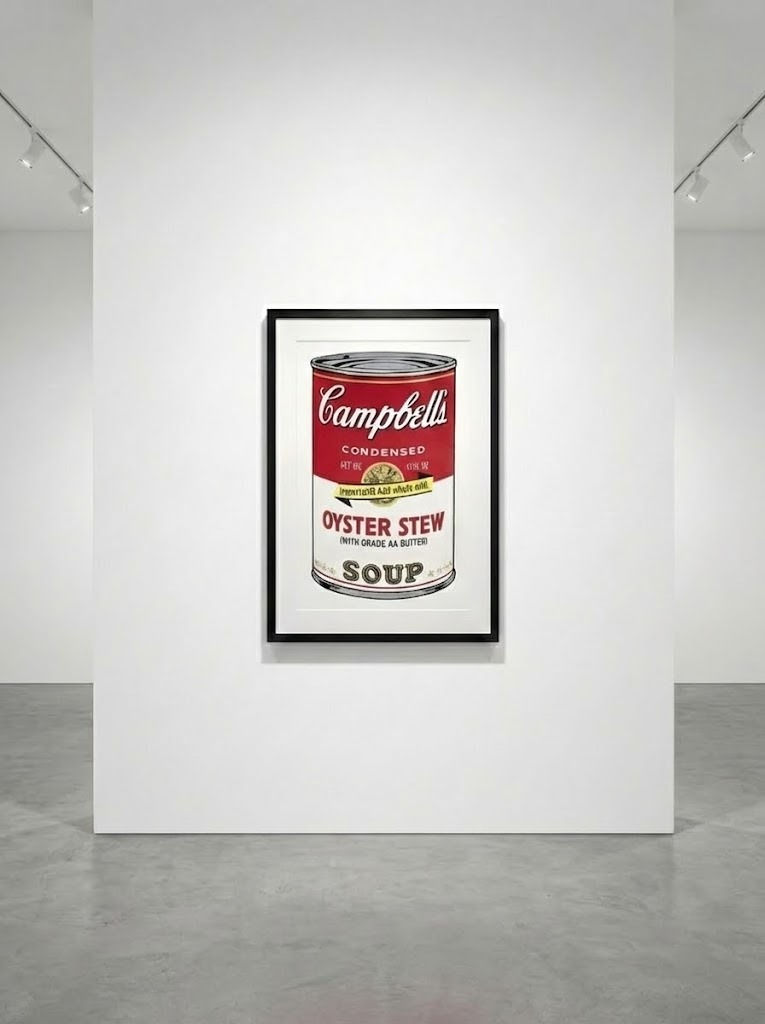
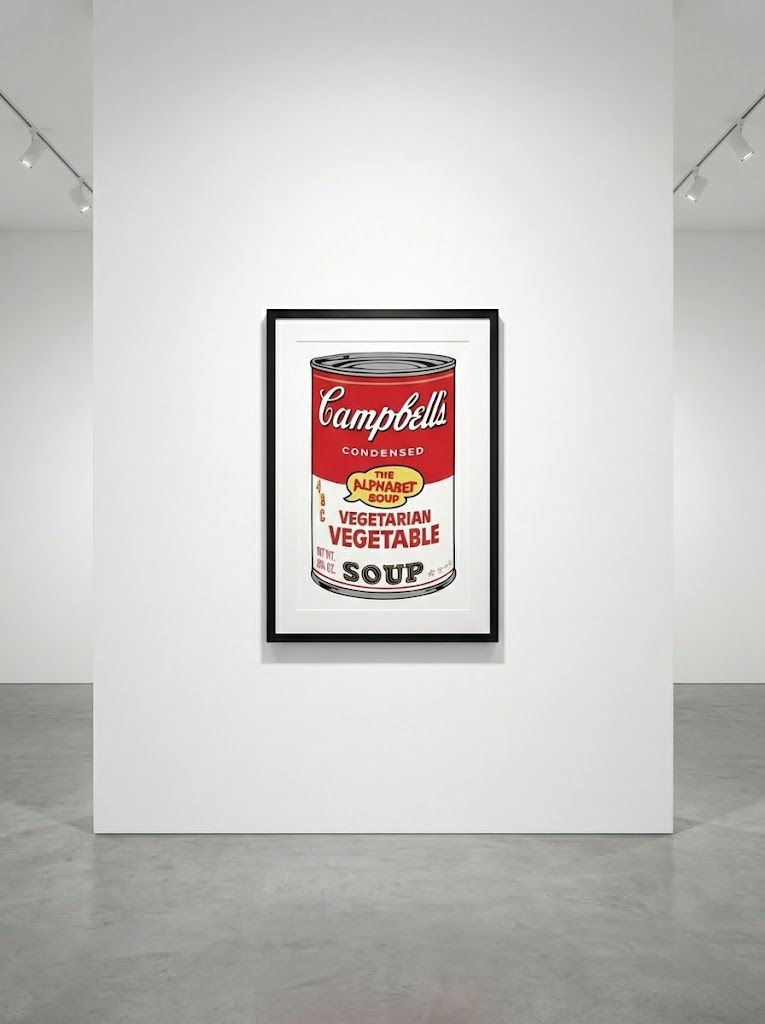
In 1968 and 1969, Warhol produced two portfolios of Campbell’s Soup Cans, each containing ten different varieties. These were published through Factory Additions, his own print-publishing enterprise. The choice to issue these works as editions was conceptually integral: they were not limited to a single original but could be reproduced, purchased, and owned by many people — much like the product they depicted.
For Warhol, the method was the message. By using the same techniques that advertising used to flood the public with imagery, he blurred the boundary between art and commerce. The image of the soup can was no longer just a subject; it was also a metaphor for how art itself could be packaged and consumed.
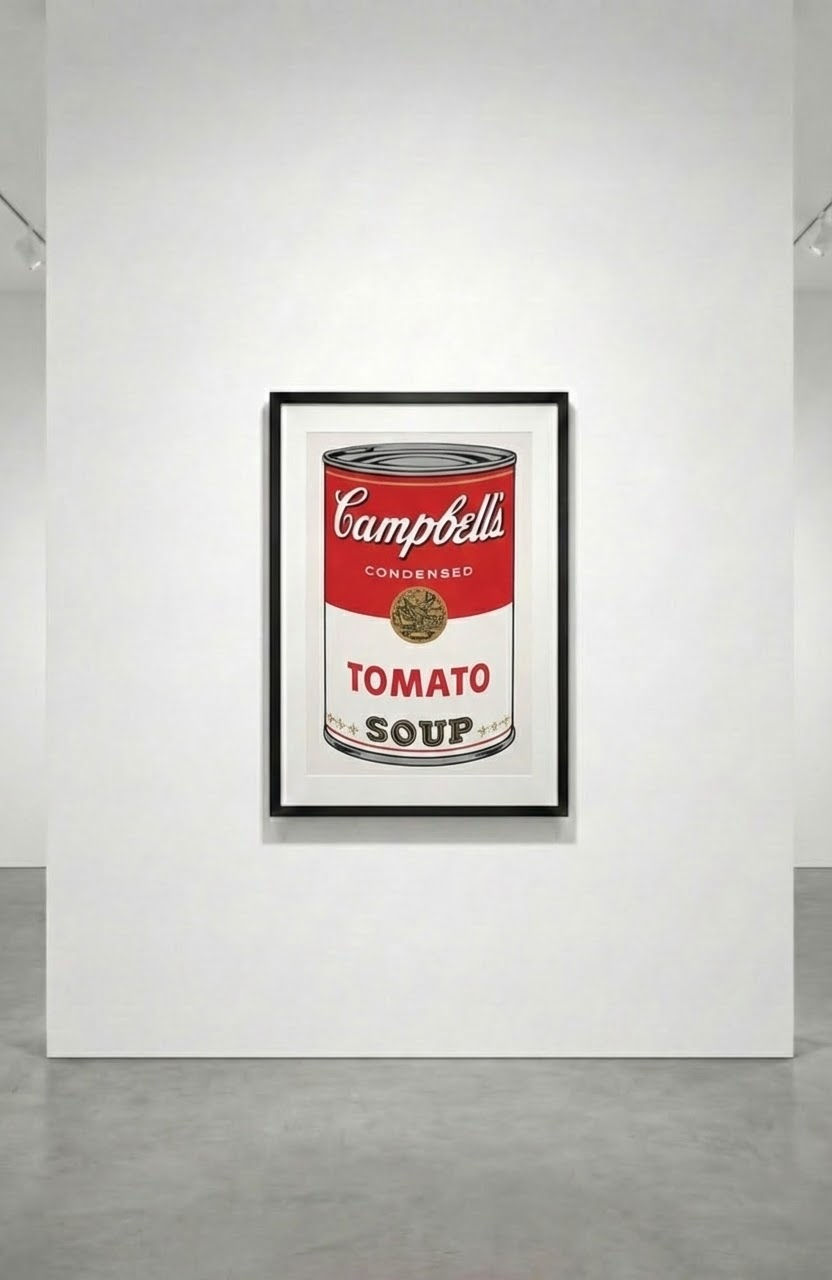
At the time of its debut, Campbell’s Soup Cans was met with a mixture of amusement, disdain, and intrigue. Many critics accused Warhol of being derivative, a mere copyist of a commercial design. Others, particularly younger artists and curators, recognized that he was doing something radical — stripping art of its elitist pretensions and grounding it in the imagery of everyday life.
The work was quickly associated with the burgeoning Pop Art movement, which also included figures like Roy Lichtenstein, Claes Oldenburg, and James Rosenquist. Together, these artists challenged the high-low divide in art, taking their cues from comic books, advertisements, and supermarket shelves rather than myth, religion, or personal expression.
Art Historical Context: From Duchamp to Pop
Warhol’s soup cans did not appear out of nowhere. In many ways, they were a continuation of the conceptual revolution sparked by Marcel Duchamp in the early 20th century. Duchamp’s readymades — most famously his 1917 Fountain, a urinal presented as art — had already posed the question: “What makes something a work of art?” Warhol’s answer was different from Duchamp’s, but equally provocative. Whereas Duchamp used industrial objects to mock the art world, Warhol embraced the industrial aesthetic, treating it not as satire but as subject matter worthy of fascination.
In doing so, he also connected his work to the traditions of still-life painting, albeit in an inverted form. Where 17th-century Dutch painters meticulously depicted fruit, flowers, and tableware as symbols of wealth and mortality, Warhol depicted a mass-produced can of soup as a symbol of 20th-century consumerism. His still life was not a celebration of abundance in the old sense, but a portrait of industrial abundance — the abundance of identical units rolling off an assembly line.
Repetition as Meaning
The repetition in Campbell’s Soup Cans is not simply a formal choice; it is the work’s central meaning. By presenting thirty-two varieties side by side, Warhol forces the viewer to confront both the sameness and the small differences within mass production. The slight shifts in lettering, the presence or absence of a fleur-de-lis, the different flavour names — these variations become significant only because they are set against a backdrop of overwhelming uniformity.
This interplay between uniformity and difference reflects the paradox of consumer culture: products are designed to be identical to build brand consistency, yet they must also offer the illusion of choice. Warhol captures this paradox with a precision that is both visual and conceptual.
The Market Legacy: From Counterculture to Commodity
Ironically, a work that questioned the relationship between art and commerce became one of the most commercially successful bodies of work in modern art. The original paintings are now among the most valuable in Warhol’s oeuvre, and the screen print portfolios are fixtures of the contemporary print market.
Collectors value them not only for their aesthetic and conceptual importance but also for their role in legitimizing editioned works as fine art. Before Warhol, multiples were often considered less valuable than unique works; after Warhol, they became central to the contemporary art economy.
Influence on Contemporary Art
The influence of Campbell’s Soup Cans can be seen in the work of countless contemporary artists. Jeff Koons’s balloon dogs, Damien Hirst’s spot paintings, and Banksy’s ironic appropriations of corporate imagery all owe a debt to Warhol’s insistence that mass-produced symbols could carry artistic weight. The idea that an artwork could exist as a brand, replicated across mediums and contexts, is now a standard part of the art world’s operating logic.
The Digital Age: Warhol’s Prescience
In the era of Instagram, TikTok, and meme culture, Warhol’s vision seems almost prophetic. He anticipated a world in which images are endlessly reproduced, remixed, and shared, often divorced from their original context. The soup can, once a supermarket product, is now a floating signifier — a meme, a T-shirt graphic, a museum icon. Its meaning is fluid, shaped as much by its circulation as by its content.
Why The Soup Cans Still Matter
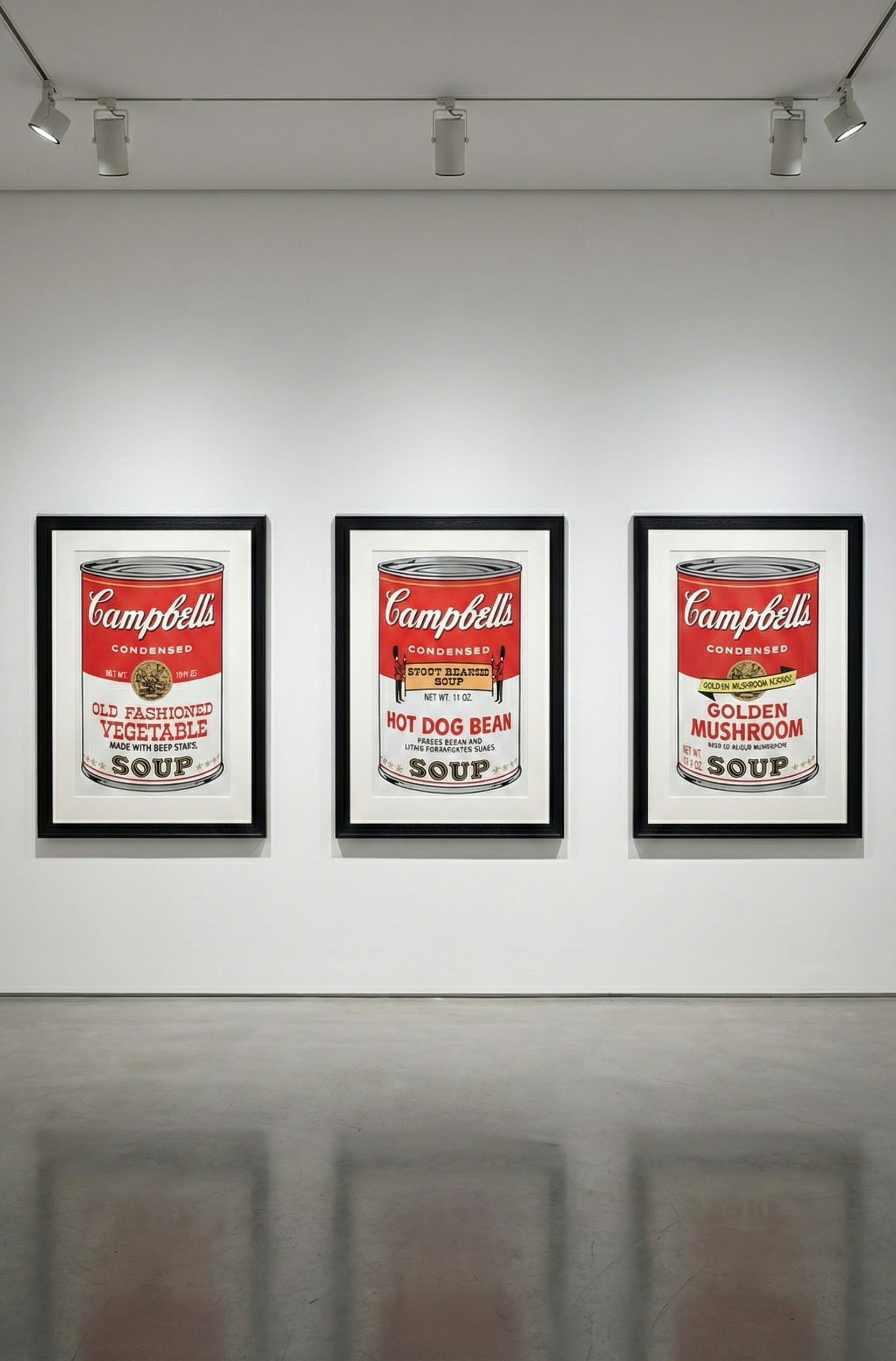
Standing before a wall of Warhol’s soup cans today, one is confronted with an image that is both utterly ordinary and profoundly symbolic. It is the face of an era — an era defined by the supermarket, the television ad, the product line, and the brand. Warhol captured that face with clarity, wit, and an unblinking eye, transforming the soup can into one of the great icons of modern culture.
Market Evolution and Long-Term Performance
The market for Warhol’s soup cans reflects the broader strength and resilience of the Warhol market as a whole. Unique soup can paintings are effectively institutional assets, rarely appearing at auction and commanding eight-figure prices when they do. One of the most significant examples, Small Torn Campbell’s Soup Can (Pepper Pot), achieved over eleven million dollars at auction, underscoring the historical and financial premium placed on early, unique works.
The print market, however, is where most collectors engage with the soup can series. Signed screenprints from the late 1960s and early 1970s consistently trade in the high five-figure to low six-figure range, with complete sets achieving substantially higher totals. Over the past decade, demand has remained steady even during broader market contractions, reflecting the soup can’s status as a blue-chip image with global recognition and deep institutional support.
Crucially, the soup can series benefits from exceptional liquidity. Collectors can enter the market at various price points, while exit opportunities remain strong due to constant demand from private collectors, museums, and corporate collections. This liquidity distinguishes Warhol’s soup cans from more speculative contemporary works and positions them as a stabilising force within diversified collections.
Collecting Warhol’s Soup Cans: A Strategic Perspective
Collecting Warhol’s soup cans requires an understanding of both artistic intent and market structure. The first consideration is categorisation. Collectors should distinguish clearly between unique early paintings, authorised screenprints, later multiples, and posthumous reproductions. Authenticity and edition legitimacy are paramount, and all acquisitions should be cross-referenced with the Andy Warhol Catalogue Raisonné and supported by clear provenance.
Condition plays a decisive role in value retention. Screenprints are particularly sensitive to light exposure, handling, and framing quality. Works preserved with archival materials and minimal colour fading command notable premiums at resale. Signature placement, edition numbering, and publisher information also significantly influence valuation, particularly when comparing impressions from the same series.
Complete sets occupy a distinct position within the market. While individual soup can prints offer flexibility and lower entry points, full portfolios tend to outperform on a long-term basis due to their rarity and institutional appeal. Museums and high-level private collections often prioritise completeness, which supports price stability and upward pressure on intact suites.
Cultural Legacy and Contemporary Relevance
The continued relevance of Warhol’s soup cans lies in their prophetic understanding of image culture. In an era defined by branding, repetition, and digital circulation, the soup can feels less like a historical artefact and more like a visual template for contemporary life. The work anticipated a world in which images are consumed, shared, and monetised at scale, long before social media or globalised advertising ecosystems existed.
For collectors, this enduring relevance translates into sustained demand. The soup can is not tied to a fleeting aesthetic trend or narrow collector base. It operates across generations, geographies, and collecting categories, appealing equally to first-time buyers and seasoned institutions.
Andy Warhol’s Campbell’s Soup Cans stand at the intersection of artistic revolution and market permanence. What began as a radical challenge to artistic convention has evolved into one of the most dependable and conceptually coherent segments of the post-war art market. For collectors, the series offers a rare combination of cultural significance, visual immediacy, and financial resilience.
To collect a Warhol soup can is to acquire not only an artwork, but a foundational symbol of modern visual culture. Its power lies in its simplicity, its repetition, and its refusal to separate art from everyday life. Few images have achieved such total integration into both art history and the global marketplace, and fewer still continue to reward collectors intellectually and financially with such consistency.
Discover andy warhol signed prints for sale and contact info@guyhepner.com for latest availabilities. Looking to sell? speak to our team on how to sell andy warhol prints.
