Pablo Picasso
Ecce Homo, d’Après Rembrandt, 1970
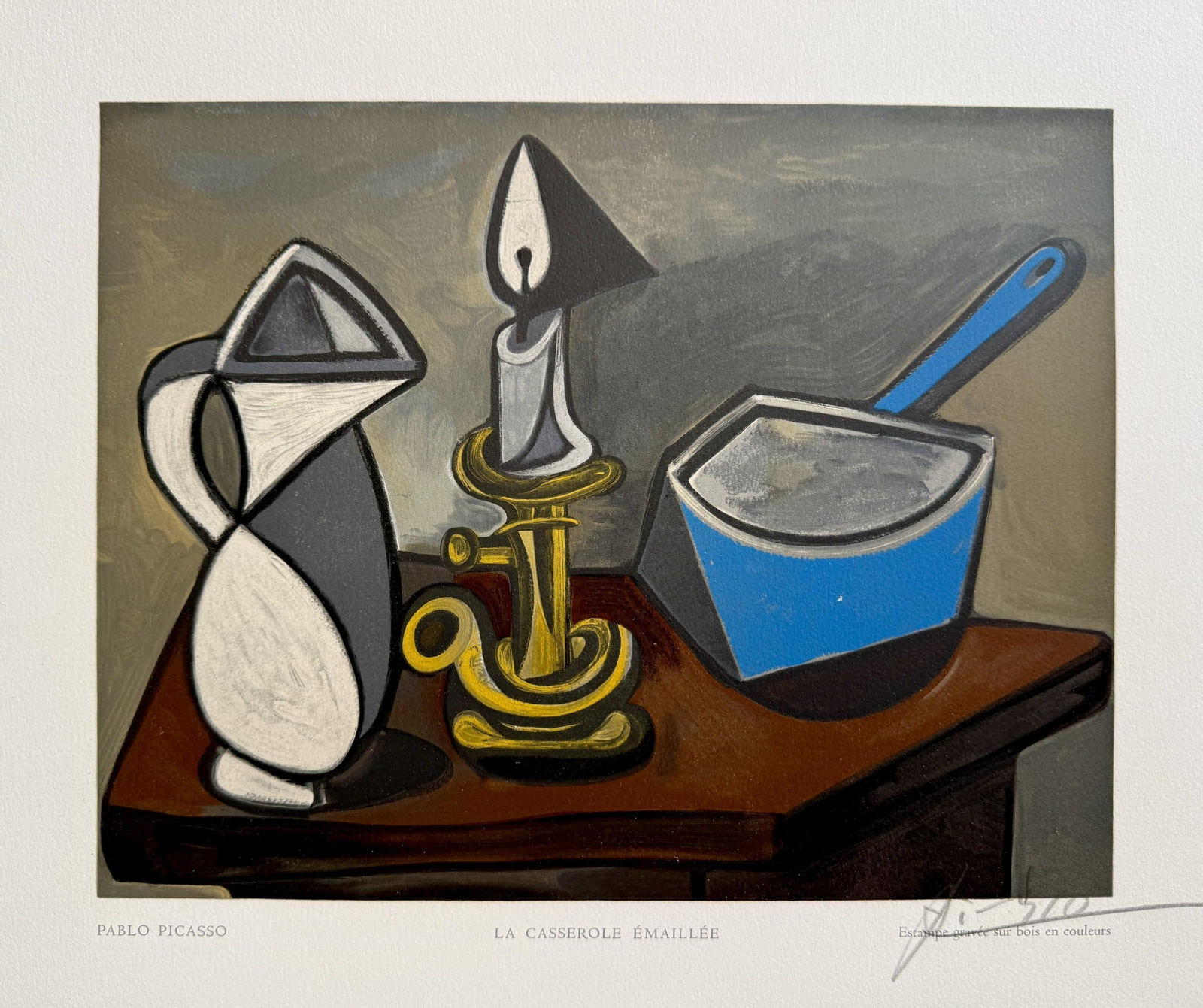
In La Casserole Émaillée, Pablo Picasso turns to the still life as a site of formal experimentation, transforming everyday domestic objects into bold, sculptural presences. Executed in 1950, the composition features a simplified tabletop arrangement—a blue enamelled casserole, a candleholder, and a faceted vessel—each rendered with assertive contours and carefully modulated color.
The wood engraving medium lends the image a striking graphic clarity. Picasso exploits the inherent resistance of the block to achieve crisp outlines and flattened planes, while the limited yet resonant palette—earthy browns, muted greys, deep black, and a vivid blue—creates a dynamic balance between warmth and restraint. Objects are reduced to their essential geometries, yet retain a tactile, almost weighty presence, emphasizing Picasso’s lifelong interest in the sculptural qualities of form.
Although rooted in the still-life tradition, La Casserole Émaillée reflects Picasso’s postwar reengagement with clarity, order, and classical balance, filtered through a distinctly modern sensibility. The composition suggests quiet intimacy while asserting the artist’s authority over line, space, and surface. Printed on Van Gelder paper, signed in pencil by both Picasso and Robert Brey, and issued in a numbered edition of 150, this work stands as a powerful example of Picasso’s mastery of printmaking and his ability to elevate the ordinary into the iconic.


