

Jean-Michel Basquiat
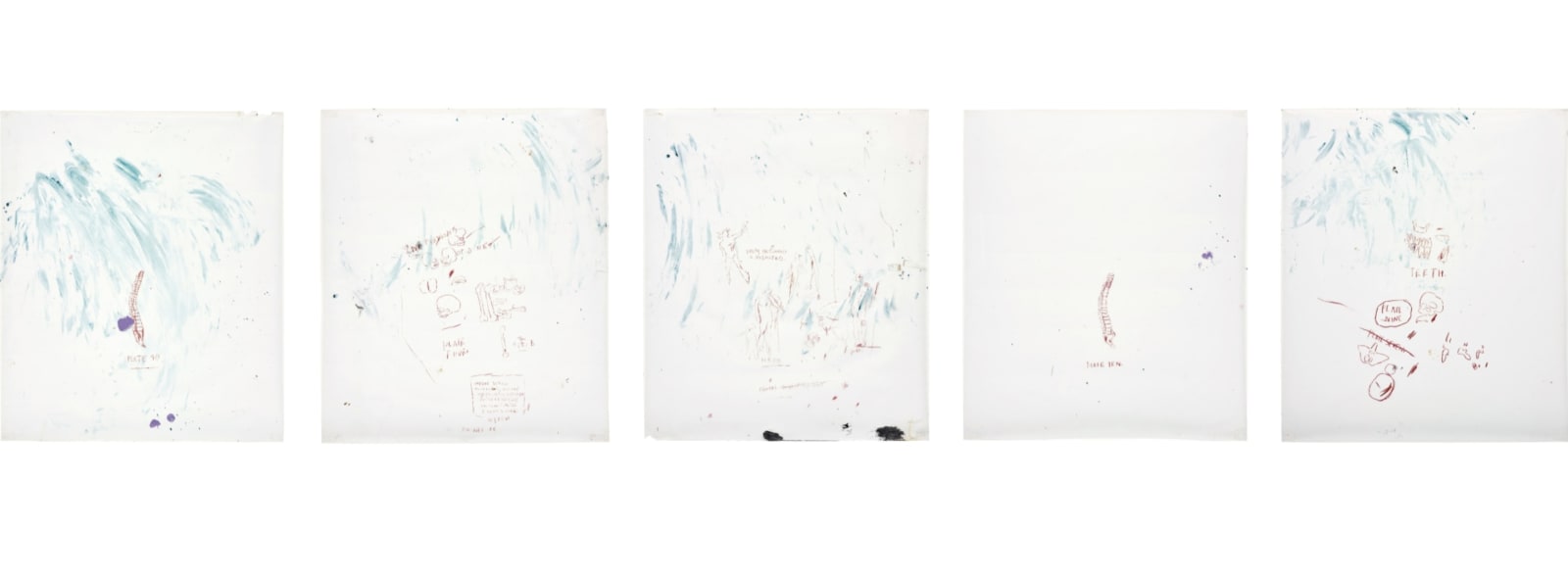
Untitled (From Leonardo), 1983
Oiilstick and acrylic on acetate, in 5 parts
Each 106.5 x 91.5 cm
Each 41 7/8 x 36 in.
Each 41 7/8 x 36 in.
Copyright The Artist
Further images




Striking a riveting balance between energy and sobriety, idealism and hyper-expression, past and present, Untitled (From Leonardo), 1983, exemplifies Jean-Michel Basquiat’s engagement with the art-historical canon as well as the...
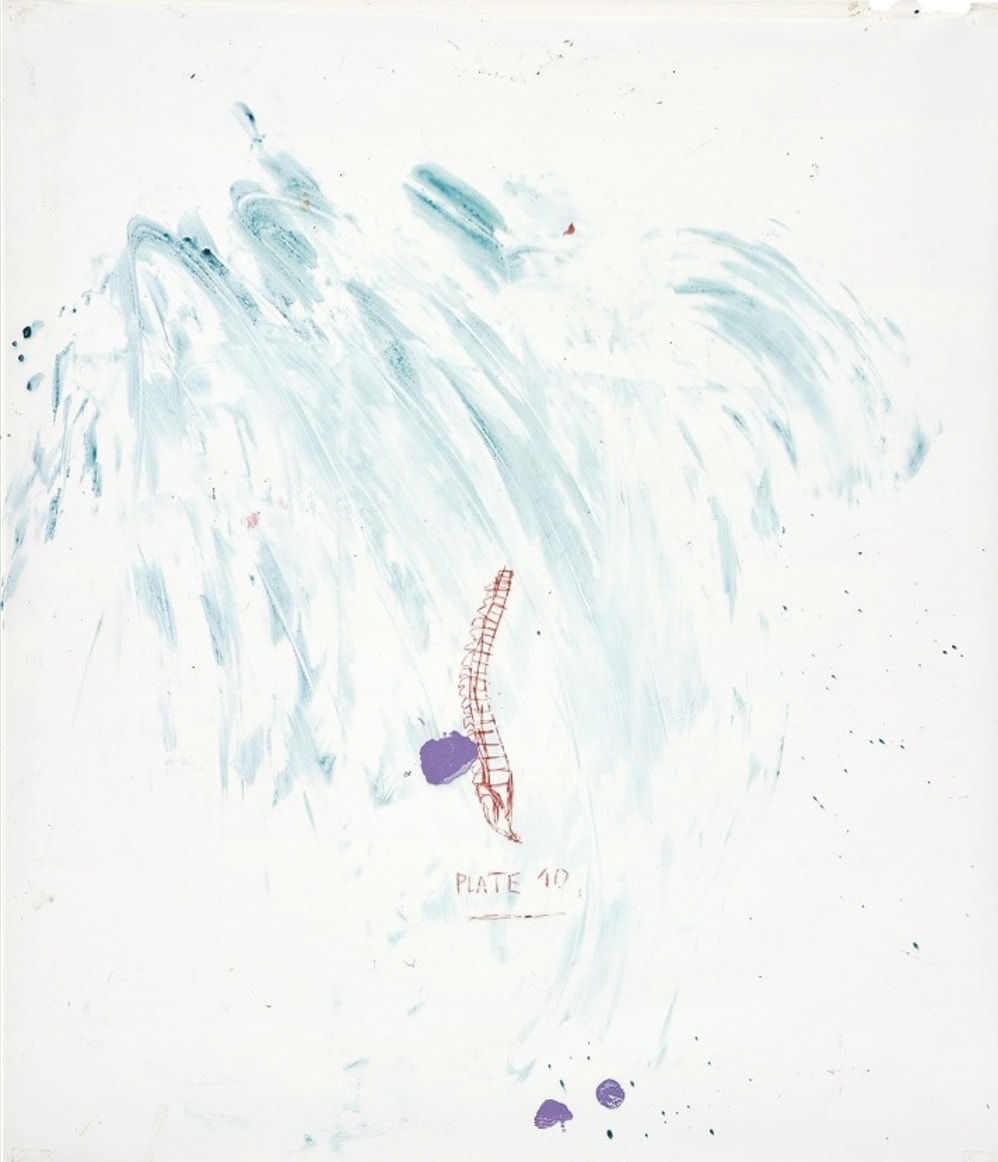
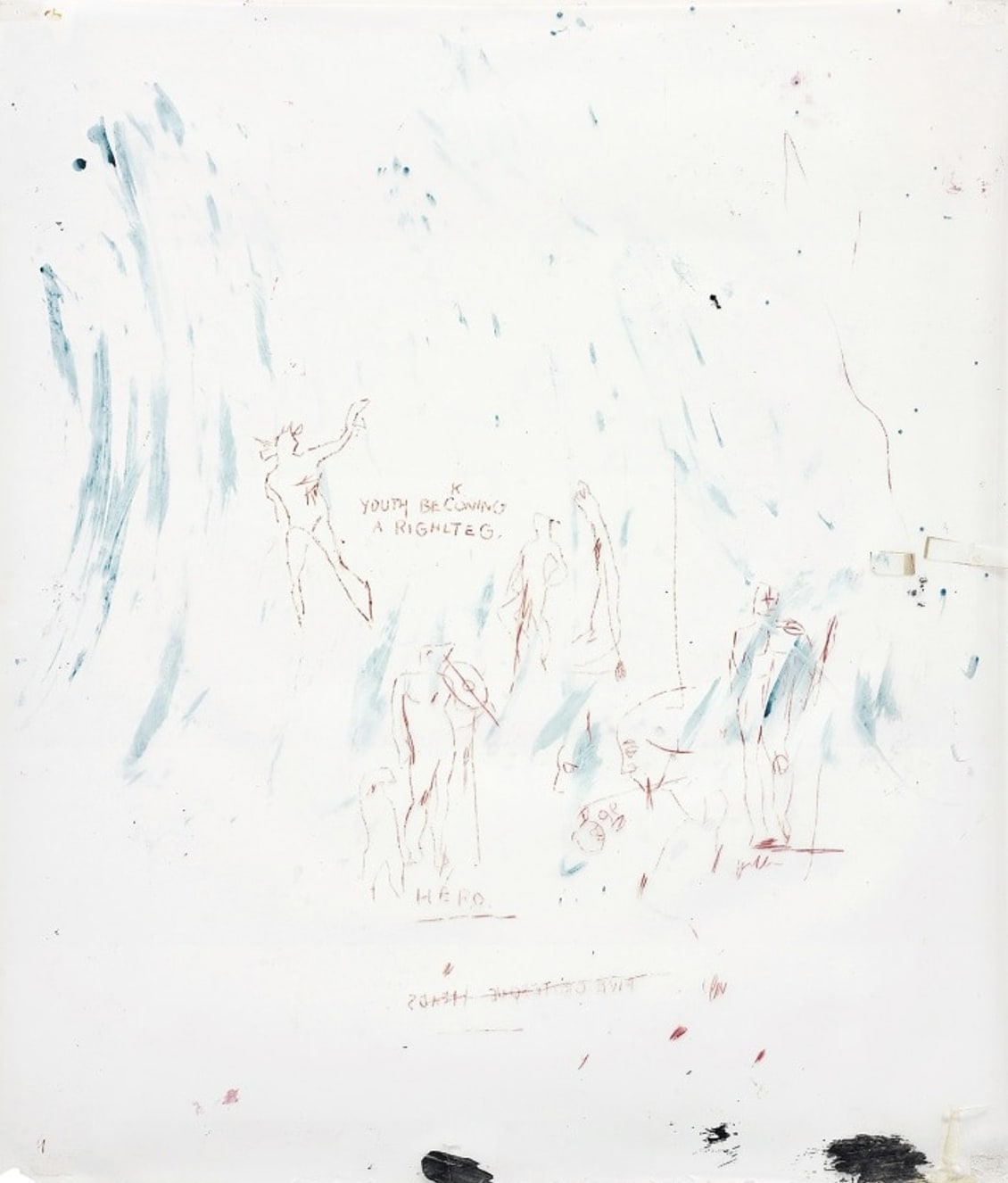
Striking a riveting balance between energy and sobriety, idealism and hyper-expression, past and present, Untitled (From Leonardo), 1983, exemplifies Jean-Michel Basquiat’s engagement with the art-historical canon as well as the development of his artistic vocabulary during a watershed moment in his career. The work, composed of five sheets of acetate, is a conspicuous homage to the sketches of Leonardo da Vinci – a subject matter that Basquiat also deployed in Leonardo da Vinci’s Greatest Hits, 1982, residing in the Schorr Family Collection. It served as the original basis from which a subsequent set of prints were developed, editions of which are held in the permanent collections of the Museum of Modern Art, New York and the Museum of Contemporary Art, Los Angeles. First drawn on clear acetates, the images were then transferred to silkscreen and printed on Japanese rice paper, disrupting the traditional printing process. However, Basquiat intentionally allowed the surfaces to collect various detritus on his studio floor, such as cigarette butts, music cassettes, and sheets of drawing paper, an act that Fred Hoffman elucidated as having endowed 'the works [with] a ‘patina’ – as though they were as old as the sources they referenced' (Fred Hoffman, 'From Leonardo', Jean-Michel Basquiat Drawing, exh. cat., Acquavella Galleries, New York, 2014, p. 117). The quintessential 1980s 'Renaissance Man', Basquiat littered the sheets of Untitled (From Leonardo) with da Vinci-esque depictions of dismembered body parts, Greco-Roman sculptures, and text, simultaneously referencing antiquity, the Old Masters, and contemporary graffiti culture.
Untitled (From Leonardo) epitomises the artist’s career-long preoccupation with corporeality and bodily fragility, which was instigated by an accident that saw seven-year-old Basquiat struck by a car while playing in the street. His mother gifted him a copy of Gray’s Anatomy while he was convalescing, enabling him to better grasp the enigmatic intricacies of human anatomy and physical pain; according to Hoffman, it was thus no surprise that the agog and precocious painter was 'drawn to Leonardo da Vinci's investigative studies of the human being - from anatomical to physiological, from birth to death. In the work of Leonardo, Basquiat found a viable means of educating himself about human form and function'. Utilising both Leonardo’s sketches and texts as sources for physiological education, Basquiat furthermore 'identified a kindred spirit able to transform scientific truth into artistic vision. Leonardo's seemingly compulsive investigation of human anatomy and physiology would become a lifelong passion for Basquiat' (Fred Hoffman, 'From Leonardo', Jean-Michel Basquiat Drawing, exh. cat., Acquavella Galleries, New York, 2014, p. 124). Untitled (From Leonardo) is thus illustrative not only of corporeality as Basquiat’s signature idée fixe – the work is even complete with a misspelled epitaph for 16-century physician Andreas Vesalius on the first sheet – but also of his idiosyncratic aesthetic vernacular that was already well-employed by 1982.
Evocative of sheets from da Vinci’s notebooks, Untitled (From Leonardo) can be viewed through an iconographic lens in which each figure exists independently, embodying a symbolic – or perhaps hieroglyphic – presence that is similar to those of various disassociated sketches on a single page. Moreover, some of the drawings carry numerous connotations; for example, the skulls that pepper the present work simultaneously act as a nod to the rigorous diagrams of the Renaissance master and as a self-referential motif, pointing to the recurrent use of the momento mori symbol in his oeuvre, such as in Untitled, 1982, located in the Broad Museum, Los Angeles. In the first sheet as well, two skulls face each other, but the nature of what is portrayed – either a confrontational encounter between two men or simply two angles of an anatomical representation – is left unclear.
Despite the fractured nature of the present work, replete with severed spines and outlined bones, Untitled (From Leonardo) carries an ironic sense of totality. By vigorously crafting dismembered organs, Basquiat was, in essence, conceiving of how to physically reassemble himself. As art historian Olivier Berggruen has astutely noted, Basquiat’s anatomical works such as Untitled (From Leonardo) '[create] an aesthetic of the body as damaged, scarred, fragments, incomplete or torn apart, once the organic whole has disappeared. Paradoxically, it is the very act of creating these representations that conjures up a positive corporeal valence between the artist and his sense of self or identity. The creative act of representing a fragmented body probably helped Basquiat regain a temporary sense of wholeness' (Olivier Berggruen, 'The Prints of Jean-Michel Basquiat', Print Quarterly 26, no. 1, pp. 21-32).
Untitled (From Leonardo) epitomises the artist’s career-long preoccupation with corporeality and bodily fragility, which was instigated by an accident that saw seven-year-old Basquiat struck by a car while playing in the street. His mother gifted him a copy of Gray’s Anatomy while he was convalescing, enabling him to better grasp the enigmatic intricacies of human anatomy and physical pain; according to Hoffman, it was thus no surprise that the agog and precocious painter was 'drawn to Leonardo da Vinci's investigative studies of the human being - from anatomical to physiological, from birth to death. In the work of Leonardo, Basquiat found a viable means of educating himself about human form and function'. Utilising both Leonardo’s sketches and texts as sources for physiological education, Basquiat furthermore 'identified a kindred spirit able to transform scientific truth into artistic vision. Leonardo's seemingly compulsive investigation of human anatomy and physiology would become a lifelong passion for Basquiat' (Fred Hoffman, 'From Leonardo', Jean-Michel Basquiat Drawing, exh. cat., Acquavella Galleries, New York, 2014, p. 124). Untitled (From Leonardo) is thus illustrative not only of corporeality as Basquiat’s signature idée fixe – the work is even complete with a misspelled epitaph for 16-century physician Andreas Vesalius on the first sheet – but also of his idiosyncratic aesthetic vernacular that was already well-employed by 1982.
Evocative of sheets from da Vinci’s notebooks, Untitled (From Leonardo) can be viewed through an iconographic lens in which each figure exists independently, embodying a symbolic – or perhaps hieroglyphic – presence that is similar to those of various disassociated sketches on a single page. Moreover, some of the drawings carry numerous connotations; for example, the skulls that pepper the present work simultaneously act as a nod to the rigorous diagrams of the Renaissance master and as a self-referential motif, pointing to the recurrent use of the momento mori symbol in his oeuvre, such as in Untitled, 1982, located in the Broad Museum, Los Angeles. In the first sheet as well, two skulls face each other, but the nature of what is portrayed – either a confrontational encounter between two men or simply two angles of an anatomical representation – is left unclear.
Despite the fractured nature of the present work, replete with severed spines and outlined bones, Untitled (From Leonardo) carries an ironic sense of totality. By vigorously crafting dismembered organs, Basquiat was, in essence, conceiving of how to physically reassemble himself. As art historian Olivier Berggruen has astutely noted, Basquiat’s anatomical works such as Untitled (From Leonardo) '[create] an aesthetic of the body as damaged, scarred, fragments, incomplete or torn apart, once the organic whole has disappeared. Paradoxically, it is the very act of creating these representations that conjures up a positive corporeal valence between the artist and his sense of self or identity. The creative act of representing a fragmented body probably helped Basquiat regain a temporary sense of wholeness' (Olivier Berggruen, 'The Prints of Jean-Michel Basquiat', Print Quarterly 26, no. 1, pp. 21-32).